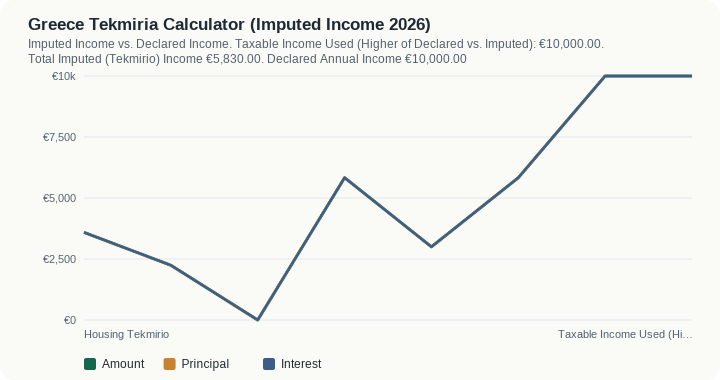
Quick Answer: A taxpayer with a 110m² primary residence and one 1,600cc car registered after November 2010, declaring €10,000 in income, has a combined asset-based imputed income of €5,830 (€3,590 housing + €2,240 vehicle): below their €10,000 declared income, so their declared income is what gets taxed. If the same taxpayer had only declared €4,000, the €5,830 in imputed income would take over and become their taxable base instead.
What does this calculator do?
Τεκμήρια διαβίωσης ("presumptions of living expenses," commonly just "tekmiria") is a mechanic that has no direct equivalent in most other countries' tax systems, and it trips up almost every newcomer to Greek taxation. Rather than relying solely on the income you declare, AADE separately computes a minimum income the tax authority presumes you must have earned, based on specific assets you own: the size of your home, the engine size or emissions class of your car, boats, swimming pools, domestic staff, private tutors, and private school tuition. If this presumed ("imputed") income is HIGHER than the income you actually declared, you get taxed on the higher, imputed figure, not on what you reported.
The logic is straightforward once you see it: if you own a large house, an expensive car, and a boat, but report only €8,000 of taxable income for the year, Greek tax authorities reason that maintaining those assets requires more real income than that, someone is either receiving untaxed income or being supported by resources not reflected on their tax return. Rather than auditing every such case individually, the law simply imputes a minimum income from asset ownership and taxes the higher of the two figures automatically, every year, for every taxpayer with tekmiria-triggering assets.
This is governed by Articles 31-34 of the Income Tax Code (Law 4172/2013). Each asset category has its own formula: a primary or secondary residence imputes income based on its size (in a tiered €/square-meter schedule that gets steeper for larger homes), a car imputes income based on engine displacement (for older vehicles) or CO2 emissions (for vehicles registered from November 2010 onward), and a household-wide minimum living-expense floor applies even to taxpayers with no tekmirio-triggering assets at all.
Important scope note. This calculator computes housing and vehicle tekmiria from the Article 31 tables and applies the minimum living-expense floor. Boats, swimming pools, aircraft, domestic staff and private school fees also impute income under Article 31, each on its own formula; this calculator takes them as one combined figure that you enter (from your myAADE pre-filled E1 form or a tax advisor).
How is this calculated?
Step 1: Housing tekmirio. Your home's imputed income is built from a tiered €/m² schedule that gets progressively steeper for larger properties:
| Size Tier | Marginal Rate |
|---|---|
| First 80 m² | €28/m² |
| 81-120 m² | €45/m² |
| 121-200 m² | €77/m² |
| 201-300 m² | €140/m² |
| Above 300 m² | €280/m² |
A single-family home (μονοκατοικία) adds a 20% surcharge on top of the computed amount. A secondary/vacation residence gets a 50% discount instead.
Step 2: Vehicle tekmirio. For cars first registered from 1 November 2010 onward, the imputed amount is based on CO2 emissions (g/km); for older cars, it is based on engine displacement (cc). Both use their own tiered schedule starting at a €2,000 base amount for the smallest/cleanest vehicles and rising from there. Fully electric vehicles carry a €0 tekmirio if their pre-tax retail price is €50,000 or less, or a flat €2,000 if above that. The separate 5% or 13% luxury living tax on large-engine cars is a tax, not imputed income, so it is not added here.
Step 3: Other assets (manual entry). Boats, swimming pools, aircraft, domestic staff and private school fees each impute additional income under Article 31. Enter their combined total here.
Step 4: Sum and floor.
Sum of Asset Tekmiria = Housing + Vehicles + Other Assets
Total Imputed Income = max(Sum of Asset Tekmiria, Minimum Living-Expense Floor)
The minimum floor (€3,000 for a single filer, €5,000 for a married couple) applies even if you own no tekmirio-triggering assets at all: everyone has SOME presumed minimum cost of living.
Step 5: The comparison that actually determines your tax.
Taxable Income Used = max(Total Imputed Income, Declared Annual Income)
Worked Example
Using the calculator's default inputs: a 110m² primary residence (not single-family), a 1,600cc car registered after November 2010 with CO2 emissions of 130g/km, no other assets, single filer, €10,000 declared income.
- Housing: 80m² × €28 + 30m² × €45 = €2,240 + €1,350 = €3,590.
- Vehicle: CO2 130g/km falls in the 123-139g/km band: €2,000 + (130-122) × €30 = €2,000 + €240 = €2,240.
- Sum of asset tekmiria: €3,590 + €2,240 + €0 (other) = €5,830.
- Minimum floor for a single filer: €3,000 (already exceeded by the €5,830 sum, so the floor does not bind here).
- Total imputed income: max(€5,830, €3,000) = €5,830.
- Comparison: declared income (€10,000) vs. imputed income (€5,830): declared income wins, so €10,000 is the taxable base used.
For a contrasting example where imputed income takes over: the same taxpayer owns no house and no car (declares only €1,000 of income, married filing jointly). Sum of asset tekmiria is €0, but the married minimum floor is €5,000, so total imputed income is €5,000, which exceeds the €1,000 declared income, meaning €5,000 becomes the taxable base, not the €1,000 actually reported.
What does this calculator not account for?
- Boats, swimming pools, aircraft, domestic staff and private school fees are not computed. Article 31 sets each one: an outdoor pool at €160/m² up to 60 m² and €320/m² above, doubled for an indoor pool; a boat by type and length, from €2,800 for an open motorboat up to 5 metres; staff at the statutory minimum pay; and private school fees as actually paid. This calculator takes their combined total as a manual entry; your myAADE pre-filled E1 form shows the figures.
- The "asset acquisition expense" presumption (δαπάνη απόκτησης περιουσιακών στοιχείων). Separately from the annual living-expense tekmiria modeled here, Greek tax law also imputes income in the specific year you ACQUIRE major assets (buying a home, car, or securities), based on the acquisition cost. That one-time acquisition-year mechanic is not modeled in this calculator, which covers only the recurring annual living-expense tekmiria.
- High-value zones and auxiliary spaces. Article 31 raises the housing amounts by 30% where the zone price is €2,800 to €4,999 per m² and by 58% from €5,000 per m², and adds €28/m² for auxiliary spaces such as storage rooms. Neither is applied here, so a home in an expensive zone will show too low a figure.
- Rebuttal evidence. Taxpayers can rebut tekmiria with documented evidence (e.g., proceeds from a prior asset sale, an inheritance, a loan, or savings drawn down) that explains the gap between declared and imputed income without paying tax on the imputed figure. This calculator computes the raw comparison only; it does not model the rebuttal/justification process.
- Freelancer/self-employed presumptive taxation (τεκμαρτός προσδιορισμός εισοδήματος). A separate, unrelated presumptive-income mechanic applies specifically to self-employed professionals based on years in business; this is NOT the same as the asset-based tekmiria modeled here and is not covered by this calculator.
What mistakes do people make with this?
- Assuming tekmiria only affects the wealthy. Even a modest home and an ordinary car can push a taxpayer with genuinely low declared income (e.g., early retirees, students supported by family, or people between jobs) above their reported income for tax purposes: the minimum floor alone applies to everyone.
- Forgetting the sale-proceeds/savings rebuttal exists. Many taxpayers overpay because they don't realize documented one-off events (selling a previous property, inheriting funds, drawing down savings) can be used to justify a gap between declared and imputed income, avoiding tax on the imputed figure.
- Confusing the CO2-based and cc-based vehicle scales. Whether your car's tekmirio uses engine displacement or CO2 emissions depends entirely on its first registration date (before or after 1 November 2010): using the wrong scale for your vehicle's age will produce a materially wrong figure.
- Overlooking the single-family surcharge and secondary-residence discount. These two adjustments (+20% and -50% respectively) are easy to miss and meaningfully change the housing tekmirio in either direction.
- Not accounting for jointly-owned or family-provided assets. If a car or home is registered to a family member rather than you directly, tekmiria rules have specific attribution provisions (e.g., for a spouse or dependent's assets) that are not modeled in this single-taxpayer calculator.
Frequently Asked Questions
What exactly does "the higher of the two is taxed" mean in practice?
Can I avoid tekmiria by not declaring the assets?
What if my tekmirio is higher than my real income for a genuine reason (e.g., I sold my previous home)?
Do electric vehicles really have a zero tekmirio?
Why doesn't this calculator include my swimming pool or boat?
Is the minimum tekmirio floor really unavoidable?
Sources
- Income Tax Code (ΚΦΕ, Law 4172/2013), Article 31 par. 1: the housing tiers, zone and single-family uplifts and secondary-residence halving (a, b), the cc and CO2 car scales (c), private school fees (d), staff (e), boats (f), aircraft (g), pools (h) and the €3,000 / €5,000 minimum (θ). Consolidated text: taxheaven.gr/law/4172/2013/article/31/view
Also consulted: Law 4710/2020 for the electric-vehicle rule; Law 4111/2013, art. 44, for the separate luxury living tax.