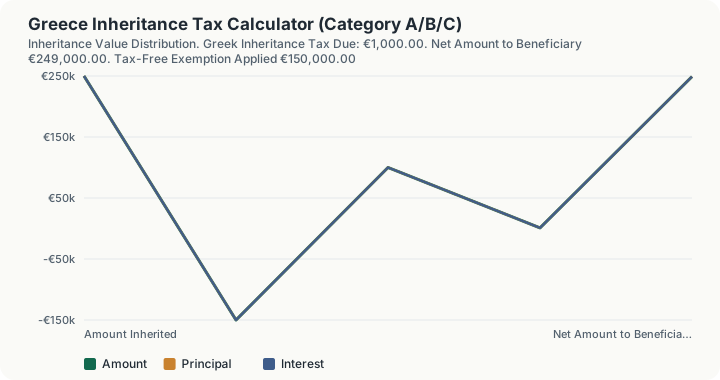
Quick Answer: A child inheriting €250,000 from a parent in Greece (Category A) owes an estimated €1,000 in inheritance tax, after a €150,000 tax-free exemption and a 1% rate on the €100,000 above it -- an effective rate of just 0.4% on the full inheritance.
Overview
Greek inheritance tax (φόρος κληρονομιάς) is governed by Law 2961/2001, and it works nothing like a single flat rate applied to an estate's total value. Instead, it is assessed per beneficiary, on the value each individual heir personally receives, and the exemption threshold and rate schedule both depend entirely on that beneficiary's relationship to the deceased -- not on the overall size of the estate.
Every heir falls into one of three statutory categories:
- Category A -- spouse, children, parents, and grandchildren -- the closest family, with the largest exemption (€150,000) and the gentlest rates (1%-10%).
- Category B -- siblings, nieces/nephews, grandparents, and in-laws -- more distant family, with a smaller exemption (€30,000) and higher rates (5%-20%).
- Category C -- unrelated heirs or very distant relations -- the smallest exemption (€6,000) and the steepest rates (20%-40%).
A special enhanced exemption of €400,000 applies specifically to a surviving spouse (or registered civil partner) or a minor child, but only where the marriage or partnership lasted at least 5 years before the decedent's death -- a materially larger shield than the standard €150,000 Category A exemption.
This calculator computes the tax due for a single beneficiary receiving a single inherited amount, under whichever category and exemption applies to that specific heir. If an estate is split among multiple heirs in different categories, calculate each heir's tax separately using their own inherited share.
Important timing note. Law 5303/2026, published in the Government Gazette on 22 May 2026, is the first full rewrite of the Greek Civil Code's inheritance book since 1946. It applies to deaths occurring on or after 16 September 2026 and it changes civil succession law, not the tax schedule: wills, inheritance contracts, the surviving spouse's intestate share, heir liability for estate debts, and the conversion of the forced-heirship claim into a mainly monetary one. The exemption thresholds and bracket rates in this calculator come from the separate inheritance tax code, Law 2961/2001, which Law 5303/2026 does not amend. What the new law can change is how much a given heir receives, which then feeds into the tax calculation here. Work out the share under the correct succession regime first, then enter that amount.
How This Is Calculated
Step 1: Determine the beneficiary's category and exemption.
| Category | Who | Exemption |
|---|---|---|
| A | Spouse, children, parents, grandchildren | €150,000 (or €400,000 for a qualifying spouse/minor child) |
| B | Siblings, nieces/nephews, grandparents, in-laws | €30,000 |
| C | Unrelated / distant relations | €6,000 |
Step 2: Apply the category's progressive bracket schedule to the inherited amount above the exemption.
Category A:
| Bracket | Rate |
|---|---|
| €0 - €150,000 | 0% (exempt) |
| €150,001 - €300,000 | 1% |
| €300,001 - €600,000 | 5% |
| Above €600,000 | 10% |
Category B:
| Bracket | Rate |
|---|---|
| €0 - €30,000 | 0% (exempt) |
| €30,001 - €100,000 | 5% |
| €100,001 - €300,000 | 10% |
| Above €300,000 | 20% |
Category C:
| Bracket | Rate |
|---|---|
| €0 - €6,000 | 0% (exempt) |
| €6,001 - €100,000 | 20% |
| €100,001 - €300,000 | 30% |
| Above €300,000 | 40% |
Step 3: Tax due. Each bracket only taxes the portion of the inherited amount that falls within it -- the schedule is marginal, exactly like an income tax scale, not a single flat rate applied to the whole inheritance once a threshold is crossed.
Special spouse/minor-child exemption mechanics. When the €400,000 exemption applies instead of the standard €150,000, it is modeled as raising the effective floor of whichever bracket it falls within -- in practice, this fully absorbs the ordinary 1% tier (which sits entirely below €400,000), so tax on a special-exemption inheritance begins directly at the 5% tier for amounts above €400,000.
Worked Example
Category A, standard exemption: a child inherits €250,000 from a parent.
- Exemption: €150,000.
- Taxable amount: €250,000 − €150,000 = €100,000, which falls entirely within the 1% bracket (€150,001-€300,000).
- Tax due: €100,000 × 1% = €1,000.
- Net to beneficiary: €250,000 − €1,000 = €249,000. Effective rate: 1,000 / 250,000 = 0.4%.
Category A, larger inheritance spanning two brackets: a child inherits €500,000.
- Exemption: €150,000. The €150,000-€300,000 tier is fully used: €150,000 × 1% = €1,500.
- The €300,000-€500,000 portion (€200,000) falls in the 5% tier: €200,000 × 5% = €10,000.
- Total tax due: €1,500 + €10,000 = €11,500.
Category A, spouse with the special €400,000 exemption: the same €500,000 inheritance, but received by a surviving spouse married 5+ years.
- Exemption: €400,000 instead of €150,000 -- this fully absorbs the 1% bracket.
- The €400,000-€500,000 portion (€100,000) falls in the 5% tier: €100,000 × 5% = €5,000 total tax due -- less than half the tax owed under the standard exemption for the same inherited amount.
Category C, unrelated heir: someone with no family relationship inherits €50,000.
- Exemption: €6,000.
- Taxable amount: €50,000 − €6,000 = €44,000, taxed at the 20% bracket (€6,001-€100,000).
- Tax due: €44,000 × 20% = €8,800 -- an effective rate of 17.6%, over 40 times the effective rate a Category A heir would pay on the same amount.
What This Does Not Account For
- Who inherits, and how much. Law 5303/2026 rewrites Greek succession law for deaths on or after 16 September 2026, including the surviving spouse's intestate share and the treatment of forced-heirship claims. This calculator does not compute anyone's share of an estate; it taxes the amount you enter. Establish the share under the succession rules that apply to the date of death, then bring that figure here.
- Real estate valuation quirks. Where the inheritance includes real estate, Greek inheritance tax is typically assessed on the property's official objective/zone value (the same "τιμή ζώνης" concept used for ENFIA), not necessarily its market value. This calculator assumes you have already determined the correct taxable value of whatever you inherited.
- Multiple beneficiaries of the same estate. This calculator computes tax for one beneficiary's individually-received share only. If an estate is split among several heirs, each heir's tax must be calculated separately on their own share and category.
- Debts, funeral expenses, and other deductions. Certain estate liabilities and expenses can reduce the taxable inheritance before the exemption and brackets are applied; this calculator assumes the "inherited amount" you enter is already the final net taxable value.
- Special exemptions beyond the spouse/minor-child case. Additional exemptions exist for specific circumstances (e.g., disabled heirs, certain agricultural property, works of art donated to the state) that are not modeled here.
- Lifetime gifts and parental transfers (γονική παροχή). Greece taxes lifetime gifts and parental property transfers under a related but separate framework with its own rate schedule; this calculator covers inheritance-at-death only, not gifts made during the donor's lifetime.
- Filing deadlines and procedural requirements. This calculator computes the tax amount only; it does not address the inheritance tax return filing deadline (generally within months of death, extended for heirs abroad) or the procedural steps for accepting an inheritance in Greece.
Common Pitfalls
- Assuming the standard €150,000 Category A exemption applies to a surviving spouse. Spouses (and minor children) married/partnered 5+ years qualify for the much larger €400,000 exemption -- using the standard exemption instead would significantly overstate their tax bill.
- Misclassifying a beneficiary's category. The three categories map to specific relationship groups (e.g., siblings are Category B, not Category A) -- getting the category wrong changes both the exemption and every bracket rate that applies.
- Applying the bracket rate to the whole inheritance instead of just the amount above the exemption. Like an income tax scale, each bracket taxes only its own slice -- someone inheriting exactly at a bracket boundary does not suddenly owe the higher rate on their entire inheritance.
- Forgetting real estate is often valued at its objective/zone value, not market price. This can cut both ways -- sometimes lower than market value, sometimes higher, depending on how current the zone valuation is for that property.
- Assuming the September 2026 law changed the tax rates. It did not. Law 5303/2026 is a succession law reform, and the Law 2961/2001 exemptions and brackets used here are unaffected by it. What it can change is the size of the share a spouse or forced heir ends up with, which is the number you feed into this calculator.
Frequently Asked Questions
Who counts as "Category A"?
Is inheritance tax paid by the estate or by each heir individually?
What is the special €400,000 exemption, exactly?
Does the new 2026 inheritance law change these rates?
How is real estate valued for inheritance tax purposes?
Can inheritance tax be paid in installments?
Sources
- Internal Revenue Service, the official authority for the tax rules this calculator relates to. irs.gov
Also consulted: Law 2961/2001 (Greek Inheritance, Gift, and Parental Transfer Tax Code), as amended: Category A/B/C exemption and bracket structure, CONFIRMED via cross-corroboration between an independent secondary-source summary table and a direct fetch of a Greek law firm's published guide, both giving identical figures; Secondary-source confirmation of the special €400,000 spouse/minor-child exemption (5-year marriage/partnership requirement); Law 5303/2026 (published in the Government Gazette 22 May 2026, applying to deaths on or after 16 September 2026): a reform of the Greek Civil Code's inheritance book covering wills, inheritance contracts, the spouse's intestate share, heir liability for estate debts, and forced heirship. Verified 2026-08-28 against published Greek law-firm commentary as affecting succession law only, leaving the Law 2961/2001 tax schedule intact; Ministry of Economy and Finance (Greece), Capital Taxation guidance -- general framework reference for capital/inheritance taxation; AADE (Independent Authority for Public Revenue) is the official source of record for filing procedures and any case-specific rulings; its portal could not be fetched directly during this research session.