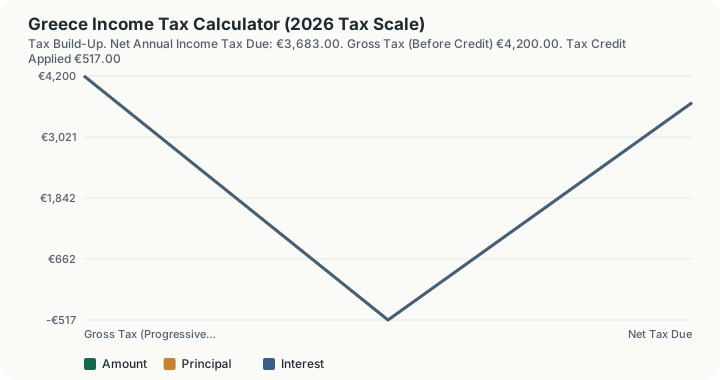
Quick Answer: A Greek salaried employee or pensioner earning €25,000 a year with no dependent children owes an estimated €3,683 in 2026 income tax (a gross tax of €4,200 under the progressive scale, reduced by a €517 Article 16 tax credit after phase-out), for an effective rate of 14.73%.
Overview
Greece taxes employment income and pensions under a single progressive scale set out in Article 15 of the Income Tax Code (ΚΦΕ), reformed for tax year 2026 by Law 5246/2025. The reform cut most bracket rates by two percentage points from their prior levels and split the old top bracket into two tiers: a new 39% band for income between €40,000 and €60,000, with 44% reserved for income above €60,000. Six brackets apply in total, from 9% on the first €10,000 up to 44% on income above €60,000.
On top of the bracket calculation, Article 16 ΚΦΕ provides a tax credit (μείωση φόρου) that directly reduces the computed tax, scaled by the number of dependent children in the household. This credit phases out gradually for taxpayers with higher income, rather than applying at a flat amount regardless of earnings.
2026 also brought two other headline changes this calculator incorporates: the Special Solidarity Contribution (ειδική εισφορά αλληλεγγύης), a separate surtax that used to stack on top of the income tax scale for higher earners, has been abolished for private-sector employment and pension income; and workers under age 25 now pay a 0% rate on their first €20,000 of income, a specific youth incentive layered into the same scale.
This calculator is built for employment and pension income specifically -- Article 15's scale applies identically to both income types, which is why Greek payslips and pension statements are taxed under the same table. It does not cover business/self-employment income (which follows the same brackets but with different deduction rules) or investment income (which is generally taxed separately at flat withholding rates).
A note on precision. The six-bracket progressive scale and the abolition of the Special Solidarity Contribution for 2026 are both cross-corroborated by multiple independent sources, including PwC's Worldwide Tax Summaries explicitly dated for tax year 2026. The €777 base tax credit for taxpayers with no children is similarly well-corroborated. The exact credit amounts for taxpayers with 1, 2, 3, or 4+ children, and the precise €20-per-€1,000 phase-out rate above €12,000 of income, reflect the credit structure that has been stable in Greek tax law since 2019 and is widely cited by secondary sources as continuing into 2026, but could not be independently confirmed against Law 5246/2025's exact amendment text this session. If you have dependent children, treat the credit portion of your result as a well-reasoned estimate and confirm the exact figure with a Greek tax advisor or AADE.
How This Is Calculated
Step 1: Gross tax from the progressive scale.
| Income Band | Rate |
|---|---|
| €0 - €10,000 | 9% |
| €10,001 - €20,000 | 20% |
| €20,001 - €30,000 | 26% |
| €30,001 - €40,000 | 34% |
| €40,001 - €60,000 | 39% |
| Above €60,000 | 44% |
Each bracket only taxes the portion of income that falls within it -- this is a marginal-rate schedule, not a single flat rate applied to your whole income.
Step 2: Under-25 override (if applicable). If you are under 25, the first €20,000 of income is taxed at 0% instead of the standard 9%/20% tiers, with the 26%/34%/39%/44% tiers unchanged above that.
Step 3: Article 16 tax credit. A base credit applies according to your number of dependent children (€777 for none, rising for more children), then reduced by €20 for every €1,000 of income above €12,000, pro-rated for part of a €1,000 step:
The credit can never exceed your gross tax liability -- it reduces your bill to zero at most, it does not create a refund.
Step 4: Net tax.
Worked Example
Using the calculator's default inputs: €25,000 annual income, no dependent children, not under 25.
- First €10,000 at 9% = €900.
- Next €10,000 (€10,000-€20,000) at 20% = €2,000.
- Remaining €5,000 (€20,000-€25,000) at 26% = €1,300.
- Gross tax: €900 + €2,000 + €1,300 = €4,200.
- Base credit for 0 children: €777. Income (€25,000) exceeds €12,000 by €13,000, or 13 full €1,000 increments. Phase-out: 13 × €20 = €260.
- Credit after phase-out: €777 − €260 = €517.
- Net tax due: €4,200 − €517 = €3,683, an effective rate of 3,683 / 25,000 = 14.73%.
For a family comparison, the same €25,000 income with 2 dependent children: the base credit rises to €1,120, the phase-out is unchanged at €260, so the credit after phase-out is €860, and net tax falls to €4,200 − €860 = €3,340 -- €343 less than the childless case.
For a high earner at €70,000: gross tax spans all six brackets and totals €21,100, but the phase-out at that income level (58 × €20 = €1,160) fully exceeds even the largest modeled credit tier, so the credit is reduced to €0 and net tax equals the full €21,100 gross figure.
What This Does Not Account For
- Phase-out rate. The €20-per-€1,000-of-excess phase-out rate reflects the stable historic structure but was not independently re-confirmed against the 2026 statute text this session.
- Business and self-employment income. Article 15's scale applies to business profits too, but with different deduction and pre-payment (προκαταβολή φόρου) rules not modeled here. Use this calculator for employment/pension income only.
- Investment income. Dividends, interest, capital gains, and rental income are generally taxed separately at flat withholding rates in Greece, not under this progressive scale, and are not modeled here.
- Social security contributions. This calculator computes income tax only. Mandatory social security contributions (EFKA) are calculated and withheld separately, on top of income tax, and are not deducted here.
- The proposed child-count bracket-rate reform. A separate reform proposal, described in at least one source as "not yet voted" at the time of research, would reduce the 20% second-bracket rate based on child count (e.g., to 18%/16%/9%/0% for 1/2/3/4+ children) instead of, or alongside, the flat Article 16 credit. Because this measure's enactment status could not be confirmed, it is NOT modeled in this calculator -- only the flat, well-established Article 16 credit is applied.
- Non-resident and expat tax regimes. Greece's non-dom program and other special regimes for foreign pensioners and high-net-worth individuals moving to Greece apply flat rates or exemptions entirely different from the standard scale modeled here.
- Regional and municipal surtaxes. This calculator computes only the national income tax; it does not include any separate local levies that may apply to specific income types.
Common Pitfalls
- Assuming a flat rate applies to all of your income. Greece's scale is a genuine marginal-bracket system: earning €25,000 does not mean paying 26% (the marginal rate) on the whole amount -- only the portion above €20,000 is taxed at 26%, with lower tiers taxed at their own lower rates.
- Forgetting the credit phases out. The Article 16 credit is largest for lower earners and shrinks steadily above €12,000 of income, disappearing entirely well before the top brackets. Don't assume the full €777 (or higher, with children) always applies.
- Mixing up gross salary and taxable income. This calculator treats your entered annual income as the amount subject to the Article 15 scale directly; if your actual payslip includes pre-tax deductions or allowances that reduce taxable income below gross salary, enter the taxable figure, not gross salary, for an accurate result.
- Overlooking the Special Solidarity Contribution's abolition. If you are working from older guidance (pre-2026) or comparing to a prior year's payslip, remember the Special Solidarity Contribution no longer applies to private-sector employment and pension income starting in 2026 -- don't add it on top of this calculator's result.
- Applying the under-25 rate incorrectly. The 0% rate on the first €20,000 is specifically for taxpayers under 25; it does not apply once you turn 25 partway through the tax year in the way some taxpayers assume -- confirm the exact eligibility cutoff with AADE guidance for your specific birth date.
Frequently Asked Questions
Does this calculator apply to pension income the same way as salary?
What changed in the 2026 tax reform specifically?
I have 3 children. Is the multi-child credit amount in this calculator guaranteed accurate?
Why did my credit phase out to zero?
Does this calculator include EFKA social security contributions?
Is there really a 0% tax rate for young workers?
Sources
- Internal Revenue Service, the official authority for the tax rules this calculator relates to. irs.gov
Also consulted: Greece Income Tax Code (ΚΦΕ), Articles 15 and 16, as amended by Law 5246/2025 for tax year 2026: six-tier progressive scale (9%/20%/26%/34%/39%/44%), cross-corroborated by three independent secondary sources including PwC's Worldwide Tax Summaries (Greece, "last reviewed February 16, 2026, tax year 2026"); Secondary-source confirmation that the Special Solidarity Contribution no longer applies to private-sector employment/pension income as of 2026 (two independent sources); PwC Worldwide Tax Summaries ("Greece. Individual. Deductions," reviewed 16 Feb 2026) for the full Article 16 credit scale (€777/€900/€1,120/€1,340/€1,580/€1,780 for 0-5 children, +€220/child beyond 5), corroborated by an independent Oct 2025 briefing on Law 5246/2025; The €20-per-€1,000 phase-out above €12,000 is a secondary-source description of the historic structure, not independently re-confirmed against the 2026 statute text this session -- flagged for confirmation; AADE (Independent Authority for Public Revenue) is the official source of record for the current-year scale and credit amounts; its portal could not be fetched directly during this research session.