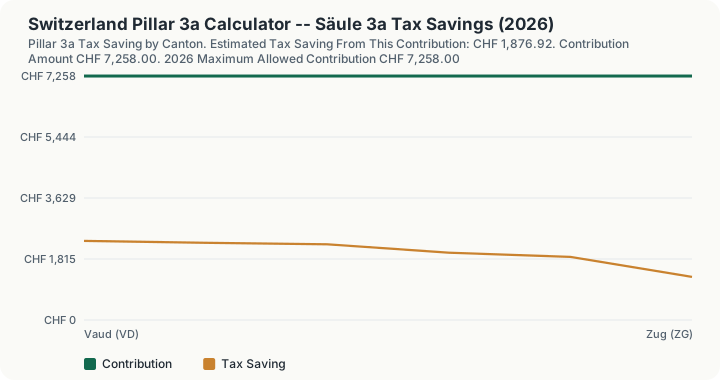
Quick Answer: An employee in Zurich with CHF 100,000 of taxable income who contributes the full 2026 Pillar 3a maximum of CHF 7,258 saves an estimated CHF 1,876.92 in combined federal, cantonal, and communal tax -- an effective marginal savings rate of about 25.9%. The same contribution in Zug, a much lower-tax canton, saves noticeably less, because the tax being avoided is smaller to begin with.
Overview
Säule 3a (Pillar 3a) is Switzerland's voluntary, tax-privileged private pension pillar -- the third of the country's three-pillar retirement system, alongside the mandatory state pension (AHV, Pillar 1) and the mandatory occupational pension fund (BVG, Pillar 2). Money paid into a Pillar 3a account (either a bank foundation savings account or an insurance-linked policy) is fully deductible from taxable income in the year it is paid, up to an annual cap that depends on whether you are employed with an occupational pension fund or self-employed without one.
The catch that makes Pillar 3a genuinely valuable, rather than just a forced-savings gimmick, is timing: your marginal tax rate while working is almost always higher than the tax rate applied when you eventually withdraw the funds (Pillar 3a withdrawals are taxed separately, at a much lower capital-withdrawal rate, and can be staggered across multiple accounts to reduce that rate further). This calculator focuses on the FIRST half of that equation -- the immediate tax saving from this year's contribution -- by comparing your combined federal, cantonal, and communal tax bill with and without the deduction, using this platform's own Switzerland income-tax model.
Because Swiss cantonal tax varies so much by location (see this platform's companion Switzerland Income Tax Calculator), the SAME Pillar 3a contribution produces a noticeably different tax saving depending on where you live. A franc of taxable income avoided in high-tax Basel-Stadt or Geneva is worth more, in immediate tax terms, than the identical franc avoided in low-tax Zug.
How This Is Calculated
- Maximum allowed contribution. Employees with a 2nd-pillar (BVG) occupational pension fund get a flat 2026 cap of CHF 7,258. Self-employed people without a 2nd pillar get 20% of net self-employment income instead, capped at CHF 36,288.
- Tax without the contribution. This calculator computes your combined federal + cantonal + communal tax at your entered taxable income, using this platform's Switzerland income-tax model (ESTV's official 2026 federal bracket table plus a cantonal/communal estimate sourced from ESTV's own official tax calculator).
- Tax with the contribution. The same combined tax is recomputed on taxable income reduced by your contribution amount (which defaults to your maximum allowed cap if you don't specify a smaller amount).
- Tax saving and marginal rate. The difference between the two is your estimated tax saving; dividing that by the contribution size gives your effective marginal savings rate -- effectively, your marginal combined tax rate at that income and canton.
Worked Example
Using the calculator's default inputs -- employed, CHF 100,000 taxable income, single, Zurich, maximum contribution:
- Maximum contribution: CHF 7,258.00 (the flat 2026 employee cap).
- Tax at CHF 100,000: CHF 15,912.35 (CHF 2,684.35 federal + CHF 13,228.00 cantonal/communal, per this platform's Zurich model).
- Tax at CHF 92,742.00 (100,000 − 7,258): interpolating this platform's Zurich cantonal model between its CHF 80,000 and CHF 100,000 reference points gives roughly CHF 11,830.11 cantonal/communal tax; federal tax at that income (still in the 6.6% bracket) is roughly CHF 2,205.32. Total: CHF 14,035.43.
- Tax saving: CHF 15,912.35 − CHF 14,035.43 = CHF 1,876.92, an effective marginal savings rate of about 25.86% of the contribution.
- Switching only the canton to Zug (same income, same contribution): the tax saving is meaningfully smaller, because Zug's marginal rate at this income is lower than Zurich's -- the contribution is identical, but the tax being avoided is smaller.
What This Does Not Account For
- Withdrawal taxation. This calculator only estimates the CURRENT-YEAR contribution deduction, not the (generally much lower, separately taxed, canton-dependent) rate applied when you eventually withdraw Pillar 3a funds, typically at or near retirement. Staggering withdrawals across multiple accounts in different years is a common strategy to reduce that later tax further, not modeled here.
- Multiple Pillar 3a accounts. Many Swiss residents split contributions across 2-5 separate Pillar 3a accounts specifically to stagger later withdrawals into different tax years and reduce progression at withdrawal. This calculator only models the current year's contribution and deduction.
- The 2026 retroactive top-up rule. Starting in 2026, Switzerland allows retroactive Pillar 3a top-up contributions for gaps going back up to 10 years, but only for shortfalls from 2025 onward. This calculator estimates a single current-year contribution and does not model multi-year retroactive top-ups.
- Church tax and other surcharges. Not included in the underlying income-tax model this calculator relies on.
- Your actual commune, not just the capital city. The tax saving is estimated using your canton's capital city as a representative example; your own commune's multiplier may differ.
- Insurance-linked (Säule 3a with insurance coverage) products. This calculator assumes a straightforward savings-account-style Pillar 3a contribution, not an insurance policy bundled with a savings component, which can carry different fee and payout structures.
Common Pitfalls
- Contributing the maximum without checking your marginal rate. The tax saving scales with your marginal rate, not a flat percentage -- someone near a bracket boundary can see the marginal savings rate change meaningfully with even a partial contribution.
- Forgetting the deadline. Pillar 3a contributions must be paid into the account by 31 December of the tax year to count as a deduction for that year -- a bank transfer initiated on 31 December that settles in January does not count.
- Assuming the self-employed cap is always CHF 36,288. It is a CEILING, not a flat amount -- self-employed people earning under roughly CHF 181,440 in net income get a smaller cap (20% of their actual net income), and only those earning above that threshold reach the full CHF 36,288 ceiling.
- Treating Pillar 3a purely as a tax play and ignoring liquidity. Funds are generally locked until 5 years before the ordinary AHV retirement age, with narrow exceptions (buying a home, starting a business, leaving Switzerland permanently, and a few others) -- do not contribute money you may need access to sooner.
- Comparing the tax saving across cantons without also comparing the underlying tax burden. A smaller Pillar 3a saving in a low-tax canton like Zug reflects a genuinely lower overall tax bill, not a worse deal -- the after-tax cost of the SAME contribution is still lower in absolute terms if your total tax bill is already lower.
Frequently Asked Questions
Why does the tax saving differ by canton if the contribution cap is the same everywhere?
Should I always contribute the maximum?
What's the difference between Pillar 3a and Pillar 3b?
Can I still contribute if I have no occupational pension fund at all (not self-employed)?
Does contributing to Pillar 3a affect my AHV (state pension) benefit?
Sources
- Swiss Federal Tax Administration (ESTV): Form 58c 2026 federal tax tariff and official interactive tax calculator (swisstaxcalculator.estv.admin.ch), used for this calculator's underlying combined income-tax model. estv.admin.ch
Also consulted: UBS Switzerland, AXA Switzerland, Kala Swiss SA, and Expat Savvy: 2026 Pillar 3a maximum contribution guidance (CHF 7,258 employed / CHF 36,288 or 20% of net income, self-employed), cross-corroborated.