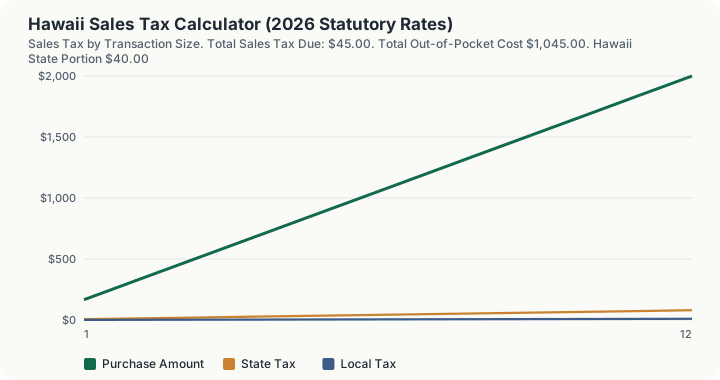
Quick Answer: A $1,000 taxable purchase in Hawaii costs $45.00 in combined state and local sales tax, for a total of $1,045.00 out the door.
Hawaii's General Excise Tax in Context
Hawaii sets its statutory state sales tax rate at 4.00%, the starting point for nearly every retail transaction in the state. Local jurisdictions (cities, counties, and in some cases special taxing districts) are free to add their own surcharges on top of that, and the statewide average of those add-ons is 0.50%, which brings the typical combined rate to 4.50%.
For a household budgeting a large purchase or a business pricing a product line, the difference between the bare state rate and the fuller combined figure of 4.50% is not academic: it is real money added at the point of sale. That 4.50% average combined rate ranks among the five lowest of any state that still levies a general sales tax. Shoppers crossing county lines within Hawaii can still see the number shift slightly, since the 4.50% used throughout this calculator is a statewide average rather than a single fixed rate that applies everywhere.
How This Is Calculated
Hawaii does not have a sales tax in the ordinary sense. It levies a general excise tax on the gross income of businesses, and the two differ in ways that matter: the GET applies to services, rents, commissions and wholesale transactions that a conventional sales tax would leave alone, and because it is a tax on the seller, businesses are permitted to pass through slightly more than the nominal rate to recover the tax on the tax. The state rate is 4.00% and county surcharges average 0.50%, so this calculator returns $45.00 on a $1,000 purchase at the combined 4.50%.
Treating the pass-through as a simple add-on to the price, the arithmetic matches the standard form:
The calculator does the following:
- Take the entered amount as the base. No adjustments are made to the price before tax is computed.
- No item-level exemption filtering and no pass-through gross-up. The visible rate is applied directly to the entered amount; the slightly higher effective pass-through rate a Hawaii retailer may charge is not modeled.
- Compute the state portion. The base is multiplied by the state statutory rate.
- Apply the county surcharge. The 0.50% average reflects the county surcharges adopted on Oahu, Kauai, Hawaii and Maui, which are not identical to each other.
- Sum and total. The state and local amounts are added to give total tax, and the total is added back to the price to give the out-of-pocket cost.
Worked Example
For a $1,000 taxable purchase in Hawaii:
- Starting purchase price. The buyer rings up a $1,000.00 taxable retail purchase in Hawaii, the baseline amount before any tax is applied.
- State portion. Hawaii's statutory state sales tax rate of 4.00% applies to the full purchase amount: $1,000.00 × 4.00% = $40.00 owed to the state.
- Local portion. Local municipal, county, and special-district surcharges add an average of 0.50% on top of that: $1,000.00 × 0.50% = $5.00 more.
- Combined tax due. Summing the two pieces, $40.00 in state tax plus $5.00 in local surcharge comes to $45.00 in total sales tax owed on the transaction.
- Total out-of-pocket cost. Adding that $45.00 in tax to the $1,000.00 purchase price brings the buyer's total out-of-pocket cost to $1,045.00.
This example uses Hawaii's statewide average local rate of 0.50%; actual combined rates vary by city and county, so a real receipt could show a combined rate above or below the 4.50% average used here.
Four Percent That Is Not a Sales Tax
Hawaii does not levy a sales tax. It levies a general excise tax on the gross income of the business, at 4.00% statewide with a 0.50% county surcharge in the table this engine reads, and sellers are permitted to visibly pass it on. The calculator treats it exactly like a sales tax, which is the right arithmetic on a straightforward retail sale and the wrong model for several situations named below.
Two rungs. Row 3 rings up $500.00 and returns $20.00 of state GET plus $2.50 of county surcharge. Row 6, the $1,000 baseline, returns $40.00 and $5.00 for $45.00 combined and $1,045.00 out the door. Each $100 of Hawaii spend carries $4.50, the lowest per-hundred figure of any taxing state on this site.
The county surcharge, priced. Switching the local toggle off takes the answer from $45.00 to $40.00. The 0.50% surcharge is worth $5.00 on the baseline and $125.00 on a $25,000 purchase, where the engine returns $1,125.00 combined against $1,000.00 of state GET alone.
Working backwards. A $1,000 all-in budget supports a $956.94 sticker price: the engine returns $43.06 of tax and exactly $1,000.00 out the door there. Because the rate is low, Hawaii gives the shopper about $27 more of goods on the same budget than Georgia does at 7.56%.
The subtraction error, priced. Taking 4.50% off $1,000.00 gives $955.00. The engine returns $42.98 of tax on that and a $997.98 total, $2.02 short of the budget. That is the smallest version of this error on any state page here, and it is small precisely because the rate is small: the size of the gap scales with the square of the rate, not with the rate.
Where treating GET as a sales tax goes wrong. Because GET falls on the seller's gross income, it applies to services, commissions, rents and professional fees that a conventional sales tax would never reach, and it pyramids: a wholesale transaction is taxed at 0.50% and then the retail sale is taxed again at 4.00%, so a good passing through several Hawaii businesses is taxed more than once. This engine models a single 4.50% pass-through on one transaction and nothing else. It has no wholesale rate, no pyramiding, no visible-pass-on maximum of 4.712%, and no county differentiation, so the true Honolulu figure a receipt shows will usually run slightly above the 4.50% used here.
What This Does Not Account For
- Statutory exemptions on unprepared groceries, prescription medications, or manufacturing equipment.
- Special industry excise taxes (lodging hotel taxes, vehicle rental fees, alcohol/tobacco excise).
- Use tax compliance on out-of-state untaxed online purchases.
- B2B resale certificate exemptions or direct pay permit programs.
Common Pitfalls
- Confusing State and Combined Rates: Quoting the state base rate without factoring in local city and county add-on taxes.
- Overlooking Consumer Use Tax: Failing to self-report and remit use tax on untaxed out-of-state purchases on your state income tax return.
- Missing Annual Sales Tax Holidays: Many states offer annual tax-free weekends for back-to-school items, severe weather supplies, or energy-efficient appliances.
- Failing to Collect Resale Certificates: Selling wholesale without collecting valid exemption certificates exposes sellers to full sales tax liability upon audit.
Frequently Asked Questions
What is the sales tax rate in Hawaii?
Are groceries taxed in Hawaii?
How does use tax differ from sales tax?
Are digital goods and SaaS taxable in Hawaii?
Sources
- Hawaii Department of Taxation: 2026 Sales and Use Tax Rate Schedules. tax.hawaii.gov
- Streamlined Sales Tax Governing Board (SSTGB): State Taxability Matrix. streamlinedsalestax.org/for-businesses/taxability-matrix