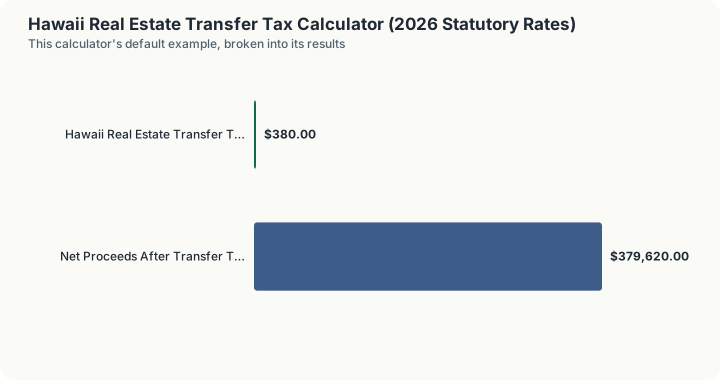
Quick Answer: A $380,000 owner-occupied home sale in Hawaii falls entirely inside the first conveyance tax bracket, producing $380 in tax due at the 0.10% rate.
Overview
Hawaii's conveyance tax under HRS Chapter 247 is the most finely graduated bracket schedule among states with a transfer tax, stepping up seven times as the sale price rises: from 0.1% on the portion up to $600,000 to a full 1.0% on any amount above $10 million. Each bracket taxes only the slice of price that falls within it, so a $12 million estate pays a blended effective rate well below the top 1.0% marginal rate.
The schedule above applies to owner-occupied property; Hawaii separately maintains a non-owner-occupant schedule with rates roughly 50% higher at every tier, reflecting a policy of taxing investment and second-home purchases more heavily than primary residences. Customarily, the seller (grantor) pays Hawaii's conveyance tax at closing, though the parties can negotiate a different allocation in the purchase agreement. This calculator carries both schedules: set the owner-occupancy question to "No" and it applies the higher investment schedule instead.
With seven brackets rather than the two or three tiers used by states like Connecticut or Rhode Island, Hawaii's schedule is the most granular in this dataset, which means small differences in sale price near a bracket boundary matter less here than in a state with only one or two thresholds to cross.
How This Is Calculated
Hawaii runs the longest bracket ladder of any state, seven tiers, and it runs two of them: one schedule for a certified owner-occupant and a higher one for everyone else. This calculator applies whichever one your answer to the owner-occupancy question selects.
- $0 to $600,000: 0.10%
- $600,000 to $1,000,000: 0.20%
- $1,000,000 to $2,000,000: 0.30%
- $2,000,000 to $4,000,000: 0.50%
- $4,000,000 to $6,000,000: 0.70%
- $6,000,000 to $10,000,000: 0.90%
- Above $10,000,000: 1.00%
Each tier's rate applies only to the dollars inside that tier, and the pieces are summed. A higher bracket never reaches back over the lower portions of the price. The engine walks the ladder in exact decimal arithmetic so rounding does not compound across seven steps, and reports the blended effective rate alongside net proceeds.
The non-owner-occupant schedule runs roughly 50% higher at every tier and is applied whenever you answer "No" to owner-occupancy. Hawaii's $1.00 statutory minimum per recorded transaction is a floor that binds only far below the price range this calculator is built for.
Worked Example
Hawaii's conveyance tax has seven marginal brackets, more than any other state's. The baseline sale never leaves the first one.
Step 1 -- The consideration. Contract sale price = $380,000
Step 2 -- Bracket 1, the first $600,000 at 0.10%. $380,000 x 0.001 = $380.00
Step 3 -- Total conveyance tax due. No higher bracket is reached, so the tax is $380.00
Step 4 -- Net proceeds after tax. $380,000.00 - $380.00 = $379,620.00
Step 5 -- The effective rate. $380.00 / $380,000 = 0.100%
Now the calculator's $1,500,000 scenario, which climbs through three brackets.
Step 6 -- Bracket 1 filled to its ceiling, $0 to $600,000 at 0.10%. $600,000 x 0.001 = $600.00
Step 7 -- Bracket 2, $600,000 to $1,000,000 at 0.20%. $400,000 x 0.002 = $800.00
Step 8 -- Bracket 3, $1,000,000 to $1,500,000 at 0.30%. $500,000 x 0.003 = $1,500.00
Step 9 -- Total conveyance tax due. $600.00 + $800.00 + $1,500.00 = $2,900.00
Step 10 -- The effective rate at $1.5M. $2,900.00 / $1,500,000 = 0.193%
Because the brackets are marginal, nothing discontinuous happens at a boundary. A $599,000 sale owes $599.00; a $601,000 sale owes $602.00. Two thousand dollars of extra price adds three dollars of tax, since only the first thousand above $600,000 sees the higher 0.20% rate. The effective rate in Step 10 therefore drifts upward with price rather than jumping, from 0.100% at the entry level toward the 1.00% top bracket that only sales above $10,000,000 approach. One thing the numbers above depend on entirely: these are the owner-occupant certified rates, the lower of Hawaii's two schedules. A buyer who cannot certify owner-occupancy, which includes most second-home and investment purchases, faces the higher schedule. On an $800,000 sale that is $1,400.00 against $1,000.00 -- switch the owner-occupancy answer to see it.
What This Does Not Account For
- Certification itself: the calculator applies whichever schedule you select, but it does not test whether you actually qualify to certify owner-occupancy. That determination is made on the conveyance-tax certificate filed at recording, and getting it wrong is a filing problem rather than an arithmetic one.
- County-level real property transfer disclosures and recording fees: The Bureau of Conveyances charges separate document recording fees that are not part of the conveyance tax itself.
- General Excise Tax (GET) implications: Hawaii's GET can apply to certain real estate transactions and is entirely separate from the conveyance tax computed here.
- Leasehold versus fee simple distinctions: Certain leasehold interest transfers have historically been treated differently under HRS 247 and may not map cleanly onto a simple sale-price calculation.
- Negotiated allocation of the tax between buyer and seller: While the conveyance tax is customarily paid by the seller in Hawaii, purchase contracts can shift this obligation, and this calculator does not model contract-specific allocation.
Common Pitfalls
- Assuming a flat rate applies to the whole price. Because the tax is bracketed, using the top marginal rate against the full sale price will substantially overstate the amount due for any transaction that spans multiple tiers.
- Forgetting the owner-occupant certification requirement. Buyers must certify occupant status to qualify for the lower schedule; failing to file the certification correctly can default a transaction to the higher non-owner-occupant rate.
- Confusing conveyance tax with property tax. Hawaii's conveyance tax is a one-time transaction tax paid at closing; it has no relationship to the recurring annual real property tax assessed by each county.
- Ignoring the Bureau of Conveyances recording fees. These are billed alongside the conveyance tax at closing but are calculated under a completely separate fee schedule.
- Using stale bracket thresholds. Hawaii's conveyance tax brackets are set by statute and have been amended over time; always confirm the current HRS 247 rate table rather than relying on outdated summaries.
Frequently Asked Questions
Who pays Hawaii's conveyance tax, the buyer or the seller?
Why did my $1,500,000 sale generate $2,900 in tax instead of a flat 0.30%?
Does the rate change if I am buying a second home instead of a primary residence?
Is there a minimum conveyance tax even on very low-priced transactions?
Does this calculator include county real property tax or General Excise Tax?
Sources
- Hawaii Department of Taxation, conveyance tax guidance and HRS Chapter 247 rate schedules. tax.hawaii.gov