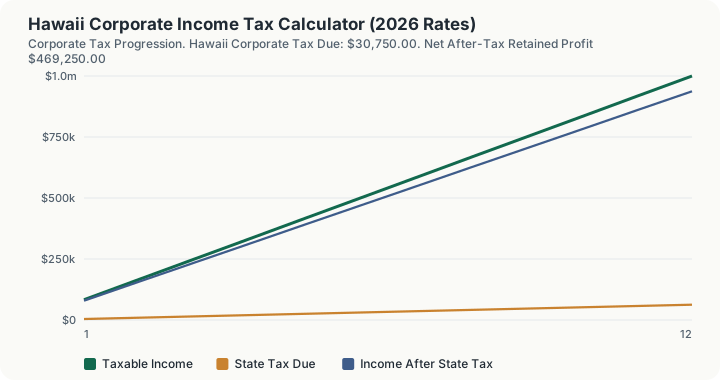
Quick Answer: On $500,000 of pre-apportioned taxable income, Hawaii's graduated corporate income tax brackets (reaching 6.40% at this income level) produce $30,750.00 in state tax due and $469,250.00 in net after-tax profit.
Three Brackets, and a Bigger Tax Beside Them
Unlike most Pacific and Western states, which tend to run either a flat rate or no corporate income tax at all, Hawaii uses a three-bracket graduated schedule: 4.40% on the first $25,000 of apportioned income, 5.40% on the next tier up to $100,000, and 6.40% on everything above that.
For any corporation with more than $100,000 of Hawaii-sourced taxable income (a low bar for most active businesses), the 6.40% top rate applies to the bulk of earnings, meaning the early, lower brackets shelter only a small fraction of a typical filer's tax base. That 6.40% ceiling lands in the middle of the range among the ten graduated-rate states in this dataset, above Arkansas's 4.30% and Nebraska's 4.55% but well below Maine's 8.93% and New Jersey's 9.00%.
Working through Hawaii's three brackets at $500,000 of apportioned income produces a 6.15% effective rate, meaningfully below the 6.40% top bracket: the $25,000 and $100,000 lower tiers still shelter a non-trivial share of income even at this level. A filer with several million dollars of Hawaii income would see that effective rate climb much closer to 6.40%.
How This Is Calculated
Hawaii keeps a genuinely graduated three-bracket corporate schedule, 4.40%, 5.40%, and 6.40%, and separates capital gains for corporations at a preferential rate. It is also one of the few states where the general excise tax on gross receipts, levied at every stage of business activity, usually costs a company more than the corporate income tax does. At $500,000 of income the schedule produces $30,750.00, an effective rate of 6.15%.
where $c_i$ are the bracket ceilings ($25{,}000$, $100{,}000$, then unlimited) and $r_i$ the corresponding rates ($4.40\%$, $5.40\%$, $6.40\%$).
- The entered income is taken as the Hawaii base. No apportionment factor, no three-factor formula, no additions or subtractions, and no net operating loss deduction is computed in this path.
- Walk the three brackets. The portion of income up to $25,000 is taxed at 4.40%, the portion between $25,000 and $100,000 at 5.40%, and everything above $100,000 at 6.40%. Each slice is taxed at its own rate and the pieces are summed, which is why the effective rate always sits below the top rate reached.
- Subtract credits, floored at zero.
- Effective rate. Net tax divided by entered income: $30,750.00 over $500,000 gives 6.15%, not the 6.40% top bracket.
- Net retained profit. Entered income minus net tax.
- Twelve tiers. The bracket walk is repeated at incomes from one sixth of your figure to twice it, which is what makes the two bracket edges below visible in the table.
Worked Example
Using this calculator's baseline scenario: a corporation with $500,000 in taxable income apportioned to Hawaii.
- Start with apportioned taxable income. The corporation has $500,000 of taxable income apportioned to Hawaii before state tax is applied.
- Work through Hawaii's bracket schedule. Hawaii taxes corporate income progressively: each slice of income is taxed only at the rate for its own bracket rather than the entire amount being taxed at the top rate, so lower brackets are filled first and the marginal rate rises step by step as income climbs.
- Marginal rate reached at this income level. At $500,000 of taxable income, the highest bracket reached is 6.40%.
- Sum the marginal brackets. Adding together the tax owed within every bracket the $500,000 passes through produces a total Hawaii state tax liability of $30,750.00.
- Net retained profit. $500,000 − $30,750.00 = $469,250.00 retained after state tax, before any separate federal tax liability.
Because the calculation sums each bracket's marginal tax rather than applying one flat rate to the whole amount, the resulting effective rate (6.15%) is always lower than the top marginal bracket actually touched.
Two Real Bracket Edges: $25,000 and $100,000
Hawaii is the only graduated corporate schedule in this set, so unlike its flat-rate neighbours the tier table above genuinely steps. There are two edges, and both are worth walking.
At $24,999 of taxable income. Every dollar is inside the first bracket, and the engine returns $1,099.96 at a 4.40% effective and 4.40% marginal rate.
At $25,001, two dollars later. The engine returns $1,100.05. The effective rate is still 4.40% but the marginal rate has moved to 5.40%: the first $25,000 remains taxed at 4.40% and only the two dollars above it meet the higher rate. The step costs nine cents. This is what a properly marginal bracket looks like, and it is the answer to the question people actually ask, which is whether crossing a bracket edge re-taxes everything below it. It does not.
At $99,999. The engine returns $5,149.95, a 5.15% effective rate against a 5.40% marginal rate.
At $100,001. The engine returns $5,150.06 and the marginal rate steps to 6.40%. Eleven cents for two dollars of income. Above this point every further dollar costs 6.40 cents and the effective rate begins climbing towards, but never reaching, 6.40%: at the $500,000 baseline it is 6.15%, and at $1,000,000 it is 6.28%.
The marginal figure above the top edge. Each additional $1,000 of Hawaii income above $100,000 costs $64.00. The engine returns $30,814.00 at $501,000 against $30,750.00 at $500,000.
The reverse question. A corporation holding Hawaii tax to $25,000 can carry $410,156.25 of income; the engine returns exactly $25,000.00 there at a 6.10% effective rate.
Credit against deduction. A $25,000 credit takes the baseline liability from $30,750.00 to $5,750.00, saving $25,000.00. Removing $25,000 from the base returns $29,150.00 and saves $1,600.00, which is the top bracket rate of 6.40% applied to $25,000 rather than the 6.15% effective rate, because the deduction comes off the top slice.
What the brackets do not include. The general excise tax on gross receipts usually costs a Hawaii company more than this income tax does, and it is not in this code path. Neither is the preferential corporate capital gains rate, apportionment on Hawaii's equally weighted three-factor formula, or any net operating loss carryforward.
What This Does Not Account For
- Federal corporate income tax (21% under IRC § 11).
- Specialized gross receipts taxes (e.g. Ohio CAT, Washington B&O, Texas Franchise Tax) where applicable.
- Minimum entity franchise tax fees or annual report filing charges.
- Base Erosion and Anti-Abuse Tax (BEAT) or Global Intangible Low-Taxed Income (GILTI) provisions.
- Local municipal corporate earnings taxes (e.g. NYC General Corporation Tax).
Common Pitfalls
- Applying the Top Bracket to All Income: Assuming Hawaii's 6.40% top rate applies to the full $500,000 rather than only the portion above $100,000, the same bracket-blending mistake that inflates a quick effective-rate estimate.
- Improper Apportionment Sourcing: Applying market-based sourcing vs cost-of-performance rules incorrectly for service revenue apportioned to Hawaii before it's run through the three-bracket schedule.
- Ignoring Unitary Group Combined Reporting: Failing to account for Hawaii's mandatory combined return requirements across related entities.
- Neglecting State NOL Carryforward Caps: Overlooking Hawaii's annual percentage limitations on net operating loss deductions, which shift where a filer's income lands within the 4.40%/5.40%/6.40% brackets.
Frequently Asked Questions
Does Hawaii have a corporate income tax?
When are Hawaii corporate tax returns due?
Does Hawaii tax S-corporations and LLCs?
How is multi-state corporate income apportioned to Hawaii?
Sources
- Hawaii Department of Taxation: Corporate Tax Statutes and Guidance (2026). tax.hawaii.gov
- Multistate Tax Commission (MTC): Uniform Apportionment and Allocation Guidelines. mtc.gov