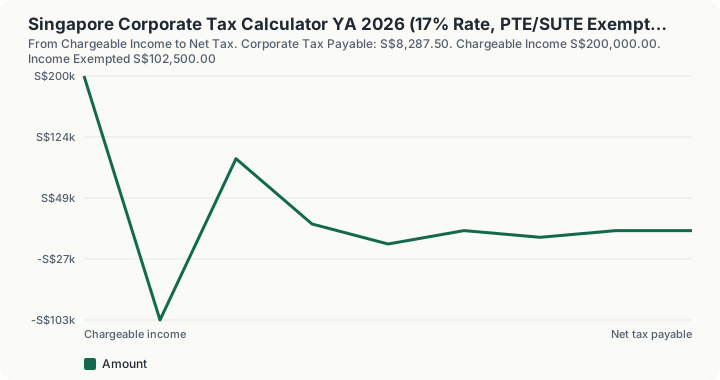
Quick Answer: S$200,000 of chargeable income under the Partial Tax Exemption, with the YA 2026 CIT Rebate of 50% capped at S$40,000 and no Cash Grant received, leaves S$8,287.50 of corporate tax payable. That is an effective rate of 4.14%, against S$34,000 at a flat 17%, so the exemption and rebate together are worth S$25,712.50.
What does this calculator do?
Singapore's headline corporate tax rate is a single flat 17%, which makes it the least informative number in a Singapore tax computation. What actually determines a small company's bill is the exemption applied before the rate and the rebate applied after it, and the two are not interchangeable steps.
Two exemption schemes exist, both covering the first S$200,000 of chargeable income. The Partial Tax Exemption exempts 75% of the first S$10,000 and 50% of the next S$190,000, a maximum of S$102,500 per Year of Assessment. The Start-Up Tax Exemption exempts 75% of the first S$100,000 and 50% of the next S$100,000, a maximum of S$125,000, and it is available only for a qualifying company's first three consecutive YAs. From the fourth YA the company falls back to PTE. Investment holding companies and property developers are excluded from SUTE but keep PTE.
On top of that, the CIT Rebate for YA 2026 is 50% of tax payable, capped at S$40,000 less the S$2,000 CIT Rebate Cash Grant where that grant was received.
Because both exemptions stop at S$200,000 of chargeable income, the relief is worth exactly the same in dollars to a S$200,000 company as to a S$20,000,000 one, and vastly more as a percentage.
How is this calculated?
Net tax = max(0, [(CI − E) × 17%] − R)
where $CI$ is chargeable income, $E$ the exemption and $R$ the rebate actually allowed.
Step 1: Start with chargeable income. This is taxable profit after deductible expenses, capital allowances and loss relief. It is not accounting profit: S$200,000
Step 2: Exempt 75% of the first S$10,000 under PTE. S$10,000 x 75% = S$7,500
Step 3: Exempt 50% of the next S$190,000. S$190,000 x 50% = S$95,000
Step 4: Total the exemption. S$7,500 + S$95,000 = S$102,500 This is the maximum PTE allows in any YA, and S$200,000 of income is exactly where it is reached.
Step 5: Reduce chargeable income by the exemption. S$200,000 − S$102,500 = S$97,500 taxable at 17%
Step 6: Apply the 17% rate. S$97,500 x 17% = S$16,575.00 of gross tax
Step 7: Compute the CIT Rebate at 50% of gross tax. S$16,575.00 x 50% = S$8,287.50
Step 8: Apply the S$40,000 cap. (S\}8{,}287.50,\ \text{S\$}40{,}000) = $ S$8,287.50 The cap is applied here, before the Cash Grant is netted off. Reversing those two steps overstates the rebate for any company whose uncapped rebate exceeds S$42,000.
Step 9: Net off the CIT Rebate Cash Grant. No Cash Grant was received, so S$0 is deducted and the rebate allowed is S$8,287.50.
Step 10: Subtract the rebate from gross tax. S$16,575.00 − S$8,287.50 = S$8,287.50 net tax payable
Step 11: Express that as an effective rate. S$8,287.50 ÷ S$200,000 = 4.14%
Step 12: Compare against a naive headline-rate calculation. S$200,000 x 17% = S$34,000 S$34,000 − S$8,287.50 = S$25,712.50 of total relief value
Step 13: Test the alternative scheme. Under SUTE the exemption would be S$125,000, leaving S$75,000 taxable, S$12,750 of gross tax, a S$6,375 rebate and S$6,375 of net tax: S$1,912.50 less.
Worked Example
A Singapore-incorporated trading company in its fifth Year of Assessment reports S$200,000 of chargeable income for YA 2026. It is past the three-year SUTE window, so Partial Tax Exemption applies. It did not receive the S$2,000 CIT Rebate Cash Grant.
Step 1: The first tier of exemption. S$10,000 x 75% = S$7,500
Step 2: The second tier. S$190,000 x 50% = S$95,000
Step 3: Total exempt. S$102,500, which is the PTE ceiling exactly
Step 4: Taxable income. S$200,000 − S$102,500 = S$97,500
Step 5: Gross tax. S$97,500 x 17% = S$16,575.00
Step 6: Rebate. S$16,575.00 x 50% = S$8,287.50, well under the S$40,000 cap: S$8,287.50
Step 7: Net tax payable. S$16,575.00 − S$8,287.50 = S$8,287.50
Step 8: Profit after tax. S$200,000 − S$8,287.50 = S$191,712.50
Two variations show how much of the answer sits outside the 17% rate. Had this been one of the company's first three YAs, SUTE would have exempted S$125,000 instead of S$102,500, and net tax would have been S$6,375: a saving of S$1,912.50, real but far smaller than the headline "75% exemption on the first S$100,000" suggests, because the rebate takes half of the extra relief straight back. And a company with only S$17,500 of chargeable income, no exemption scheme and the Cash Grant received would compute a rebate of S$1,487.50, which is less than the S$2,000 grant, so no rebate is given at all.
What does this calculator not account for?
- It does not compute chargeable income. You enter it. Deductible expenses, capital allowances, unutilised loss and donation carry-forwards, group relief, and the adjustment from accounting profit to tax profit are all assumed already done.
- Eligibility is not tested, only applied. Whether the company qualifies for SUTE at all (fewer than 20 shareholders, at least one individual holding 10% or more, not an investment holding company or a property developer) is a set of conditions, not arithmetic, so scheme selection is your input.
- The three-YA SUTE window is not tracked. Selecting SUTE applies it; the calculator does not know which YA the company is in.
- The rebate percentage and cap are exposed as inputs rather than hard-wired, because they are announced Budget by Budget. The defaults are the YA 2026 figures published by IRAS; a future year may differ.
- No withholding tax, GST, stamp duty, foreign tax credit or tax treaty relief is modelled. Only the corporate income tax computation is.
- Tax incentive schemes are excluded: Pioneer Certificates, Development and Expansion Incentives, the Finance and Treasury Centre incentive and similar concessionary rates all sit outside this calculation.
- There is no penalty, interest, or instalment modelling, and no handling of the estimated chargeable income filing obligation.
What mistakes do people make with this?
- Quoting 17% as the rate a small company pays. At S$200,000 of chargeable income the effective rate here is 4.14%. For most Singapore SMEs the headline rate materially overstates the bill.
- Applying the S$2,000 Cash Grant before the S$40,000 cap. IRAS applies the cap first. For a company whose uncapped 50% rebate exceeds S$42,000, doing it the other way round overstates the rebate. IRAS's own S$497,500 example settles it: 50% of S$124,575 is S$62,287.50, capped to S$40,000, less S$2,000 gives S$38,000.
- Forgetting that a small rebate is extinguished entirely. Where the Cash Grant was received and the capped rebate is S$2,000 or less, no rebate is given at all.
- Assuming SUTE saves far more than PTE. The maximum difference in exempt income is S$22,500, which is S$3,825 of gross tax, and the 50% rebate then claws back half of that. About S$1,912 of net tax at these figures.
- Expecting the exemption to scale with profit. Both schemes stop at S$200,000 of chargeable income. Beyond that the exemption is a fixed dollar amount, and it becomes a rounding error against the bill for a large company.
- Treating accounting profit as chargeable income. They are rarely the same figure, and the difference is usually where the real work is.
Frequently Asked Questions
What is Singapore's corporate tax rate for YA 2026?
What is the difference between the Start-Up and Partial Tax Exemption?
How does the CIT Rebate Cash Grant interact with the rebate?
Why is my effective tax rate so far below 17%?
Does the exemption keep growing with profit?
Will the CIT Rebate exist next year?
Sources
- Inland Revenue Authority of Singapore, "Corporate Income Tax Rate, Rebates and Tax Exemption Schemes," read 2026-08-30. This is the source for the 17% prevailing rate, both exemption tables, the maximum exemption figures, the YA 2024 to YA 2026 CIT Rebate of 50% capped at S$40,000 (the YA 2026 row marked as updated), and the Cash Grant interaction rules. iras.gov.sg/taxes/corporate-income-tax/basics-of-corporate-income-tax/corporate-income-tax-rate-rebates-and-tax-exemption-schemes
Also consulted: Income Tax Act 1947 (Singapore), section 43, the partial tax exemption on the first S$200,000 of chargeable income; The ordering of the S$40,000 cap before the S$2,000 Cash Grant deduction is taken from IRAS's own worked example on the page above, in which 50% of S$124,575 is capped to S$40,000 and then reduced by S$2,000 to S$38,000.