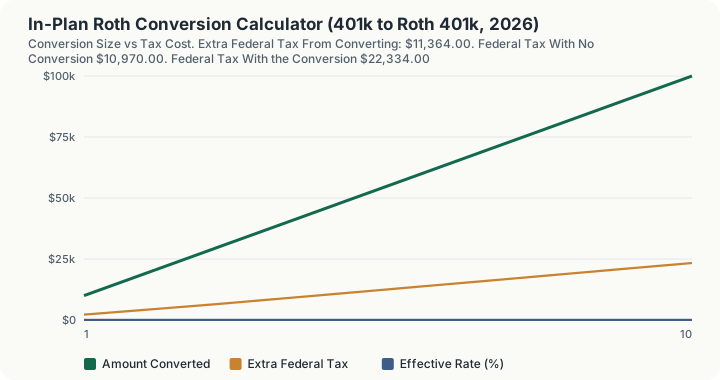
Quick Answer: Converting $50,000 inside the plan, on top of $90,000 of other ordinary income for a single filer, costs $11,364 in extra federal income tax. That is an effective rate of 22.73% on the amount converted, not the 22% bracket you started in and not the 24% bracket you ended in, because the conversion straddles the boundary between them.
What does this calculator do?
An in-plan Roth rollover under IRC section 402A(c)(4) moves a pre-tax balance into the Roth account inside the same 401(k), 403(b) or governmental 457(b), without the money ever leaving the plan. You pay ordinary income tax on the amount converted this year, and in exchange everything that balance earns afterwards is tax free.
The number people get wrong is the tax. They look up their marginal bracket, multiply, and get an answer that is too low. The converted amount stacks on top of your other ordinary income, so a conversion large enough to cross a bracket boundary is taxed partly at one rate and partly at the next. This calculator computes the cost by running the full progressive bracket calculation twice, once with the conversion and once without, and differencing. That is the only way to get the real number, and dividing it by the amount converted gives the effective rate that actually matters.
The second lever is bracket management. There is a specific amount you could convert that would stop exactly at your current bracket ceiling and avoid the higher tier entirely. The calculator computes that figure, because for many people the right answer is not "convert or do not convert" but "convert this much this year, and the rest next year".
The third lever is where the tax comes from. Paying it from taxable savings keeps the whole conversion inside the Roth wrapper. Withholding it from the conversion shrinks the Roth balance, and if you are under 59 1/2 the withheld portion is itself an early distribution subject to the 10% additional tax under section 72(t)(1).
How is this calculated?
The tax cost is a difference of two progressive tax computations:
Incremental Tax = T(Other Income + Conversion) − T(Other Income)
Effective Rate = (Incremental Tax)/Conversion
Step 1: Apply the 2026 standard deduction to the income without the conversion. $90,000 - $16,100 = $73,900 of taxable income
Step 2: Tax that through the 2026 single brackets. 10% on the first $12,400 = $1,240 12% on $12,400 to $50,400, a band of $38,000 = $4,560 22% on $50,400 to $73,900, a band of $23,500 = $5,170 $1,240 + $4,560 + $5,170 = $10,970 of tax without the conversion
Step 3: Add the conversion and re-run. $73,900 + $50,000 = $123,900 of taxable income
Step 4: Tax the higher figure. Tax accumulated to the $105,700 top of the 22% band = $17,966 24% on $105,700 to $123,900, a band of $18,200 = $4,368 $17,966 + $4,368 = $22,334 of tax with the conversion
Step 5: Difference the two. This is the headline. $22,334 - $10,970 = $11,364
Step 6: Divide by the amount converted to get the effective rate. $11,364 / $50,000 = 22.73%
Step 7: Measure the room left at the top of the pre-conversion bracket. The 22% band ends at $105,700 of taxable income. $105,700 - $73,900 = $31,800
Step 8: Check the early distribution exposure. The default pays the tax from outside savings, so nothing is withheld from the conversion. Withheld from conversion = $0, so the 10% additional tax = $0
Step 9: Everything therefore lands in the Roth. $50,000
Step 10: Grow the Roth to withdrawal, tax free. $50,000 x 1.07^20 = $193,484.22
Step 11: Grow the same balance left pre-tax, then tax it as ordinary income at withdrawal. $193,484.22 x (1 - 0.22) = $150,917.69
Step 12: The net value of converting. $193,484.22 - $150,917.69 = $42,566.53
Worked Example
A single filer with $90,000 of wages wants to convert $50,000 of her pre-tax 401(k) balance to the Roth side of the plan. She will pay the tax from a taxable brokerage account, she is over 59 1/2, and she expects to be in the 22% bracket in retirement twenty years from now.
Step 1: What she pays without converting. $10,970 of federal tax on $73,900 of taxable income.
Step 2: What she pays with the conversion. $22,334 on $123,900 of taxable income.
Step 3: The cost of converting. $11,364, or 22.73% of the amount converted.
Step 4: The bracket-management alternative. Converting only $31,800 would fill her 22% bracket exactly and never touch the 24% band. The remaining $18,200 could go next year.
Step 5: What she gets. $50,000 grows to $193,484.22 in the Roth, all tax free. Left pre-tax it reaches the same gross figure but yields $150,917.69 after a 22% retirement tax.
Step 6: The verdict on these assumptions. Converting wins by $42,566.53.
That verdict is highly sensitive to one input. If she expects a 12% rate in retirement rather than 22%, the un-converted branch is worth far more and the case for paying 22.73% today weakens sharply. The single question that decides an in-plan conversion is whether your rate later will be higher or lower than your rate now, and no calculator can tell you that.
What does this calculator not account for?
- State income tax. Only federal ordinary tax is modelled. Converting in a high-tax state before moving to a no-tax one is a real and unpriced consideration.
- The Medicare IRMAA surcharge. A conversion two years before Medicare enrolment can push you into a higher Part B and Part D bracket, and that cost is not priced here. Use the Medicare Part B premium calculator alongside this one if you are within a few years of 65.
- The net investment income tax and any credit or deduction phase-outs. A conversion raises MAGI and can silently reduce credits that phase out on income.
- Itemised deductions. The standard deduction is applied.
- The growth on the tax payment. When the tax is paid from outside funds, the un-converted branch is not credited with investing that same cash in a taxable account. The comparison therefore flatters the conversion by the growth on the tax payment. The pay-from-the-conversion branch has no such asymmetry.
- Variable returns. Growth is a single annually-compounded nominal rate.
What mistakes do people make with this?
- Using your marginal rate to estimate the tax. At the defaults that gives either $11,000 at 22% or $12,000 at 24%. The real answer is $11,364, and only running the brackets twice produces it.
- Converting more than the bracket holds. Once you know the room at the top of your bracket, spilling past it is a choice, not an accident. Splitting a large conversion across two or three tax years is usually cheaper than doing it in one.
- Withholding the tax from the conversion while under 59 1/2. The withheld amount never reaches the Roth, and it is itself an early distribution subject to the 10% additional tax under section 72(t)(1). It is the worst of both outcomes.
- Assuming you can undo it. You cannot. There is no recharacterisation of an in-plan Roth rollover. A Roth IRA conversion could once be reversed; this never could, and since 2018 neither can.
- Ignoring the five-year clock. Converted amounts in a designated Roth account have their own holding requirement before earnings come out tax free. This calculator prices the tax, not the qualification rules.
- Converting in your highest-earning year. The best conversion years are usually the low-income ones: a gap year, the window between retiring and starting Social Security, a year with large deductions.
Frequently Asked Questions
How much tax will I pay on a $50,000 in-plan Roth conversion?
Can I undo an in-plan Roth conversion?
Should I pay the conversion tax from the conversion itself?
What is the difference between an in-plan Roth conversion and a Roth IRA conversion?
How much should I convert this year?
Does the conversion count as income for Medicare premiums?
Sources
- IRS Revenue Procedure 2025-32 (Internal Revenue Bulletin 2025-45): the 2026 federal income tax brackets and standard deductions carried in engine/tables/2026/federal-tax.json and used for every figure on this page. irs.gov/pub/irs-drop/rp-25-32.pdf
- IRC section 402A(c)(4), in-plan Roth rollovers, and IRS Notice 2013-74 on their application. law.cornell.edu/uscode/text/26/402A
- IRC section 72(t)(1), the 10% additional tax on early distributions, applied to amounts withheld from a conversion by a participant under 59 1/2. law.cornell.edu/uscode/text/26/72