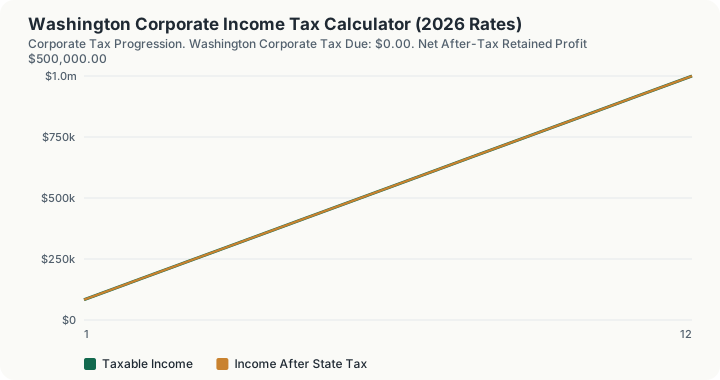
Quick Answer: On $500,000 of pre-apportioned taxable income, Washington imposes no general state-level corporate income tax, so state tax due is $0.00 and net after-tax profit equals the full $500,000 (before any separate federal tax liability).
Overview
Washington levies no net corporate income tax, one of six states in this dataset (alongside Nevada, Ohio, South Dakota, Texas, and Wyoming) with a 0.00% rate under a traditional net-income framework.
In place of an income tax, Washington imposes its Business & Occupation (B&O) Tax, a gross-receipts-style levy applied to total business revenue rather than net profit, referenced elsewhere on this page as a tax this calculator does not model. A high-revenue, thin-margin business can face a meaningfully larger burden under Washington's B&O structure than its 0.00% corporate income tax rate alone would suggest, since the B&O tax applies regardless of whether the company turns a net profit.
Because Washington's corporate income tax rate is 0.00%, the calculator's $500,000 example produces no net-income tax liability at all, compared with $44,200.00 for the identical income in neighboring California at 8.84%. Washington's B&O Tax, assessed against gross receipts rather than net income, sits entirely outside that comparison.
How This Is Calculated
Washington has no corporate income tax and no personal income tax, but it has the Business & Occupation tax, and the B&O is harsher than an income tax for thin-margin businesses because it is levied on gross receipts with essentially no deduction for costs. Rates vary by activity classification, and a business conducting several kinds of activity reports each under its own classification and rate. A distributor operating at a 2% net margin can pay B&O that exceeds its profit.
The corporate income tax result is zero at every income level. The B&O runs on gross receipts with no cost deduction:
- Corporate Income Tax Determination: Washington levies no corporate income tax, so no federal-to-state income base is computed and no income tax return is filed.
- Activity Classification: Each line of business is assigned to its B&O classification, retailing, wholesaling, manufacturing, or service and other activities, each with its own rate.
- Gross Receipts Measurement: Washington-sourced gross receipts are totalled per classification. Cost of goods sold, payroll, and overhead are not deductible from the B&O base.
- Small Business Credit: The B&O small business credit and the filing threshold are applied, which relieve the smallest filers entirely.
- Local Surtaxes: Several Washington cities, Seattle and Tacoma among them, impose their own local B&O taxes on the same receipts, reported separately from the state return.
- Capital Gains & Federal Verification: Washington's separate excise tax on long-term capital gains applies to individuals rather than to corporate operating income, and the federal 21% rate remains the only income tax on these profits.
Worked Example
Using this calculator's baseline scenario: a corporation with $500,000 in taxable income apportioned to Washington.
- Start with apportioned taxable income. The corporation has $500,000 of taxable business income apportioned to Washington.
- Apply Washington's statutory corporate income tax rate. Washington does not levy a general corporate income tax on this income, so the applicable state rate is 0.00%: $500,000 × 0.00% = $0.00.
- Washington state corporate income tax due: $0.00.
- Net retained profit. With no state income tax liability, the corporation retains the full $500,000.00 apportioned to Washington.
This calculator computes only the Washington state corporate income tax shown above; it does not compute, model, or include federal corporate income tax in this result. Separately from this calculator's output, the corporation's federal taxable income would remain subject to the flat 21% federal corporate income tax rate under IRC § 11, assessed independently by the IRS regardless of Washington's lack of a state-level corporate income tax.
A Schedule Of Zeros And What It Omits
Every row of the income sweep reads $0.00. At $100,000 of apportioned income the tax is $0.00; at $500,000 it is $0.00; at $5,000,000 it is $0.00. The reported effective rate and the reported marginal rate are both 0.00% at every point, and the twelve-row schedule that walks income in sixths from one sixth of the entered figure to twice it produces twelve zeros.
The marginal cost of the next $1,000 of apportioned income is $0.00. So is the marginal cost of the next $4,500,000: raising income from $500,000 to $5,000,000 leaves the tax unchanged at $0.00. There is no threshold, no minimum tax and no franchise floor anywhere in this code path.
The credits input does nothing here. Enter $10,000 of state tax credits against the $500,000 baseline and the result is still $0.00, because the engine takes the greater of zero and tax less credits and the tax was already zero. The input exists because this page shares a configuration with the states that do levy the tax, and on this page it is inert.
What the zero is worth, priced against neighbours. The same $500,000 of apportioned income costs $30,000.00 in Virginia at its flat 6.00%, $32,500.00 in West Virginia at 6.50%, $39,500.00 in Wisconsin at 7.90%, and $42,025.00 in Vermont under its graduated schedule. Against that range the $0.00 here is the entire practical content of the calculation, and it is a comparison the sweep on this page cannot make on its own because every one of its rows is the same number.
The omission that matters most. Washington funds itself through the Business and Occupation tax, which is levied on gross receipts rather than on net income and is not computed anywhere on this page. A company with $500,000 of net income and $8,000,000 of gross receipts owes real Washington tax that this calculator reports as $0.00, and the B&O rate turns on the classification of the activity, which no input here collects.
What This Does Not Account For
- The Business and Occupation tax is not computed. It is Washington's principal business tax, it runs on gross receipts rather than net income, and the $0.00 on this page says nothing about it.
- The credits input is inert. Any figure entered returns the same $0.00, because the engine floors tax less credits at zero and the tax is already zero.
- Federal corporate income tax (21% under IRC § 11).
- Specialized gross receipts taxes (e.g. Ohio CAT, Washington B&O, Texas Franchise Tax) where applicable.
- Minimum entity franchise tax fees or annual report filing charges.
- Base Erosion and Anti-Abuse Tax (BEAT) or Global Intangible Low-Taxed Income (GILTI) provisions.
- Local municipal corporate earnings taxes (e.g. NYC General Corporation Tax).
Common Pitfalls
- Assuming 0.00% Means Zero State Tax: Treating Washington's 0.00% corporate income tax rate as the whole picture, when the B&O Tax still applies to gross revenue regardless of net profit, hitting high-revenue, thin-margin businesses especially hard.
- Improper Apportionment Sourcing: Applying market-based sourcing vs cost-of-performance rules incorrectly for service revenue tied to Washington.
- Ignoring Unitary Group Combined Reporting: Failing to account for mandatory combined return requirements across related entities in states where a corporation does owe net income tax.
- Neglecting State NOL Carryforward Caps: Overlooking annual percentage limitations on net operating loss deductions in the other states where a Washington-based company actually owes income tax, since the B&O Tax doesn't use a traditional NOL mechanism.
Frequently Asked Questions
Does Washington have a corporate income tax?
When are Washington corporate tax returns due?
Does Washington tax S-corporations and LLCs?
How is multi-state corporate income apportioned to Washington?
Sources
- Multistate Tax Commission (MTC): Uniform Apportionment and Allocation Guidelines. mtc.gov
- Washington State Department of Revenue, the official state tax authority for Washington rates, rules and forms. dor.wa.gov
Also consulted: Washington Department of Revenue: Corporate Tax Statutes and Guidance (2026).