Quick Answer: If your 401(k) plan allows after-tax contributions and in-plan conversions, you can funnel tens of thousands of extra dollars into Roth space every year, well beyond the normal employee deferral limit, by filling the gap between your regular contributions and the total combined IRS ceiling.
Overview
Most people think of a 401(k) as having one contribution limit. It actually has two, layered on top of each other, and the gap between them is where the Mega Backdoor Roth strategy lives.
The first limit, the one everyone knows, caps how much you personally can defer from your paycheck: $24,500 for 2026. The second, much less well-known limit caps the total combined amount that can go into your account from every source in a single year, your own deferral, your employer's match or profit-sharing contribution, and any after-tax contributions you make. That combined ceiling is $72,000 for 2026. The difference between what you and your employer put in through normal channels and that $72,000 ceiling is space that, for many people, sits completely unused.
If your specific plan allows after-tax (not Roth, a third, separate contribution type) contributions, and also allows either an in-plan Roth conversion or an in-service withdrawal to an outside Roth IRA, you can fill that unused space with after-tax dollars and then convert them to Roth, where they grow tax-free for the rest of your life. This is the Mega Backdoor Roth. It requires specific plan features that not every employer's 401(k) offers, so the first real step for anyone interested is calling their plan administrator and asking two direct questions: does the plan allow after-tax contributions, and does it allow in-plan conversions or in-service distributions.
How This Is Calculated
The math has two layers that mirror the two IRS limits.
Layer one, the regular deferral. Your normal paycheck deferral is capped at $24,500 for 2026 under IRC section 402(g). If you're 50 or older, a standard catch-up adds $8,000 on top, for a total of $32,500. If you're specifically 60, 61, 62, or 63 during the year, a newer SECURE 2.0 provision replaces that standard catch-up with a larger "super catch-up" of $11,250 instead, bringing your total deferral capacity to $35,750. Notably, none of the catch-up amounts count against the combined limit in layer two; they sit entirely outside it.
Layer two, the combined ceiling. The $72,000 figure under IRC section 415(c) covers your regular elective deferral (not the catch-up), plus your employer's match and any profit-sharing contribution, plus any after-tax contributions you make. The calculator adds up your regular deferral and your employer's contribution, subtracts that sum from $72,000, and whatever's left is your available Mega Backdoor Roth room for the year. If you tell the calculator you want to contribute more after-tax money than that remaining room allows, it caps your contribution at the actual available space rather than letting you exceed the legal limit.
The reason this matters for planning: your available room shrinks as your employer's contribution grows. A generous employer match is good news for your overall retirement savings, but it directly eats into how much after-tax, convertible-to-Roth space you have left.
Worked Example
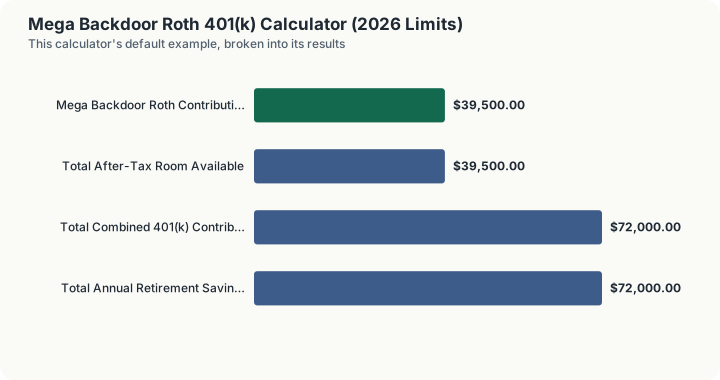
A 45-year-old, too young for any catch-up, defers the full $24,500, receives an $8,000 employer match, and would like to put $40,000 of after-tax money in behind it.
Step 1 -- Catch-up eligibility. Age 45 is under 50, so the catch-up is $0
Step 2 -- The regular deferral actually counted. $24,500, which is exactly the 402(g) cap, so nothing is trimmed: $24,500
Step 3 -- Room already consumed inside the 415(c) ceiling. $24,500 + $8,000 = $32,500
Step 4 -- Available after-tax room. $72,000 - $32,500 = $39,500
Step 5 -- The contribution the calculator will actually allow. The lesser of the $40,000 requested and the $39,500 available = $39,500
Step 6 -- Room left unused. $39,500 - $39,500 = $0.00
Step 7 -- Total contributions for the year. $24,500 + $8,000 + $39,500 = $72,000.00, landing exactly on the ceiling
Step 4 is where the planning lives, because the employer's contribution comes out of the same $72,000 the after-tax money wants. Raise the match and the Roth space shrinks dollar for dollar:
Step 8 -- The same employee with a $20,000 employer contribution. $72,000 - ($24,500 + $20,000) = $27,500 of after-tax room, $12,000 less than at an $8,000 match
The total still lands on $72,000. The generous match did not add capacity; it reallocated it from Roth space the employee controls to employer money they do not.
Now age, which behaves differently because catch-up sits outside the ceiling entirely:
Step 9 -- The same employee at 52. A standard catch-up of $8,000 applies, after-tax room is unchanged at $39,500, and total annual savings reach $72,000 + $8,000 = $80,000.00
Step 10 -- At 61, with a $5,000 match instead. The SECURE 2.0 super catch-up replaces the standard one: $11,250
Step 11 -- After-tax room at that smaller match. $72,000 - ($24,500 + $5,000) = $42,500
Step 12 -- What is actually contributed. The employee asked for $40,000, which is below the $42,500 available, so the contribution stands at $40,000 and $2,500 of room goes unused
Step 13 -- Total combined contributions. $24,500 + $5,000 + $40,000 = $69,500.00, $2,500 short of the ceiling
Step 14 -- Total annual savings including the catch-up. $69,500.00 + $11,250 = $80,750.00
Step 12 is the one to watch. The cap works in one direction only: it will stop you exceeding the limit, but it will not raise a request to fill the space you have. The $2,500 in step 13 is room that simply expires at year end.
What This Does Not Account For
- Whether your specific plan allows any of this. Not every 401(k) plan permits after-tax contributions, and among those that do, not all allow in-plan conversions or in-service distributions. This calculator shows what's mathematically possible under IRS limits, not whether your plan document permits it.
- Pro-rata and earnings-on-after-tax-contributions complications. If after-tax money sits in the plan for any length of time before being converted, it earns investment returns, and those earnings are taxable upon conversion (only the original after-tax principal converts tax-free). Frequent or immediate conversion, sometimes automated by the plan, minimizes this.
- Highly Compensated Employee (HCE) nondiscrimination testing. Some plans restrict how much high earners can contribute in after-tax dollars based on annual nondiscrimination testing results, separate from the statutory IRS limits modeled here.
- Multiple employers in one year. If you changed jobs mid-year, the $24,500 regular deferral limit is shared across all employers, but the $72,000 combined limit generally applies separately per employer's plan, a nuance this single-employer calculator doesn't model.
- State tax treatment of the conversion step. Federal tax treatment of an in-plan Roth conversion is well established; state-level treatment can vary and isn't addressed here.
Common Pitfalls
- Assuming the $69,000 or $70,000 figure from a prior year is still current. These IRS limits adjust annually for inflation. Using a stale number, especially the older $69,000 figure some resources still reference, understates how much room you may actually have in 2026.
- Forgetting catch-up contributions don't count toward the combined limit. Someone eligible for the standard or super catch-up sometimes assumes it eats into their $72,000 room; it doesn't, it's added on top.
- Converting after-tax contributions too infrequently. Letting after-tax money sit and grow before converting means a growing chunk of the eventual conversion is taxable earnings rather than tax-free principal. Many people who use this strategy convert monthly, or even set up automatic same-day conversions if their plan supports it.
- Not confirming the plan actually offers in-service distributions or in-plan conversions. Some plans allow after-tax contributions but have no mechanism to move that money into Roth status until you leave the employer, which changes the strategy's usefulness considerably.
- Overlooking that a large employer match shrinks your after-tax room. A generous match is unambiguously good for total retirement savings, but plenty of people are surprised their Mega Backdoor room is smaller than expected specifically because their employer contributes generously.
Frequently Asked Questions
What's the difference between a regular Roth 401(k) contribution and a Mega Backdoor Roth?
Do I have to convert the after-tax money to Roth right away?
What's the 2026 combined 401(k) contribution limit?
Is the Mega Backdoor Roth the same thing as a regular Backdoor Roth IRA?
Does everyone have access to this strategy?
Sources
- Internal Revenue Service, Notice 2025-67, "2026 Amounts Relating to Retirement Plans and IRAs." irs.gov
Also consulted: Internal Revenue Service, "Retirement Topics: 401(k) and Profit-Sharing Plan Contribution Limits," for general plan mechanics; SECURE 2.0 Act of 2022, Section 109, enhanced catch-up contribution limits for individuals aged 60-63.