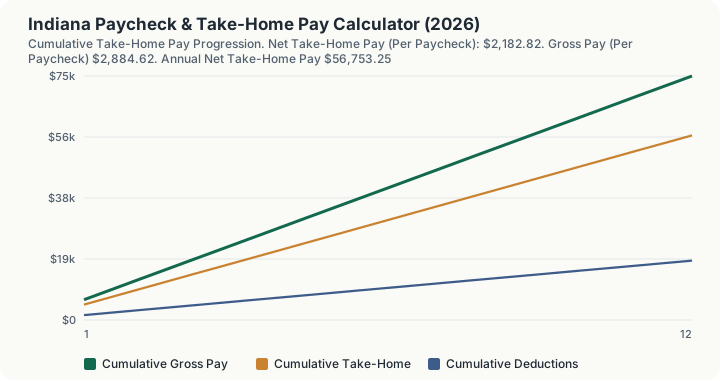
Quick Answer: A $75,000 annual salary in Indiana, paid bi-weekly and filing single, takes home about $2,182.82 per paycheck ($56,753.25 per year) after federal tax, FICA, and Indiana state withholding.
Overview
At 2.95%, Indiana runs one of the lowest flat state income tax rates in the country, a figure the legislature has been gradually reducing over several years as part of a multi-year phase-down. The Indiana Paycheck Calculator applies that flat rate on top of federal withholding and FICA to compute exact net pay.
Because the rate is both flat and comparatively low, Indiana's state withholding tends to be a smaller share of a worker's paycheck than in most other states with an income tax, though counties in Indiana can add their own local income tax on top of the state rate, a detail this calculator does not model.
Salaried employees, hourly workers, payroll administrators, and HR departments still need accurate paycheck math to plan bi-weekly, semi-monthly, monthly, and weekly schedules. With the state rate fixed and low, most of the variability in an Indiana worker's take-home pay comes from federal withholding, FICA, and whatever pre-tax benefits they've elected.
How This Is Calculated
Indiana's 2.95% state rate is one of the lowest in the country, but it is only half the story on an Indiana stub: every one of the state's 92 counties levies its own income tax on residents, at rates set locally and withheld alongside the state amount. This calculator models the state rate only. The state-level subtraction is:
The state-level figure comes from four steps:
- FICA Payroll Tax Computation: - Social Security (OASDI): 6.20% withheld on wages up to the 2026 statutory wage base ($184,500). - Medicare (HI): 1.45% withheld on all gross earnings (no wage cap), plus 0.90% Additional Medicare Tax on earnings exceeding $200,000 (single) or $250,000 (married filing jointly).
- Federal Income Tax Withholding: Evaluated using 2026 progressive federal tax brackets (10%, 12%, 22%, 24%, 32%, 35%, 37%) after applying standard deduction thresholds ($16,100 single / $32,200 married joint).
- Indiana State Income Tax Withholding: A flat 2.95% applied to Indiana taxable income. County income tax is withheld separately and is not included here.
- Pay Period Proration: Annual net compensation is divided across the designated pay frequency (26 bi-weekly, 24 semi-monthly, 12 monthly, or 52 weekly pay periods).
Worked Example
Consider an employee in Indiana earning $75,000 annually, paid bi-weekly (26 paychecks per year), filing single, with $3,500 in annual pre-tax 401(k) contributions.
- Gross pay per paycheck. $75,000 ÷ 26 pay periods = $2,884.62 before any withholding.
- Pre-tax deduction. The $3,500 annual 401(k) contribution reduces each paycheck by $134.62 and also shrinks the wages used to calculate federal and state income tax; FICA is still assessed on the full gross amount.
- FICA payroll taxes. Social Security withholds 6.2% of gross pay ($178.85) and Medicare withholds 1.45% ($41.83), for $220.67 per paycheck.
- Federal income tax withholding. Applying the 2026 IRS withholding tables to the reduced taxable wage withholds $265.38 per paycheck.
- Indiana state tax withholding. Indiana's withholding tables apply to the reduced taxable wage, withholding $81.13 per paycheck.
- Net take-home pay. $2,884.62 gross, minus $134.62 pre-tax, minus $220.67 FICA, minus $265.38 federal tax, minus $81.13 state tax leaves $2,182.82 per paycheck, or about $56,753.25 per year, an effective total tax rate of 19.66%.
Carrying The Year Forward
Indiana's 2.95% state rate is deceptively low, because county income tax is withheld on top of it and is not in this schedule at all -- so the cumulative total here is a floor, not a ceiling.
Step 7 -- Two months of cumulative pay. The schedule's first row shows $6,250.00 of cumulative gross against $4,729.44 of cumulative take-home. Row two doubles both: $12,500.00 gross, $9,458.88 take-home, with $3,041.13 accumulated on the deduction side.
Step 8 -- The full year. By month twelve the schedule reaches $75,000.00 of cumulative gross and $56,753.25 of cumulative take-home, adding $4,729.44 every month without variation.
Step 9 -- What the year actually withheld. The cumulative deduction column closes at $18,246.75. That column carries the $3,500 pre-tax 401(k) contribution alongside the tax, so tax alone is $18,246.75 - $3,500 = $14,746.75, an effective total tax rate of 19.66% on $75,000.00 of gross pay.
Step 10 -- Why the monthly increment never changes. The twelve rows rise in identical increments, which is worth naming rather than assuming. FICA is computed once on the full annual wage -- Social Security capped at $184,500, Additional Medicare charged above $200,000 for a single filer -- and the annual figure is then spread evenly across the months. So the mid-year jump in take-home that a high earner sees on a real pay stub never appears here. At $75,000 nothing crosses either threshold anyway; it would take $184,500 to reach the first and $200,000 to reach the second.
$56,753.25 is the modeled annual take-home, and it is optimistic: county tax would reduce it further. The $14,746.75 figure covers state and federal only.
Two Hundred Dollars of Salary at the Federal Bracket Edge
The twelve rows under the calculator are a cumulative month-by-month view of one salary, so they cannot show what happens when the salary itself changes. That is where every bracket in this calculation actually lives, and it is worth walking directly.
At $69,900 of gross salary. After the $3,500 pre-tax deduction and the $16,100 standard deduction, federal taxable wage is $50,300, a hundred dollars inside the 12% band. Federal withholding is $222.62 per check, Indiana withholding $75.34, and annual take-home $53,305.85.
At $70,100, two hundred dollars later. Federal taxable wage is $50,500, so a hundred dollars has crossed into the 22% band. Federal withholding rises to $223.92 per check and Indiana withholding to $75.57, giving annual take-home of $53,450.65.
The $200 of extra salary produced $144.80 of extra take-home. The federal marginal rate nearly doubled across that point and the net effect on the pay packet is a few dollars, which is the whole answer to "will a raise push me into a higher bracket and cost me money". It cannot: only the dollars above the line are re-rated.
Marginal cost of the next unit, at the default salary. Going from $75,000 to $76,000 moves annual take-home from $56,753.25 to $57,427.25. A $1,000 raise is worth $674.00 in the account, so the combined federal, FICA and Indiana wedge on the marginal dollar is 32.6%.
The reverse question, and the one lever on this page that moves real money. Raising the pre-tax deduction from $3,500 to $8,500 costs $5,000 of gross pay but only $3,752.50 of take-home: annual net falls from $56,753.25 to $53,000.75. The other $1,247.50 is tax that was never withheld, so the effective discount on that contribution is 24.95%. FICA is unaffected, because the engine assesses Social Security and Medicare on the full gross before the deduction is applied, exactly as a real payroll system does for a traditional 401(k).
Right column against wrong column. The schedule's third column is Cumulative Deductions, not cumulative tax, and the difference is the $3,500 pre-tax contribution that sits inside it. At month twelve it reads $75,000.00 less $56,753.25; subtract the $3,500 contribution and the tax withheld for the year is what remains. Treating that column as tax overstates the year's withholding by exactly $3,500 and misstates the effective rate by 4.67 points of gross pay.
What is not in any of these figures. No W-4 credits or extra withholding, no local tax of any kind, no employer-side payroll tax, and no post-tax deductions. Filing status is passed through to the state calculation. Indiana applies a single flat rate to every filer, so the state line is identical whichever status you pick -- the reason is that Indiana draws no distinction, not that the engine ignores the input. The selector does change federal withholding.
What This Does Not Account For
- Local municipal, city, or county wage taxes where applicable.
- Post-tax wage garnishments (child support, tax levies, student loans).
- Voluntary post-tax deductions (Roth 401k, charitable giving, supplemental insurance).
Common Pitfalls
- Confusing Bi-Weekly with Semi-Monthly Pay: Bi-weekly pay results in 26 paychecks per year (two 3-paycheck months), whereas semi-monthly pay results in 24 equal paychecks.
- Failing to Update Form W-4: Inaccurate withholding allowances on Form W-4 can lead to substantial underpayment penalties or large unexpected tax bills.
- Forgetting Pre-Tax Deduction Benefits: Contributions to 401(k) and HSA accounts directly reduce taxable income, lowering both federal and state tax burdens.
- Overlooking Additional Medicare Tax: Failing to anticipate the 0.9% surtax on high-earning households with multiple income sources.
Frequently Asked Questions
Does Indiana have a state income tax on paychecks?
How is overtime pay taxed in Indiana?
What is the Social Security wage cap for 2026?
Can I adjust my state tax withholding?
Sources
- Internal Revenue Service (IRS): Publication 15 (Circular E) and Publication 15-T (2026). irs.gov/publications/p15
- Social Security Administration (SSA): 2026 Social Security Wage Base Limit. ssa.gov
Also consulted: Indiana Department of Revenue: Employer Withholding Tax Tables (2026).