Quick Answer: A $1,000 taxable purchase in Indiana costs $70.00 in combined state and local sales tax, for a total of $1,070.00 out the door.
Seven Percent, and No Local Layer at All
Indiana's sales tax structure has two moving parts: a fixed 7.00% rate set at the state level, and a variable local layer that different cities and counties handle differently. Cities and counties in Indiana are not permitted to stack a local option sales tax on top of that state rate, so the 7.00% figure is close to what most shoppers actually see added at the register, with little variation from one storefront to the next.
Businesses that ship or sell into Indiana from out of state need both numbers to price correctly: using only the 7.00% state rate understates what a customer will actually owe. That leaves Indiana a bit below the roughly 7.3% average combined rate seen across the states that levy a general sales tax. Shoppers who only remember the headline 7.00% figure from a past purchase, or from a neighboring state's rate, are usually the ones surprised by the total on an Indiana receipt.
How This Is Calculated
Indiana pairs one of the highest state sales tax rates in the country, 7.00%, with no local sales tax anywhere. Counties and cities cannot add to it, so the rate is 7.00% in Indianapolis, in Gary, and in every unincorporated township, and a $1,000 purchase produces exactly $70.00 of tax statewide. Indiana funds local government through a county income tax instead, which is why the sales tax side stays flat while the income tax side varies county by county.
With no local layer to add, the formula collapses to the state rate alone:
The steps are:
- Take the entered amount as the base. No adjustments are made to the price before tax is computed.
- No item-level exemption filtering. Indiana exempts unprepared food and prescription drugs. Those exemptions are not applied here, so enter only the taxable portion.
- Compute the state portion. The base is multiplied by the state statutory rate.
- Apply the local surcharge. It is zero everywhere in Indiana, and the local toggle does not change the result.
- Sum and total. The state and local amounts are added to give total tax, and the total is added back to the price to give the out-of-pocket cost.
Worked Example
For a $1,000 taxable purchase in Indiana:
- Starting purchase price. The buyer rings up a $1,000.00 taxable retail purchase in Indiana, the baseline amount before any tax is applied.
- State portion. Indiana's statutory state sales tax rate of 7.00% applies to the full purchase amount: $1,000.00 × 7.00% = $70.00 owed to the state.
- Local portion. Local municipal, county, and special-district surcharges add an average of 0.00% on top of that: $1,000.00 × 0.00% = $0.00 more.
- Combined tax due. Summing the two pieces, $70.00 in state tax plus $0.00 in local surcharge comes to $70.00 in total sales tax owed on the transaction.
- Total out-of-pocket cost. Adding that $70.00 in tax to the $1,000.00 purchase price brings the buyer's total out-of-pocket cost to $1,070.00.
This example uses Indiana's statewide average local rate of 0.00%; actual combined rates vary by city and county, so a real receipt could show a combined rate above or below the 7.00% average used here.
One Rate, No Local Column, No Step
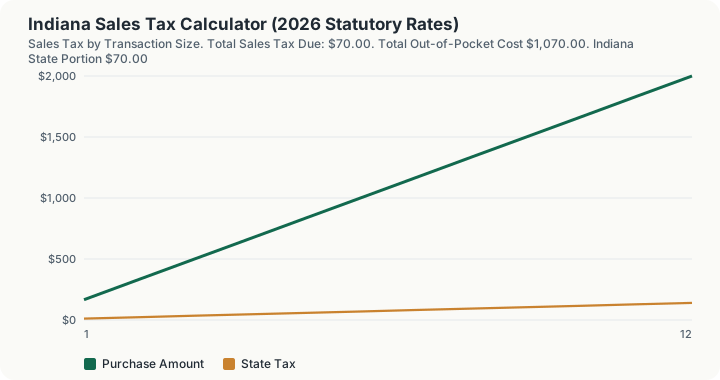
The composition, which on this page is a single line. At the $1,000 default the calculator returns $70.00 of tax, all $70.00 of it state and $0.00 local, for a total of $1,070.00. Indiana authorises no general local sales tax, so the local column in the twelve-row table below reads $0.00 on every row.
Which means one of the inputs does nothing. The "include local tax" toggle is on the page because the same primitive serves Louisiana and Illinois, where local tax is a third to a half of the bill. In Indiana it changes nothing: ticked or unticked, a $1,000 purchase returns $70.00. That is a real property of Indiana's system and it is worth knowing before you go looking for a local rate that does not exist.
At the price point that matters. A $35,000 vehicle produces $2,450.00 of tax and a $37,450.00 total. In Louisiana the same purchase produces $3,545.50, and in Kentucky $2,100.00. Indiana's 7.00% is the highest single state rate in this batch and still lands mid-table on combined cost, precisely because nothing stacks on top of it.
No threshold, no classification. The engine applies 7.00% to the whole base you enter. There is no exempt first slice, no reduced rate for groceries or prescriptions, and no item classification in calculateStateSalesTax at all. Indiana does exempt categories of goods in statute; this page taxes whatever number you type at the general rate, so an entry that includes exempt items will overstate.
Marginal cost of the next unit. Each additional $100 of taxable purchase costs $7.00, and each additional $1,000 costs $70.00. The sweep runs purchase from $166.67 to $2,000.00 and tax from $11.67 to $140.00, a straight line with the local column flat at zero throughout.
Right method against wrong method, priced. With no local layer the arithmetic is as simple as it gets, and the one error left is the tax-inclusive one. Type the $1,070.00 receipt total into the calculator and it returns $74.90 of tax rather than $70.00, overstating by $4.90, because 7% of a gross figure is not the tax inside it. The tax inside a $1,070.00 total is 6.54% of that total, and the 7.00% rate belongs only to the $1,000.00 net.
What This Does Not Account For
- Statutory exemptions on unprepared groceries, prescription medications, or manufacturing equipment.
- Special industry excise taxes (lodging hotel taxes, vehicle rental fees, alcohol/tobacco excise).
- Use tax compliance on out-of-state untaxed online purchases.
- B2B resale certificate exemptions or direct pay permit programs.
Common Pitfalls
- Confusing State and Combined Rates: Quoting the state base rate without factoring in local city and county add-on taxes.
- Overlooking Consumer Use Tax: Failing to self-report and remit use tax on untaxed out-of-state purchases on your state income tax return.
- Missing Annual Sales Tax Holidays: Many states offer annual tax-free weekends for back-to-school items, severe weather supplies, or energy-efficient appliances.
- Failing to Collect Resale Certificates: Selling wholesale without collecting valid exemption certificates exposes sellers to full sales tax liability upon audit.
Frequently Asked Questions
What is the sales tax rate in Indiana?
Are groceries taxed in Indiana?
How does use tax differ from sales tax?
Are digital goods and SaaS taxable in Indiana?
Sources
- Streamlined Sales Tax Governing Board (SSTGB): State Taxability Matrix. streamlinedsalestax.org/for-businesses/taxability-matrix
Also consulted: Indiana Department of Revenue: 2026 Sales and Use Tax Rate Schedules.