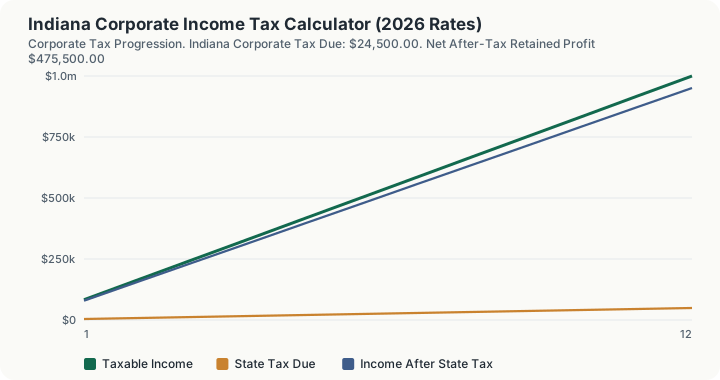
Quick Answer: On $500,000 of pre-apportioned taxable income, Indiana's flat 4.90% corporate income tax rate produces $24,500.00 in state tax due and $475,500.00 in net after-tax profit.
Indiana Against Its Neighbours, at the Same Base
For a corporation comparing Midwestern locations, Indiana's flat 4.90% corporate income tax rate stands out as notably lower than neighboring Illinois's 9.50% (nearly half the rate), and it's identical to Arizona's, the only other state in this dataset levying exactly 4.90%.
Indiana's rate applies uniformly to all apportioned taxable income with no bracket structure, so the marginal rate never changes as income grows. That flat 4.90% figure places Indiana among the lower third of states that levy a corporate income tax at all, trailing states like North Carolina, Missouri, and Oklahoma, along with a couple of graduated-rate states whose top brackets stay below 4.5%.
On the calculator's $500,000 example, Indiana's flat rate produces $24,500.00 in state tax, identical to what Arizona would generate on the same income and the two states' only shared rate figure in this dataset. Compared with neighboring Illinois's $47,500.00 on the same base, the difference is stark.
How This Is Calculated
Indiana finished a long, legislated rate glide and now sits at a flat 4.90%, one of the lowest corporate rates among states that levy one at all. There are no brackets, no minimum tax, and no franchise or net worth tax on ordinary corporations, which makes Indiana about as mechanically simple as state corporate tax gets.
- Read the income field as the taxable base. The single income input is taken as Indiana taxable corporate income exactly as typed. The code applies no modification, allocation or deduction to it before the rate stage; it is the base.
- Apply the single statutory rate. Indiana's 4.90% rate is multiplied against that figure with no bracket lookup, because the schedule has one band running from the first dollar: $500,000 x 4.90% = $24,500.00.
- Subtract credits and floor the result at zero. The credits field is subtracted from the step-2 figure and the difference is clamped at $0.00, so no credit entry can drive the liability negative. With the field at its $0 default the $24,500.00 stands; enter $10,000 of credits and the page returns $14,500.00, a reduction of exactly the credit entered because the subtraction is a straight one.
- Derive the reported rates from those two numbers. The effective rate is the tax divided by the income entered, 4.90% here, and the top statutory bracket is reported separately as 4.90%. Net after-tax retained profit is the income less the tax, $475,500.00. Those four outputs are the whole of what the engine produces.
Worked Example
Using this calculator's baseline scenario: a corporation with $500,000 in taxable income apportioned to Indiana.
- Start with apportioned taxable income. The corporation has already apportioned $500,000 of its total taxable income to Indiana using the state's statutory apportionment formula, before any state-level tax is applied.
- Apply Indiana's flat statutory rate. Indiana taxes all C-corporation income at a single flat rate of 4.90%, regardless of income size, so no bracket lookup is required: $500,000 × 4.90% = $24,500.00.
- Indiana corporate tax due: $24,500.00.
- Net retained profit. Subtracting the state tax liability from taxable income leaves $500,000 − $24,500.00 = $475,500.00 in after-tax profit retained by the corporation, before any separate federal tax liability is applied.
Because Indiana uses a single flat rate rather than graduated brackets, the 4.90% effective rate is identical to the marginal rate at every income level: a corporation earning $50,000 and one earning $50 million both face the same 4.90% state rate on their apportioned income.
One Rate, Twelve Rows, No Step
The table below the calculator sweeps apportioned income from $83,333.33 to $1,000,000.00 and holds everything else fixed. Tax runs $4,083.33 on the first row to $49,000.00 on the last, passing $24,500.00 at the $500,000 baseline. Divide any row by its income and the answer is 4.90%, to the cent, every time.
There is no threshold on this page and inventing one would be wrong. Indiana repealed its bracket structure; the schedule is a single band from the first dollar. The consequence for planning is concrete: shifting $200,000 of Indiana-apportioned income from one year to the next changes the Indiana bill by exactly nothing, because there is no lower band for it to fall into. The same shift in Iowa, whose first $100,000 is taxed at 5.50% rather than 7.10%, can be worth $1,600.
Marginal cost of the next unit. Each additional $1,000 of apportioned income costs $49.00; the calculator moves from $24,500.00 to $24,549.00. Each additional $100,000 costs $4,900.00, and it costs that at $100,000 of income and at $100,000,000. At $2,000,000 the calculator returns $98,000.00, still exactly 4.90%.
The reverse question, which here is a sourcing question. Because the rate is constant, the question worth asking is not "how much before the rate changes" but "what does moving a dollar of sales factor into Indiana cost". At the margin it is 4.9 cents of Indiana tax. The comparison that makes that number mean something is Illinois, whose 9.50% rate on the same $500,000 produces $47,500.00: every dollar of receipt sourced to Indiana rather than Illinois saves 4.6 cents of state corporate tax.
Right base against wrong base. The recurring error on this page is entering unapportioned income. The field wants income already apportioned to Indiana under the state's sales factor, and the engine performs no apportionment at all: it multiplies whatever you type by 0.049. A company with $500,000 of Indiana-apportioned income out of $2,000,000 nationwide owes $24,500.00; enter the $2,000,000 nationwide figure instead and the calculator returns $98,000.00, overstating Indiana tax by $73,500.00. Nothing in the input validation can catch it, because both numbers are valid dollar amounts.
And one thing the table never shows. Credits entered in the second field reduce the headline result only. The twelve schedule rows are built from the pre-credit bracket walk, so the table is gross Indiana tax in every row regardless of what you enter for credits.
What This Does Not Account For
- Federal Taxable Income Starting Point. Net corporate earnings are determined under IRC § 63 before Indiana modifications. This calculator starts one step later: the income box is read as the finished Indiana taxable figure and nothing is derived from a federal return.
- Indiana Additions & Subtractions. The Indiana adjusted gross income tax deducted federally is added back, and Indiana applies its own depreciation and expensing adjustments. No addback and no subtraction is computed anywhere in this page's code path, so enter an income figure that already reflects them.
- Apportionment Factor Allocation. Indiana apportions on a single sales factor with market-based sourcing for receipts other than tangible personal property. The engine performs no apportionment of any kind. The word does not appear in the primitive this page binds to; the figure you type is taken as the Indiana figure and multiplied by the rate as it stands.
- Net Operating Loss (NOL) Deductions. Allowable Indiana NOL carryforwards reduce the base before the rate is applied. No loss deduction is applied by this calculator. If a carryforward is available, subtract it yourself before entering the income.
- Federal corporate income tax (21% under IRC § 11).
- Specialized gross receipts taxes (e.g. Ohio CAT, Washington B&O, Texas Franchise Tax) where applicable.
- Minimum entity franchise tax fees or annual report filing charges.
- Base Erosion and Anti-Abuse Tax (BEAT) or Global Intangible Low-Taxed Income (GILTI) provisions.
- Local municipal corporate earnings taxes (e.g. NYC General Corporation Tax).
Common Pitfalls
- Mistaking the Flat Rate for the Final Bill: Assuming Indiana's 4.90% rate applies directly to book income rather than to apportioned taxable income after state additions, subtractions, and NOL adjustments.
- Improper Apportionment Sourcing: Applying market-based sourcing vs cost-of-performance rules incorrectly for service revenue apportioned to Indiana.
- Ignoring Unitary Group Combined Reporting: Failing to account for Indiana's mandatory combined return requirements across related entities.
- Neglecting State NOL Carryforward Caps: Overlooking Indiana's annual percentage limitations on net operating loss deductions, easy to miss given how low the 4.90% headline rate already looks.
Frequently Asked Questions
Does Indiana have a corporate income tax?
When are Indiana corporate tax returns due?
Does Indiana tax S-corporations and LLCs?
How is multi-state corporate income apportioned to Indiana?
Sources
- Multistate Tax Commission (MTC): Uniform Apportionment and Allocation Guidelines. mtc.gov
Also consulted: Indiana Department of Revenue: Corporate Tax Statutes and Guidance (2026).