Quick Answer: Up to 85% of your Social Security benefits become taxable once your provisional income, meaning other income plus half your benefits, crosses IRS thresholds that have not changed since the 1980s and 1990s.
Overview
Many people are surprised to learn that Social Security benefits can be taxed at all. The rule dates back to the Social Security Amendments of 1983, later expanded in 1993, and it works through a concept the IRS calls "provisional income," not your regular Adjusted Gross Income. Provisional income adds together your other income, any tax-exempt interest you earned, and half of your Social Security benefits. That combined figure is then compared against two sets of dollar thresholds that differ by filing status.
What makes this rule unusual, and what trips up a lot of retirees doing rough math in their head, is that the thresholds were never indexed for inflation. The $25,000 and $32,000 base amounts have applied since 1984. The $34,000 and $44,000 second-tier thresholds have applied since 1993. Every year that wages, pensions, and investment income drift upward with inflation while these lines stay perfectly flat, more retirees cross them and a larger share of the population owes tax on benefits that were, for decades before 1984, entirely tax-free. This calculator reproduces the IRS's actual worksheet, not a simplified flat-percentage estimate, so you can see exactly how much of your benefit is taxable and why.
How This Is Calculated
The IRS worksheet for this calculation appears in Publication 915 as "Worksheet 1: Figuring Your Taxable Benefits," and in nearly identical form as the Social Security Benefits Worksheet in the Form 1040 instructions. It is a specific, multi-step calculation, not a single formula, and this calculator implements every step.
Step 1: Compute provisional income. Add your other income (AGI excluding Social Security), any tax-exempt interest, and half of your total Social Security benefits.
Step 2: Compare against the base amount. If provisional income is at or below the base amount for your filing status ($25,000 for single/Head of Household/Qualifying Surviving Spouse and Married Filing Separately who lived apart all year; $32,000 for Married Filing Jointly; $0 for Married Filing Separately who lived with their spouse at any point during the year), none of your benefits are taxable and the calculation stops here.
Step 3: Determine the amount subject to the 50% tier. Take the smaller of two numbers: the amount your provisional income exceeds the base amount, or a fixed "additional amount" of $9,000 (single-type statuses) or $12,000 (Married Filing Jointly). Half of that smaller number, capped at half of your total benefits, becomes the 50%-tier taxable amount.
Step 4: Determine the amount subject to the 85% tier. Take whatever provisional income exceeds the second threshold ($34,000 or $44,000), and multiply that excess by 85%.
Step 5: Add the two tiers together, then cap the result. Add the 50%-tier amount from Step 3 to the 85%-tier amount from Step 4. Compare that sum to a hard ceiling of 85% of your total Social Security benefits. Your actual taxable benefit is whichever of those two numbers is smaller. This ceiling is why the common shorthand "85% of Social Security is taxable above the second threshold" is only an approximation. The real worksheet can produce a taxable amount below the flat 85% figure, especially for people whose provisional income sits closer to the thresholds.
Worked Example
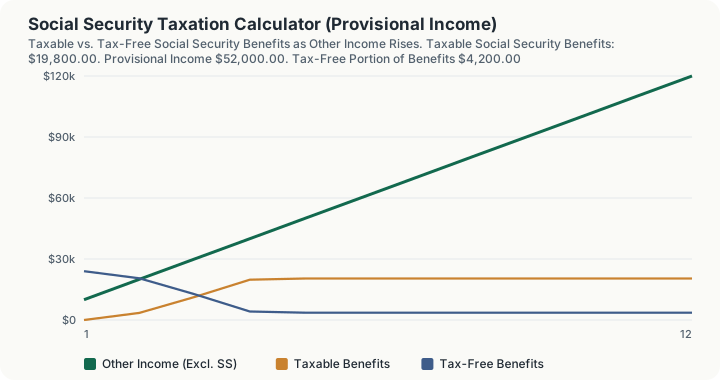
Consider a single filer receiving $24,000 a year in Social Security benefits, with $40,000 of other income and no tax-exempt interest.
- Half of benefits: $24,000 x 50% = $12,000.
- Provisional income: $40,000 + $0 + $12,000 = $52,000.
- Compare to base amount: $52,000 exceeds the single-filer base of $25,000, so some benefits are taxable.
- 50%-tier calculation: the excess over the base is $52,000 - $25,000 = $27,000. The fixed additional amount for single filers is $9,000. The smaller of $27,000 and $9,000 is $9,000. Half of that is $4,500. Comparing to half of total benefits ($12,000), the smaller value is $4,500.
- 85%-tier calculation: the excess over the second threshold is $52,000 - $34,000 = $18,000. Multiplied by 85%, that is $15,300.
- Sum and cap: $4,500 + $15,300 = $19,800. The hard ceiling is 85% of total benefits: $24,000 x 85% = $20,400. Since $19,800 is smaller than $20,400, the taxable amount is $19,800.00.
So of this filer's $24,000 in Social Security benefits, $19,800 is taxable income and $4,200 remains tax-free, meaning 82.5% of the benefit is taxable in this scenario, just short of the 85% ceiling.
What This Does Not Account For
- This calculator determines how much of your benefit counts as taxable income, not your final tax bill. The taxable amount from this worksheet gets added to the rest of your income and then run through the regular federal (and possibly state) income tax brackets.
- It does not model state taxation of Social Security. A shrinking number of states still tax Social Security benefits at the state level, each with its own separate rules and thresholds, entirely independent of the federal calculation shown here.
- It does not account for lump-sum Social Security payments covering prior years, which have a special election under IRS rules allowing the taxable amount to be calculated as if received in the year it was due, which can reduce the tax impact.
- It does not factor in the Additional Medicare Tax or Net Investment Income Tax, both of which use their own separate income thresholds unrelated to the Social Security provisional income calculation.
- It assumes you know your exact AGI excluding Social Security and any tax-exempt interest for the year. Estimating these for a future year introduces its own uncertainty this calculator cannot resolve.
Common Pitfalls
- Assuming benefits are either fully tax-free or taxed at a flat 85%. The real worksheet produces a graduated result that depends on exactly how far above each threshold your provisional income sits, as shown in the worked example above where the taxable share landed at 82.5%, not a round 85%.
- Forgetting that the thresholds are not adjusted for inflation. Someone who calculated their Social Security taxation a decade ago using the same dollar thresholds may be surprised how much more of their benefit is taxable today purely because their other income has naturally risen with cost-of-living increases, wage growth, or required minimum distributions.
- Leaving out tax-exempt municipal bond interest. Because that interest counts toward provisional income even though it is never itself taxed, retirees who moved money into municipal bonds specifically to reduce taxable income can still inadvertently push more of their Social Security benefit into taxability.
- Confusing "provisional income" with AGI. Provisional income is a separate, purpose-built figure that adds back half of Social Security and all tax-exempt interest; it will almost always be a larger number than your actual AGI.
- Not recognizing the Married Filing Separately trap. A married couple who files separately but lived together at any point during the tax year loses the base amount protection entirely, effectively taxing benefits from the first dollar of provisional income, a rule many separated-but-cohabiting couples do not realize applies to them.
Frequently Asked Questions
Why haven't the Social Security taxation thresholds been raised in decades?
Is my full Social Security benefit ever taxed?
Does this calculation apply to Social Security Disability Insurance benefits too?
What income counts toward "other income" in this calculation?
If I am married and file separately but lived apart from my spouse the entire year, which rule applies to me?
Sources
- Internal Revenue Service, Publication 915, "Social Security and Equivalent Railroad Retirement Benefits," Worksheet 1. irs.gov/publications/p915
- Internal Revenue Code Section 86, establishing the provisional income thresholds and the two-tier 50%/85% inclusion structure. law.cornell.edu/uscode/text/26/86
Also consulted: Social Security Amendments of 1983 (Pub. L. 98-21) and 1993 (Pub. L. 103-66, the Omnibus Budget Reconciliation Act), the legislation that created and later expanded the taxation of benefits.