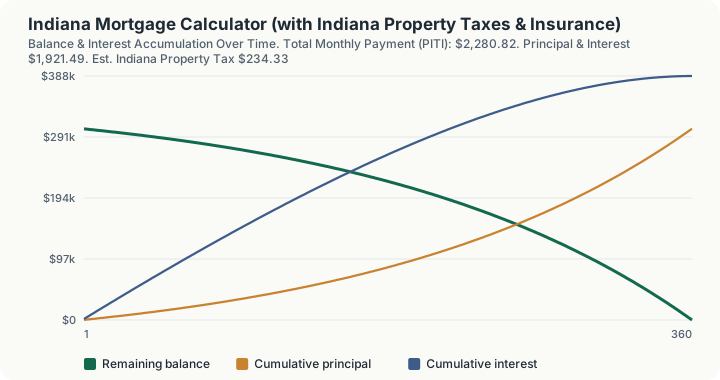
Quick Answer: On a $380,000 Indiana home with 20% down and a 6.5% rate, expect a total monthly payment (PITI) of about $2,280.82, including roughly $234.33 a month in Indiana property tax.
Overview
Indiana keeps two things unusually simple for homebuyers compared to most of the country: a flat, statewide 30-year fixed mortgage market with no unusual regional quirks, and one of the lowest effective property tax burdens in the Midwest. Article 10, Section 1 of the Indiana Constitution caps property tax at 1% of gross assessed value for owner-occupied homesteads (2% for other residential and agricultural land, 3% for commercial and personal property), and the statewide homestead standard deduction shaves a further chunk off assessed value before that cap even applies. The net effect, confirmed by Indiana Department of Local Government Finance (DLGF) county abstract data, is an effective average residential rate close to 0.74% of market value, the figure this calculator uses to estimate your Indiana property tax line.
This calculator models a conventional 30-year fixed-rate mortgage on an Indiana home purchase and folds in the state-specific property tax estimate alongside a flat homeowners insurance placeholder, so the headline number is closer to what actually leaves your bank account each month (principal, interest, taxes, and insurance, known as PITI) rather than just the principal-and-interest figure most generic mortgage tools stop at. Indiana counties bill and collect property tax in two installments, due May 10 and November 10, but the escrow math a lender runs works the same way this calculator does: divide the annual estimate by twelve and hold that amount in reserve every month.
Because the homestead credit caps and standard deductions vary somewhat by county and by exact assessed value, the 0.74% figure here is a statewide effective average, not a substitute for your county assessor's actual bill. Marion County (Indianapolis), Lake County, and Allen County tend to run a bit above the state average; several rural counties run below it.
How This Is Calculated
The engine runs a standard fixed-rate amortization on the financed loan balance, then layers Indiana-specific tax and insurance estimates on top.
- Down payment and loan principal. Down payment cash is the home price times your chosen down payment percentage. Loan principal is home price minus that cash amount.
- Monthly principal and interest (P&I). The loan principal, annual interest rate, and a 360-month (30-year) term feed a standard amortization formula: monthly payment = P × [i(1+i)^n] / [(1+i)^n − 1], where P is the loan principal, i is the monthly interest rate (annual rate divided by 12), and n is 360 total payments.
- Monthly Indiana property tax. Home price × 0.74% ÷ 12. This mirrors how a lender's escrow department would annualize and then monthly-prorate a county tax bill.
- Monthly insurance. A flat $125 placeholder for hazard/homeowners insurance, since actual premiums vary by carrier, home age, and claims history.
- Total monthly payment (PITI). Monthly P&I plus monthly property tax plus monthly insurance.
- Full amortization schedule. The engine generates all 360 monthly line items, tracking the interest and principal split at every payment and the running loan balance, so the total interest paid over the life of the loan reconciles exactly to the sum of all interest line items.
Worked Example
Using the calculator's default inputs: - Home Purchase Price: $380,000 - Down Payment: 20% ($76,000 cash) - Interest Rate: 6.5% APR, 30-year fixed
Step by step: 1. Loan principal = $380,000 − $76,000 = $304,000. 2. Monthly interest rate = 6.5% ÷ 12 = 0.5417% per period. 3. Monthly principal and interest on $304,000 over 360 payments at that rate = $1,921.49 (this is the verified test vector the calculator's engine reconciles against). 4. Monthly Indiana property tax = $380,000 × 0.74% ÷ 12 = $2,812 ÷ 12 = $234.33. 5. Monthly insurance placeholder = $125.00. 6. Total monthly payment (PITI) = $1,921.49 + $234.33 + $125.00 = $2,280.82. 7. Over the full 360-month term, cumulative interest paid on the $304,000 loan comes to just over $387,733, which is the difference between total lifetime payments (360 × $1,921.49) and the original principal.
If you instead put down only 5% ($19,000), the financed balance jumps to $361,000, pushing monthly P&I to roughly $2,282 and materially increasing lifetime interest, illustrating why the "5% Down Payment" scenario toggle exists on this page.
What This Does Not Account For
- Private mortgage insurance (PMI). Down payments under 20% typically trigger PMI, which this calculator does not add to the PITI total.
- County-specific tax variance. Marion, Lake, Hamilton, and Allen counties often diverge from the 0.74% statewide average due to local tax rate ("mill levy") differences; check your county treasurer for an exact figure.
- Homestead deduction timing. The Indiana homestead standard and supplemental deductions reduce assessed value, but only after you file for them with your county auditor; a newly purchased home may bill at a higher rate for the first tax cycle.
- HOA dues. Planned communities and condo associations charge fees this calculator excludes entirely.
- Closing costs and title insurance. Indiana closing costs (title search, recording fees, lender fees) typically run 2% to 4% of the loan amount and are not modeled here.
- Rate locks and points. Discount points paid to buy down the rate, or the cost of a rate lock extension, are not reflected in the flat APR input.
Common Pitfalls
- Assuming the 1% constitutional cap means a 1% tax rate. The circuit breaker cap limits total tax liability relative to assessed value; it is a ceiling, not the actual billed rate, which averages closer to 0.74% statewide once deductions apply.
- Forgetting the homestead deduction requires filing. Buyers who don't file the homestead deduction paperwork with their county auditor by the annual deadline can end up paying materially more than this estimate.
- Comparing this PITI figure to a P&I-only quote from a lender's advertised rate. Advertised "starting at" mortgage payments almost always exclude taxes and insurance, making Indiana homes look cheaper than the true monthly obligation.
- Ignoring the two-installment tax calendar. Indiana bills property tax semi-annually (May and November), which can catch new homeowners off guard if their lender isn't escrowing correctly from closing.
- Overlooking how down payment size compounds. Moving from 20% to 5% down doesn't just add PMI, it increases the financed principal by $57,000, which alone adds hundreds of dollars a month in interest cost.
Frequently Asked Questions
What is the average effective property tax rate in Indiana?
Does Indiana have a mortgage recording tax or transfer tax?
How often are Indiana property taxes billed?
Why does my down payment percentage change my property tax estimate?
Is 20% still the standard down payment in Indiana?
Sources
- Consumer Financial Protection Bureau (CFPB): Regulation Z (Truth in Lending Act) disclosure requirements for mortgage APR. ecfr.gov/current/title-12/chapter-X/part-1026
- Federal Reserve Economic Data (FRED): 30-year fixed mortgage rate historical benchmarks. federalreserve.gov
Also consulted: Indiana Constitution, Article 10, Section 1 (property tax caps: 1% homestead, 2% residential/agricultural, 3% other); Indiana Department of Local Government Finance (DLGF): County tax rate abstracts and homestead deduction guidance; Indiana General Assembly: Indiana Code Title 6, Article 1.1 (property taxation).