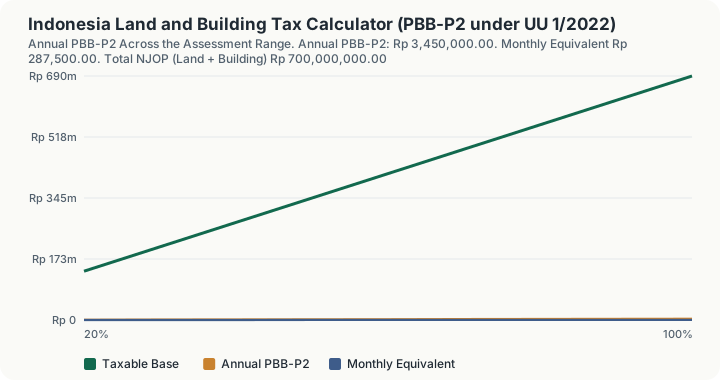
Quick Answer: A property with a combined land and building NJOP of Rp 700,000,000 attracts at most Rp 3,450,000 of annual PBB-P2, or Rp 287,500 a month. That is the upper bound, using the statutory maximum 0.5% rate and a 100% assessment percentage. Your region may set the rate lower, and may set the assessment percentage as low as 20%, in which case the same property pays Rp 690,000.
What does this calculator do?
PBB-P2 is the annual tax on land and buildings, levied by regencies and cities rather than by the central government. Since UU 1/2022, the law on financial relations between central and regional government, its structure has sat in Articles 40 to 42 of that statute.
Almost every popular summary of PBB-P2 states the formula as the rate multiplied by NJOP less NJOPTKP. That is wrong, and the error is large. Article 40(5) provides that the NJOP used for the calculation is set at not less than 20% and not more than 100% of NJOP after deducting NJOPTKP, and Article 42 then computes the tax by multiplying the rate by that Article 40(5) figure, not by the undiscounted difference. An assessment percentage survived the transition from the old law; it did not die with the previous NJKP regime as is widely claimed.
The practical consequence is that a calculator assuming 100% can overstate the bill by up to five times. Because that percentage is set by local Perda and differs between regencies, it cannot be known nationally. Nor can the rate, which Article 41 caps at 0.5% but otherwise leaves entirely to local legislation, requiring only that land used to produce food and livestock be taxed at a lower rate than other land. Nor can NJOPTKP, for which Article 40(3) sets a floor of Rp 10,000,000 per taxpayer that a region may exceed.
This calculator therefore treats all three as inputs and defaults them to the statutory maxima. The default result is an explicit upper bound rather than an invented typical bill. To get your real figure, read the rate and the assessment percentage off your local Perda or your SPPT and enter them.
How is this calculated?
Step one, the base. Article 40(1) makes NJOP, the assessed sale value, the base. Land and building values are added:
NJOP = Land NJOP + Building NJOP
Step two, the non-taxable allowance. Article 40(3) allows NJOPTKP of at least Rp 10,000,000 per taxpayer:
NJOP after NJOPTKP = max(0, NJOP − NJOPTKP)
Article 40(4) restricts this to one property per taxpayer per regency or city each year, so a second property in the same area receives nothing.
Step three, the assessment percentage. This is the step usually omitted. Article 40(5) applies a regionally determined percentage of between 20% and 100% to the figure from step two:
Taxable Base = (NJOP − NJOPTKP) × Assessment Percentage
Note the ordering. The statute says the percentage applies to NJOP "setelah dikurangi NJOP tidak kena pajak", that is, after the allowance has already been deducted. Applying the percentage first and deducting the allowance afterwards gives a different and smaller answer.
Step four, the rate. Article 42 multiplies the Article 40(5) base by the Article 41(3) rate:
PBB-P2 = Taxable Base × Rate
The rate is capped at 0.5% by Article 41(1).
Worked Example
A house in a city that has set the maximum rate and a full assessment percentage. The SPPT shows land NJOP of Rp 400,000,000 and building NJOP of Rp 300,000,000.
Step 1: Add land and building NJOP.
Rp 400,000,000 + Rp 300,000,000 = Rp 700,000,000
Total NJOP = Rp 700,000,000
Step 2: Deduct NJOPTKP at the statutory minimum.
Rp 700,000,000 − Rp 10,000,000 = Rp 690,000,000
NJOP after NJOPTKP = Rp 690,000,000
Step 3: Apply the assessment percentage under Article 40(5). This region uses 100%.
Rp 690,000,000 × 100% = Rp 690,000,000
Taxable base = Rp 690,000,000
Step 4: Apply the rate under Article 41.
Rp 690,000,000 × 0.5% = Rp 3,450,000
Annual PBB-P2 = Rp 3,450,000, or Rp 287,500 a month.
Step 5: Express it against the full property value.
(Rp 3,450,000)/(Rp 700,000,000) = 0.4929%
Effective rate = 0.4929% of NJOP, slightly below the headline 0.5% because of the allowance.
Now suppose the property is in a region that sets the assessment percentage at the statutory floor of 20% instead. Step 3 becomes:
Rp 690,000,000 × 20% = Rp 138,000,000
Taxable base = Rp 138,000,000
and step 4 becomes:
Rp 138,000,000 × 0.5% = Rp 690,000
Annual PBB-P2 = Rp 690,000
The same property, the same rate, the same allowance, and a bill one fifth the size. That is why the assessment percentage cannot be assumed.
What does this calculator not account for?
- Your region's actual rate and assessment percentage. Both are set by local Perda and vary across more than five hundred regencies and cities. The calculator applies whatever you enter and defaults to the statutory maxima, which produces an upper bound rather than a prediction.
- Your region's actual NJOPTKP, which may exceed the Rp 10,000,000 statutory minimum.
- NJOP determination. NJOP is set by the head of the region through a valuation process and reassessed at least every three years. This calculator takes the figure from your SPPT; it does not value property.
- The one-property restriction. Article 40(4) allows NJOPTKP on only one object per taxpayer per regency each year. The calculator applies whatever allowance you enter and cannot know how many properties you hold.
- Progressive or banded local rates. Some regions set different rates for different NJOP bands or property uses. A single flat rate is applied here.
- The reduced rate for food-production land required by Article 41(2). You can model it by entering a lower rate, but the calculator does not know which land qualifies.
- Exemptions and reductions for places of worship, social and educational facilities, veterans, and hardship reductions granted on application.
- PBB-P3, the central government tax on plantation, forestry and mining land, which is a different tax under different rules.
- BPHTB, the separate one-off duty on acquiring land and buildings.
- Late payment penalties and collection surcharges.
What mistakes do people make with this?
- Omitting the assessment percentage entirely. This is the big one. The formula is not rate multiplied by NJOP less NJOPTKP. Article 42 computes on the Article 40(5) figure, which has already been reduced by the regional percentage.
- Applying the percentage before deducting NJOPTKP. The statute deducts the allowance first. On the worked example above, doing it the other way round gives Rp 650,000 instead of Rp 690,000 at a 20% ratio.
- Assuming 0.5% is the normal rate. It is the statutory maximum. Many regions set less, and food-production land must be charged less.
- Confusing NJOP with market value. NJOP is an administratively assessed figure, reset at least every three years, and is often well below what a property would fetch.
- Claiming NJOPTKP on every property. It is available on one object per taxpayer per regency per year.
- Assuming the old NJKP rules were abolished. The 20% and 40% assessment ratios of the previous regime are gone by name, but Article 40(5) reintroduced a regionally set percentage in the same place in the calculation.
- Reading a national average as your bill. PBB-P2 is a local tax with locally set parameters. Two identical houses in neighbouring regencies can attract materially different tax.
Frequently Asked Questions
What is the formula for PBB-P2?
What is the maximum PBB-P2 rate?
What is NJOPTKP and how much is it?
Why does the calculator default to the statutory maximum?
Did the assessment ratio survive the 2022 reform?
How often does NJOP change?
Sources
- Undang-Undang Nomor 1 Tahun 2022 tentang Hubungan Keuangan antara Pemerintah Pusat dan Pemerintahan Daerah. peraturan.bpk.go.id/Download/189520/UU%20Nomor%201%20Tahun%202022.pdf (read 31 August 2026).
Also consulted: Article 40, verbatim in relevant part: "(1) Dasar pengenaan PBB-P2 adalah NJOP." "(3) NJOP tidak kena pajak ditetapkan paling sedikit sebesar Rp10.000.000,00 (sepuluh juta rupiah) untuk setiap Wajib Pajak." "(4) Dalam hal Wajib Pajak memiliki atau menguasai lebih dari satu objek PBB-P2 di satu wilayah kabupaten/kota, NJOP tidak kena pajak ... hanya diberikan atas salah satu objek PBB-P2 untuk setiap Tahun Pajak." "(5) NJOP yang digunakan untuk perhitungan PBB-P2 ditetapkan paling rendah 20% (dua puluh persen) dan paling tinggi 100% (seratus persen) dari NJOP setelah dikurangi NJOP tidak kena pajak sebagaimana dimaksud pada ayat (3)." "(6) NJOP ... ditetapkan setiap 3 (tiga) tahun ..."; Article 41, verbatim: "(1) Tarif PBB-P2 ditetapkan paling tinggi sebesar 0,5% (nol koma lima persen). (2) Tarif PBB-P2 ... yang berupa lahan produksi pangan dan ternak ditetapkan lebih rendah daripada tarif untuk lahan lainnya. (3) Tarif PBB-P2 ... ditetapkan dengan Perda."; Article 42, verbatim: "Besaran pokok PBB-P2 yang terutang dihitung dengan cara mengalikan dasar pengenaan PBB-P2 sebagaimana dimaksud dalam Pasal 40 ayat (5) dengan tarif PBB-P2 sebagaimana dimaksud dalam Pasal 41 ayat (3).".