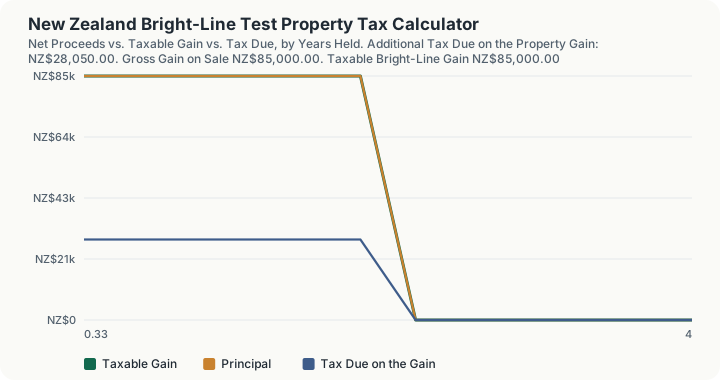
Quick Answer: A New Zealand residential property bought for NZ$750,000 and sold 1.5 years later for NZ$850,000, with NZ$15,000 of transaction costs and no main home exclusion, falls inside the 2-year bright-line period, so the NZ$85,000 gain is fully taxable as income. Stacked on NZ$80,000 of other income it is taxed at 33%, producing NZ$28,050.00 of tax. Sold just past 2 years, the gain is tax-free.
Overview
This calculator is built specifically for New Zealand's bright-line test and reports every figure in New Zealand dollars (NZ$). New Zealand has no general capital gains tax -- the bright-line test is a narrower, specific rule that taxes gains on residential land as ordinary income if the property is sold within a set period of acquisition. Get the period wrong, or misunderstand the main home exclusion, and the tax consequence can swing from zero to tens of thousands of dollars.
The bright-line period has changed multiple times through different governments -- 2 years originally (2015), extended to 5 years (2018), then 10 years for most existing homes with a 5-year carve-out for new builds (2021), and back down to a flat 2 years for any property sold on or after 1 July 2024. This calculator models the current rule only: a uniform 2-year bright-line period for all residential land, regardless of when it was purchased, as long as the sale happens on or after 1 July 2024.
How This Is Calculated
Step 1 -- identify the bright-line start and end dates. The start date is generally when the property's title was transferred to you (settlement date, registered with Land Information New Zealand). The end date is generally when you enter into a binding sale and purchase agreement to sell -- not the later settlement date of the sale itself.
Step 2 -- check the 2-year period. For any property sold on or after 1 July 2024, if the bright-line end date falls within 2 years of the start date, the sale is within the bright-line period and any gain is potentially taxable. Sell even one day after the 2-year mark, and the bright-line test no longer applies at all -- regardless of how long you actually owned the property beyond that.
Step 3 -- check the main home exclusion. Since 1 July 2024, this is an all-or-nothing test with two conditions, BOTH of which must be satisfied: more than 50% of the land area was used for a dwelling that was your main home, AND that dwelling was used as your main home for more than 50% of the time you owned it during the bright-line period. If either condition is 50% or less, the exclusion does not apply at all -- there is no partial or proportional exclusion any more (that was the rule before 1 July 2024; it has been replaced).
Step 4 -- calculate the gain. Gross gain equals the sale price minus your cost basis (purchase price, plus legal fees, agent commission and other transaction costs, plus any capitalized improvements). If the sale is within the bright-line period and the main home exclusion doesn't apply, the entire gross gain is taxable; otherwise the taxable gain is zero.
Step 5 -- apply your marginal tax rate. A taxable bright-line gain is not a separate flat-rate tax -- it's added to your other income for the year and taxed at your ordinary marginal income tax rate(s), following New Zealand's normal progressive brackets. This calculator shows the incremental tax by comparing tax on (your other income + the gain) against tax on your other income alone, correctly reflecting how the gain stacks on top of whatever bracket your other income already puts you in.
Worked Example
Consider Daniel, who bought a rental property for NZ$750,000, spent NZ$15,000 on legal fees and agent commission across the purchase and sale, made no capital improvements, and sold it 1.5 years later for NZ$850,000. He earns NZ$80,000 from his job in the year of sale, and the property was never his main home.
Cost basis: NZ$750,000 + NZ$15,000 = NZ$765,000. Gross gain: NZ$850,000 − NZ$765,000 = NZ$85,000.
Bright-line check: 1.5 years is within the current 2-year period, and there's no main home exclusion, so the full NZ$85,000 is taxable.
Tax on NZ$80,000 alone: NZ$1,638.00 (10.5% band) + NZ$6,632.50 (17.5% band) + NZ$7,380.00 (30% band) + NZ$627.00 (33% band on the last NZ$1,900) = NZ$16,277.50.
Tax on NZ$80,000 + NZ$85,000 = NZ$165,000: the same first three bands, NZ$1,638.00 + NZ$6,632.50 + NZ$7,380.00, plus 33% on the remaining NZ$86,900 (from NZ$78,100 to NZ$165,000) = NZ$28,677.00. Total: NZ$44,327.50.
Incremental tax on the gain: NZ$44,327.50 − NZ$16,277.50 = NZ$28,050.00, all at his 33% marginal rate. Net proceeds after tax: NZ$85,000 − NZ$28,050.00 = NZ$56,950.00.
Had Daniel instead sold at 3 years -- past the 2-year mark -- none of the NZ$85,000 gain would be taxable under the bright-line test at all.
What This Does Not Account For
- Superseded bright-line regimes. This calculator applies only the CURRENT flat 2-year rule for property sold on or after 1 July 2024. It does not model the previous 2015 (2-year), 2018 (5-year), or 2021 (10-year/5-year new-build) regimes for property both bought and sold entirely before 1 July 2024.
- Other statutory exclusions. Inherited property, transfers under a relationship property agreement, business premises, farmland, and property compulsorily acquired by the Crown or a local authority following a designated North Island severe weather event are all separately excluded from the bright-line test by statute, but are not modeled as numeric inputs here -- if one of these applies to your situation, the bright-line test likely doesn't apply regardless of the holding period.
- The rollover relief rule. Certain transfers (e.g. between associated persons in specific circumstances, or via a look-through company/partnership) can carry over the original bright-line start date rather than resetting it; this calculator assumes a straightforward arm's-length purchase and sale.
- Losses. If bright-line rules apply and the sale produces a loss, that loss may be deductible against other land-sale income in some circumstances; this calculator only computes tax on a gain and shows zero on a loss, without modeling any offsetting deduction.
- GST and other property-specific taxes. GST for GST-registered property traders/developers, and local council rates, are separate from the bright-line test and not modeled here.
- Provisional tax and payment timing. This calculator estimates the tax liability on the gain itself, not when it must be paid or any use-of-money interest for late payment.
Common Pitfalls
- Assuming the bright-line period is still 5 or 10 years. The period has changed multiple times; the current rule (since 1 July 2024) is a flat 2 years for every residential property sold from that date forward, regardless of purchase date or whether it's a new build.
- Using the sale settlement date instead of the sale AGREEMENT date as the end date. The bright-line end date is generally when you sign a binding sale and purchase agreement, not the later date the sale actually settles -- using the wrong date can incorrectly place a sale inside or outside the 2-year window.
- Assuming partial main-home use gives a partial exclusion. Since 1 July 2024 the main home exclusion is strictly all-or-nothing: failing either the 50%-of-land or 50%-of-time test (even by a small margin) means the FULL gain is taxable, not just the "non-main-home portion" as under the old rules.
- Forgetting the gain stacks on other income. The bright-line gain isn't taxed at a flat rate in isolation -- it's added on top of your other income for the year, which can push a large chunk of the gain into a higher marginal bracket than you'd expect if you only look at the gain amount alone.
- Confusing the start date with the purchase offer date. The bright-line start date is generally the date title transfers (settlement), not the date you signed the purchase agreement to buy -- an easy source of miscounted holding periods.
Frequently Asked Questions
What is the current bright-line test period in New Zealand?
Has the bright-line period changed before?
Does selling my main home ever get taxed under the bright-line test?
Is the bright-line gain taxed at a special capital gains rate?
What counts as the bright-line "start date" and "end date"?
Does inherited property get taxed under the bright-line test?
Sources
- Inland Revenue (IRD), "The bright-line test" (ird.govt.nz/property/buying-and-selling/when-you-need-to-pay/the-brightline-test) -- current 2-year period for property sold on or after 1 July 2024, start/end date definitions. ird.govt.nz
Also consulted: Inland Revenue (IRD), exclusions to the bright-line test (ird.govt.nz/property/buying-and-selling/when-you-need-to-pay/the-brightline-test/exclusions-to-the-brightline-test) -- main home, inherited property, relationship property, business premises, farmland, and adverse-weather-event exclusions; Inland Revenue (IRD), "Tax rates for individuals" -- used to compute the incremental tax on a taxable bright-line gain (see the companion PAYE & KiwiSaver Calculator for the full bracket citation); Davenports Law and QCL, secondary summaries of the 1 July 2024 bright-line and main home exclusion reform, corroborating the direct IRD source above.