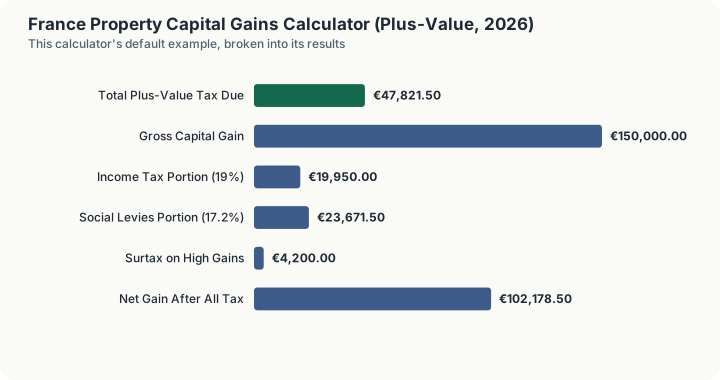
Quick Answer: Selling a French investment property for €450,000 after buying it for €300,000 and holding it 10 years generates a €150,000 gross capital gain, but only €47,821.50 in total plus-value tax (19% income tax + 17.2% social levies + a surtax bracket) -- a net gain after tax of €102,178.50. Sell your primary residence instead, at any gain and after any holding period, and you owe €0.
Overview
France taxes real estate capital gains -- plus-value immobilière -- through a structure most other countries don't replicate: the gain is split into two entirely separate tax bases that shrink at DIFFERENT speeds the longer you hold the property. The income-tax portion (19%) becomes fully abated after 22 years of ownership. The social-levies portion (17.2%) takes a full 30 years to fully abate. Because these two schedules run on different clocks, the SAME euro of gain can be fully exempt from one tax and still partially taxable under the other for an 8-year window (years 23 through 30) -- a detail that trips up even experienced sellers who assume "22 years = tax-free."
On top of the ordinary 36.2% combined rate (before abatement), France layers a surtax of 2%-6% on taxable gains above €50,000, aimed specifically at large capital gains. And regardless of gain size or how long you owned it, selling your résidence principale (primary residence) is always fully exempt from both portions of the tax -- no abatement schedule needed, because the exemption is unconditional.
How This Is Calculated
- Compute the gross gain: sale price minus your acquisition cost basis (original purchase price plus acquisition costs and eligible capital improvements).
- Check for the primary residence exemption first. If this was your primary residence at the time of sale, the calculation stops here -- the gain is fully exempt from both the income tax and social levies, at any amount, after any holding period.
- Apply the income-tax holding-period abatement (19% portion): 0% for years 1-5 of ownership; then 6% per additional full year for years 6-21 (accumulating to 96% by year 21); then a final 4% in year 22, reaching full (100%) exemption at 22 years.
- Separately apply the social-levies holding-period abatement (17.2% portion), on its own slower schedule: 0% for years 1-5; then 1.65% per year for years 6-21 (accumulating to 26.4%); then 1.6% in year 22 (reaching 28%); then a much faster 9% per year for years 23-30, reaching full (100%) exemption only at 30 years.
- Apply each rate to its own (differently-abated) taxable base: 19% to the income-tax-taxable gain, 17.2% to the social-levies-taxable gain.
- Apply the surtax -- 2% to 6%, based on which bracket the income-tax-taxable gain falls into -- only if that taxable gain exceeds €50,000.
- Sum all three components for the total plus-value tax due.
Worked Example
Using the calculator's default inputs -- €450,000 sale price, €300,000 acquisition cost basis, 10 full years held, not a primary residence:
- Gross gain: €450,000 − €300,000 = €150,000.
- Income-tax abatement at 10 years: (10 − 5) × 6% = 30%. Taxable base: €150,000 × 70% = €105,000. Tax: €105,000 × 19% = €19,950.
- Social-levies abatement at 10 years: (10 − 5) × 1.65% = 8.25%. Taxable base: €150,000 × 91.75% = €137,625. Levies: €137,625 × 17.2% = €23,671.50.
- Surtax: the income-tax-taxable base (€105,000) falls in the €100,000-€150,000 bracket, taxed at 4%: €105,000 × 4% = €4,200.
- Total tax: €19,950 + €23,671.50 + €4,200 = €47,821.50.
- Net proceeds after tax: €150,000 − €47,821.50 = €102,178.50.
Compare this to the same €150,000 gain after 32 years of ownership: both abatement schedules reach 100%, so the taxable base for every component is €0, and the entire €150,000 gain passes tax-free.
What This Does Not Account For
- The surtax "lissage" (smoothing) mechanism. The official schedule under CGI art. 1609 nonies G softens the transition right at each bracket edge (roughly within €10,000 above €50,000, €100,000, €150,000, and €200,000) so the tax doesn't jump sharply at those exact thresholds. This calculator applies the flat bracket rate to the whole taxable gain without that smoothing adjustment -- a disclosed simplification whose effect is limited to gains landing very close to a bracket edge.
- Notaire fees, real estate agency commissions, and other transaction costs on the sale side, which are not automatically netted against the sale price in this calculator -- enter a sale price net of those costs if you want the tax computed on your true economic gain.
- Flat-rate acquisition cost allowances. French law allows sellers to add a flat 7.5% of the original purchase price for acquisition costs (instead of actual receipts) and, after 5 years of ownership, a flat 15% for improvement works (instead of actual invoiced costs) -- this calculator assumes you supply your own final acquisition cost basis already inclusive of whichever method you're using.
- Building land (terrains à bâtir) special rules and specific abatement exclusions that apply only to undeveloped land sales, which differ from the built-property schedule modeled here.
- Non-resident-specific withholding requirements (the notaire-collected "représentant fiscal" mechanism) for sellers who are not French tax residents.
- Second-home / non-primary-residence-specific one-time exemptions available to certain non-resident sellers or first-time non-primary-residence sales, which are narrow exceptions not modeled here.
Common Pitfalls
- Assuming a single "years to exemption" number applies to the whole tax. The 19% income-tax portion is fully exempt at 22 years; the 17.2% social-levies portion needs a full 30 years -- a seller in year 25, for example, owes €0 in income tax but still owes social levies on 45% of the gain.
- Forgetting the surtax exists on large gains. Sellers focus on the headline 36.2% combined rate and the abatement schedule, then are surprised by an additional 2%-6% layer once the taxable gain (after abatement) clears €50,000.
- Not distinguishing the primary residence exemption from the holding-period abatement. These are two entirely different mechanisms -- the primary residence exemption is unconditional and immediate; the abatement schedule applies only to non-primary-residence sales and phases in gradually over years.
- Using the sale price instead of the acquisition cost basis to measure the gain, or forgetting to add eligible acquisition costs and capital improvements to the cost basis, both of which understate the true (lower) taxable gain.
- Applying the abatement percentage to the wrong base -- remember the income-tax and social-levy abatements are computed independently, on the SAME gross gain, not sequentially on top of each other.
Frequently Asked Questions
After how many years is a property sale completely tax-free in France?
Is my primary residence exempt from plus-value tax?
What is the surtax on high capital gains?
Do second homes and rental properties get any abatement at all in the early years?
Can I add renovation costs to my acquisition cost basis?
Does this apply to selling land as well as a house or apartment?
Sources
- Service-Public.gouv.fr, "Impôt sur le revenu - Plus-value immobilière": service-public.gouv.fr/particuliers/vosdroits/F10864.
Also consulted: Code Général des Impôts, articles 150 U to 150 VH (plus-value immobilière) and article 1609 nonies G (surtax on high gains); Holding-period abatement schedule and surtax bracket figures cross-checked against multiple current (2026) French tax-advisory sources citing the same unchanged CGI provisions.