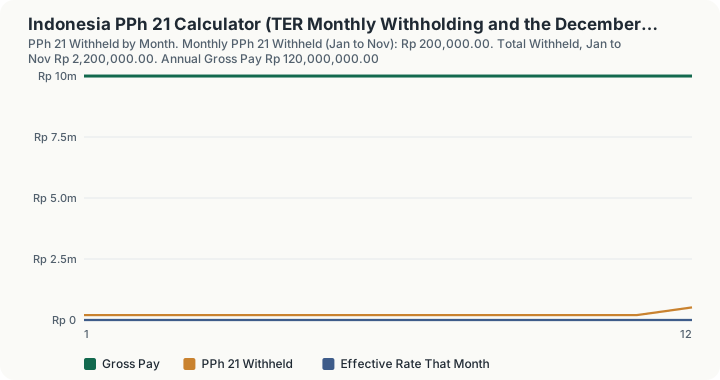
Quick Answer: An employee with PTKP status K/0 earning Rp 10,000,000 a month has Rp 200,000 of PPh 21 withheld in each month from January to November, using the 2% TER Kategori A rate. December is different: the employer recomputes the whole year under the ordinary tax ladder and withholds Rp 515,000, roughly two and a half times an ordinary month.
What does this calculator do?
Since PP 58/2023 took effect, Indonesian employers withhold PPh 21 in two entirely different ways depending on the month. For January through November they apply a Tarif Efektif Rata-rata, an average effective rate read straight off a published schedule against that month's gross pay. In the final tax period they throw that away, compute the real annual liability under the ordinary Article 17 ladder, subtract everything already withheld, and deduct the difference.
The consequence catches people out every December. The TER months use gross pay with no deductions at all: no biaya jabatan, no PTKP, no pension relief. Those reliefs have not disappeared. They are baked into the TER percentages, which is why the schedules are so finely graded. But because they only appear explicitly in the December recalculation, and because the TER schedule is deliberately calibrated to slightly under-collect, December almost always carries a larger deduction than any other month.
There are three TER schedules, assigned by PTKP status as it stood at the start of the tax year. Kategori A covers TK/0, TK/1 and K/0. Kategori B covers TK/2, TK/3, K/1 and K/2. Kategori C covers K/3 alone. They have 44, 40 and 41 bands respectively, and they are not simply shifted copies of one another: Kategori B has no 1.25% or 1.75% band at all, while Kategori C has no 2.5% band. This calculator implements all three exactly as the regulation prints them.
The default inputs reproduce the worked example in the regulation's own explanatory notes, so you can check the engine against the source directly.
How is this calculated?
The TER months, January to November. First the category is fixed from PTKP status at 1 January. Then the monthly gross is looked up on that category's schedule and the rate applied:
Monthly Withholding = Monthly Gross × TER Rate
Nothing is deducted before the rate is applied. Band boundaries read "di atas X sampai dengan Y", so the lower bound is exclusive and the upper bound inclusive: a gross of exactly Rp 5,400,000 sits in the 0% band of Kategori A, and one rupiah more does not.
The December reconciliation. The employer computes the year properly:
Net Income = (Monthly Gross × 12) − Biaya Jabatan − Pension Contributions
where biaya jabatan is 5% of annual gross capped at Rp 6,000,000. Then:
PKP = Net Income − PTKP
rounded down to a whole thousand rupiah, and the Article 17 ladder is applied to it. Finally:
December Withholding = Annual Tax − (Monthly TER Withholding × 11)
If that comes out negative, the TER months over-collected and December is a refund rather than a deduction.
This calculator assumes level monthly pay with no bonus or THR, which is why annual gross is simply twelve times the monthly figure.
Worked Example
This is the example printed in PP 58/2023's own explanatory notes. Tuan R has PTKP status K/0, earns Rp 10,000,000 a month, and pays Rp 100,000 a month into a pension fund.
Step 1: Establish the TER category from PTKP status. K/0 falls in Kategori A.
Category = A
Step 2: Look Rp 10,000,000 up on the Kategori A schedule. It falls in the band above Rp 9,650,000 and up to Rp 10,050,000.
TER rate = 2%
Step 3: Apply that rate to gross pay for each of the eleven TER months.
Rp 10,000,000 × 2% = Rp 200,000
Monthly withholding, January to November = Rp 200,000
Step 4: Total the eleven months.
Rp 200,000 × 11 = Rp 2,200,000
Withheld by the end of November = Rp 2,200,000
Step 5: Compute annual gross.
Rp 10,000,000 × 12 = Rp 120,000,000
Annual gross = Rp 120,000,000
Step 6: Deduct biaya jabatan at 5%, capped at Rp 6,000,000.
5% × Rp 120,000,000 = Rp 6,000,000
Biaya jabatan = Rp 6,000,000
Step 7: Deduct the year's pension contributions.
Rp 100,000 × 12 = Rp 1,200,000
Pension contributions = Rp 1,200,000
Step 8: Arrive at net income.
Rp 120,000,000 − Rp 6,000,000 − Rp 1,200,000 = Rp 112,800,000
Net income = Rp 112,800,000
Step 9: Subtract PTKP for status K/0.
Rp 112,800,000 − Rp 58,500,000 = Rp 54,300,000
Taxable income = Rp 54,300,000
Step 10: Apply the first band of the ladder, since this is under Rp 60,000,000.
Rp 54,300,000 × 5% = Rp 2,715,000
Annual tax = Rp 2,715,000
Step 11: Subtract what has already been withheld.
Rp 2,715,000 − Rp 2,200,000 = Rp 515,000
December withholding = Rp 515,000, which is 2.575 times an ordinary month.
Carrying The Withholding Across The Twelve Months
Step 12: Cumulative after January. Rp 200,000
Step 13: Cumulative after February. Rp 200,000 + Rp 200,000 = Rp 400,000
Step 14: Cumulative after November. Rp 200,000 x 11 = Rp 2,200,000, an effective rate of 2% every month
Step 15: December, at an effective rate of 5.15%. Rp 2,200,000 + Rp 515,000 = Rp 2,715,000
Step 16: Reconcile to the annual liability. Rp 2,715,000 from step 10 equals the running total exactly, so the TER months under-collected by Rp 515,000 across the year.
The TER schedule is a cash-flow device, not a separate tax. Eleven months at a flat 2% of gross always leaves a remainder because the annual computation subtracts biaya jabatan, pension contributions and PTKP that the monthly rate never sees. An employee who reads their December payslip as a penalty is reading a reconciliation.
What does this calculator not account for?
- Irregular pay. The model assumes the same gross every month. In reality each TER month uses that month's own gross, so a month with overtime attracts a higher TER rate on the whole amount. Annual gross would then not be twelve times any single month.
- Bonuses and THR. Religious holiday allowance and bonuses are part of gross pay in the month received, pushing that month into a higher TER band. Neither is modelled here.
- Employees who join or leave mid-year. The final tax period for a leaver is the month of departure, not December, and the annualisation differs.
- The daily TER schedule for casual and daily-paid workers, which is a separate two-row table.
- Non-permanent employees, pensioners and non-employee recipients, each of which has its own PPh 21 rules.
- Employees with more than one employer, where each employer withholds on its own payroll and the taxpayer reconciles on the annual return.
- The 20% surcharge historically applied to recipients without a tax identification number.
- Employer-borne tax (tunjangan pajak) and gross-up arrangements, which change the gross figure the TER rate applies to.
- Benefits in kind, which became taxable in the hands of employees under UU HPP and should be included in gross pay where they are.
What mistakes do people make with this?
- Deducting PTKP before applying the TER rate. The TER rate applies to gross pay. Subtracting PTKP first, then applying TER, roughly halves the correct figure for a typical earner.
- Expecting December to look like the other months. It rarely does. A December deduction several times larger than November's is the normal, correct result of the system, not a payroll error.
- Using the wrong category after a life event. Category is fixed by PTKP status at the start of the tax year. A child born in June does not move you from Kategori A to B until the following January.
- Treating the band boundary as exclusive at the top. The bands read "up to and including", so a gross exactly equal to a boundary figure sits in the lower band.
- Assuming the three schedules are the same shape. They are not. Kategori B skips the 1.25% and 1.75% steps entirely, and the 34% top band starts at a different figure in each: Rp 1,400,000,000 for A, Rp 1,405,000,000 for B and Rp 1,419,000,000 for C.
- Forgetting that pension contributions do nothing until December. They have no effect on the TER months at all, which is one of the biggest reasons the December figure surprises people.
Frequently Asked Questions
What is TER and why did Indonesia introduce it?
Which TER category am I in?
Why is my December PPh 21 so much bigger?
Can December be a refund instead?
Does the TER rate apply to my gross or net pay?
Is there a level of pay where nothing is withheld?
Sources
- Peraturan Pemerintah Nomor 58 Tahun 2023 tentang Tarif Pemotongan Pajak Penghasilan Pasal 21. peraturan.bpk.go.id/Download/332609/PP%20Nomor%2058%20Tahun%202023.pdf (read 31 August 2026). Source for the category assignment in Pasal 2 ayat (4), for all three TER schedules in the Lampiran, and for the worked example in the Penjelasan reproduced above.
- Undang-Undang Nomor 7 Tahun 2021 tentang Harmonisasi Peraturan Perpajakan, Pasal 3 angka 2, amending Article 17 of the Income Tax Law, used for the December recalculation. peraturan.bpk.go.id/Download/178620/UU%20Nomor%207%20Tahun%202021.pdf (read 31 August 2026).
- Peraturan Menteri Keuangan Nomor 250/PMK.03/2008, via pajak.go.id/en/node/61792 (read 31 August 2026), for biaya jabatan at 5% of gross capped at Rp 6,000,000 a year.
Also consulted: Peraturan Menteri Keuangan Nomor 101/PMK.010/2016, Pasal 1, for the PTKP amounts used in the December recalculation.