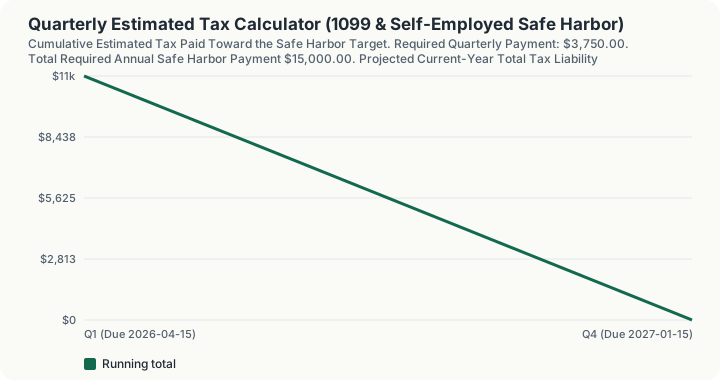
Quick Answer: A single filer with $100,000.00 in projected 2026 net self-employment income and $15,000.00 in prior-year tax (on a $90,000.00 prior-year AGI) owes a required annual safe-harbor payment of $15,000.00, paid in four $3,750.00 installments due April 15, June 15, September 15, 2026, and January 15, 2027.
Overview
Employees have taxes withheld from every paycheck automatically. Self-employed and 1099 workers do not, which means the IRS expects them to estimate and pay their own tax liability four times a year through Form 1040-ES. Miss those payments, or underpay them by enough, and the IRS charges an underpayment penalty, calculated as if it were interest on the shortfall, even if the full balance is paid by the April filing deadline.
The IRS "safe harbor" rule exists to make that estimate forgiving: as long as you pay in enough during the year, through withholding, estimated payments, or both, to satisfy one of two thresholds, no penalty applies regardless of how much you ultimately owe at filing. This calculator computes both thresholds, tells you which one is lower (and therefore which one to target), and splits the result into the four quarterly payments with their 2026 due dates.
Because self-employment income has no employer withholding it, this calculator computes your projected total tax liability starting from scratch: Schedule SE self-employment tax on your net profit, plus federal income tax on your total taxable income (net self-employment profit plus other income, minus the 50% above-the-line SE tax deduction and your standard/itemized deductions).
How This Is Calculated
- Self-employment tax. Computed via this platform's Schedule SE primitive: 92.35% of net self-employment profit forms the SE-taxable base, then 12.4% Social Security (up to the annual wage base) and 2.9% Medicare (uncapped, plus 0.9% Additional Medicare above the filing-status threshold) apply to that base.
- Income tax. Total income (net self-employment profit plus other income) minus the 50%-of-SE-tax above-the-line deduction, minus the standard deduction (or itemized, if you enter more), run through this platform's progressive-bracket federal tax engine.
- Two safe harbor thresholds.
- Required payment. The safe harbor is the LESSER of the two thresholds; paying at least that amount over the year through withholding and estimated payments avoids the underpayment penalty entirely.
- Quarterly installments. The required annual amount is split into four equal payments, due on the IRS's 2026 Form 1040-ES schedule.
Worked Example
Using the calculator's default inputs:
- Projected Net Self-Employment Income: $100,000.00
- Filing Status: Single
- Prior-Year Tax Liability: $15,000.00
- Prior-Year AGI: $90,000.00
Step by step:
- Schedule SE: taxable SE earnings = $100,000 × 92.35% = $92,350.00. Social Security: $92,350 × 12.4% = $11,451.40. Medicare: $92,350 × 2.9% = $2,678.15. Total SE tax = $14,129.55. 50% deductible for AGI = $7,064.78.
- Income tax base: $100,000 − $7,064.78 = $92,935.22. Minus the 2026 single standard deduction of $16,100: taxable income = $76,835.22, landing in the 22% bracket.
- Federal income tax = $12,400 × 10% + $38,000 × 12% + $26,435.22 × 22% = $1,240.00 + $4,560.00 + $5,815.75 = $11,615.75.
- Current-year total tax liability = $11,615.75 + $14,129.55 = $25,745.30.
- Threshold 1 (90% of current year) = $25,745.30 × 90% = $23,170.77.
- Threshold 2 (100% of prior year, since $90,000 AGI is under $150,000) = $15,000.00 × 100% = $15,000.00.
- The lesser of the two is $15,000.00, so the required annual safe harbor payment is $15,000.00, split into four installments of $3,750.00 each.
Carrying the Safe Harbor Across the Four Due Dates
- Q1, due 15 April 2026: pay $3,750.00. Cumulative $3,750.00, remaining safe harbor obligation $11,250.00.
- Q2, due 15 June 2026: pay $3,750.00. Cumulative $7,500.00, remaining $7,500.00. Note the gap is two months, not three.
- Q3, due 15 September 2026: cumulative $11,250.00, remaining $3,750.00.
- Q4, due 15 January 2027: cumulative $15,000.00, remaining $0.00. The safe harbor is satisfied in the following calendar year.
The four installments discharge the penalty exposure, not the tax. The actual liability is $25,745.30, so after the fourth payment there is still $10,745.30 to settle with the return in April 2027, penalty-free but very much owed. Budgeting only the $15,000 is the most common way this calculation goes wrong in practice.
2026 Quarterly Due Dates
| Quarter | Period Covered | Due Date |
|---|---|---|
| Q1 | January 1 - March 31 | April 15, 2026 |
| Q2 | April 1 - May 31 | June 15, 2026 |
| Q3 | June 1 - August 31 | September 15, 2026 |
| Q4 | September 1 - December 31 | January 15, 2027 |
Note that the IRS payment periods are not equal three-month quarters: Q2 covers only two months and Q4 covers four. If a due date fell on a weekend or federal holiday it would shift to the next business day; none of the 2026 dates above require that adjustment. The Q4 payment can be skipped if you file your full return and pay any remaining balance by February 1, 2027.
Why Prior-Year AGI Determines 100% vs. 110%
Congress built a specific guardrail against high earners gaming the prior-year safe harbor: since the prior-year threshold uses a known, fixed number from last year's return regardless of how much current-year income spikes, someone with a big one-time income jump could otherwise lock in a tiny safe harbor payment. Once prior-year AGI exceeds $150,000 ($75,000 for married filing separately), the required prior-year percentage rises to 110%, closing most of that gap while still offering a predictable, income-spike-proof number to plan around.
What This Does Not Account For
- The annualized income installment method. Business owners with sharply uneven quarterly income (a seasonal business, for example) can use IRS Form 2210 Schedule AI to pay unequal, income-matched quarterly installments instead of four equal payments. This calculator always splits the required amount evenly across four quarters.
- Withholding from a W-2 job. If you also have W-2 income with its own withholding, that withholding counts toward your safe harbor total and can reduce or eliminate the need for estimated payments; this calculator does not net out withholding, so if you have any, treat the payment amounts shown here as an upper bound.
- State estimated tax requirements. Most states with an income tax impose their own separate quarterly estimated payment system with different thresholds and due dates; this calculator covers federal safe harbor only.
- Mid-year income changes. This calculator assumes a single, stable full-year income projection entered up front. If your actual income shifts significantly partway through the year, recompute with updated figures and adjust remaining quarterly payments accordingly.
- The Additional Net Investment Income Tax (NIIT). The 3.8% NIIT on investment income above statutory thresholds is not included in this calculator's tax liability estimate.
Common Pitfalls
- Assuming safe harbor payments equal your true tax bill. Safe harbor payments are a penalty-avoidance floor, not necessarily your exact liability; if your income comes in higher than projected, you may still owe a larger balance at filing even after making all four safe harbor payments correctly.
- Missing a due date entirely. Even one missed or late quarterly payment can trigger a penalty for that specific period, calculated separately, even if the other three quarters were paid on time and in full.
- Forgetting that "prior year" means the return you actually filed. The 100%/110% threshold is based on your actual prior-year tax liability and AGI as filed, not an estimate; use the figures from your actual prior-year return.
- Not adjusting after a big income year. If last year's income spiked, this year's 110% prior-year safe harbor payment can be substantial; compare it against 90% of your realistic current-year estimate, since the calculator (and the IRS rule) always lets you pay the lesser of the two.
- Ignoring state-level estimated tax deadlines, which frequently do not match the federal schedule exactly.
Frequently Asked Questions
What happens if I don't pay enough during the year?
Can I just pay 100% of my prior year's tax and call it done?
Do I have to pay exactly four equal installments?
What if I have no prior-year tax liability at all?
Does self-employment tax count toward my safe harbor requirement?
Sources
- Internal Revenue Service: Publication 505, Tax Withholding and Estimated Tax. irs.gov/publications/p505
- Internal Revenue Service: Form 1040-ES (2026), Estimated Tax for Individuals. irs.gov
Also consulted: Internal Revenue Service: Instructions for Form 2210, Underpayment of Estimated Tax by Individuals, Estates, and Trusts; Internal Revenue Service: Revenue Procedure 2025-32, 2026 federal income tax brackets and standard deduction amounts.