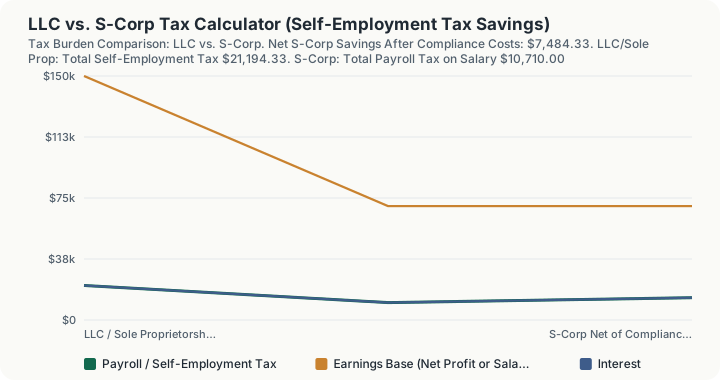
Quick Answer: A single-member business with $150,000.00 in net profit and a $70,000.00 reasonable S-Corp salary saves $10,484.33 in raw payroll/self-employment tax by electing S-Corp status, or $7,484.33 after a $3,000.00 estimated compliance cost offset for payroll processing and a separate corporate return.
Overview
A default LLC (taxed as a sole proprietorship, or a partnership with multiple members) runs its entire net profit through self-employment tax: 15.3% (on a 92.35% statutory base) for Social Security and Medicare combined. An S-Corp election changes that math. The owner becomes a W-2 employee of their own company, drawing a "reasonable salary" that is subject to standard payroll FICA, while the remaining profit is paid out as a distribution that is not subject to self-employment tax or FICA at all.
That structural difference is the entire basis of the LLC-vs-S-Corp tax planning conversation: shrinking the base subject to the 15.3% combined SE/FICA rate by converting part of it into a distribution. This calculator quantifies exactly how much that's worth for a specific profit and salary combination, and nets it against a compliance cost offset you supply, since an S-Corp is not free to operate.
Importantly, the salary cannot be set arbitrarily low to maximize the distribution. The IRS requires S-Corp owner-employees to pay themselves "reasonable compensation" for the work they actually perform, and aggressively low salaries are a well-documented audit target. This calculator does not determine what a reasonable salary is for your situation; it takes the salary figure you enter as a given and shows the tax consequence of that specific split.
How This Is Calculated
- LLC/sole proprietorship path. The entire net profit runs through Schedule SE self-employment tax via this platform's shared payroll primitive.
- S-Corp path. Only the reasonable salary is run through standard W-2 payroll FICA, both the employee and employer halves, since as the business owner you ultimately bear both. The remainder is a distribution with $0 SE tax or FICA exposure.
- Raw savings. The difference between the two paths' tax burden, before any compliance cost is considered.
- Net savings. Raw savings minus the compliance cost offset you enter, covering the extra payroll processing, bookkeeping, and separate Form 1120-S corporate return an S-Corp requires that a default LLC does not.
Worked Example
Using the calculator's default inputs:
- Net Business Profit: $150,000.00
- Reasonable S-Corp Salary: $70,000.00
- Filing Status: Single
- Compliance Cost Offset: $3,000.00
Step by step:
- LLC path: SE-taxable earnings = $150,000 × 92.35% = $138,525.00. Social Security (12.4%, under the wage base): $138,525 × 12.4% = $17,177.10. Medicare (2.9%, uncapped): $138,525 × 2.9% = $4,017.23. Total LLC self-employment tax = $21,194.33.
- S-Corp path: $70,000.00 salary through standard payroll FICA. Employee side: $70,000 × 6.2% + $70,000 × 1.45% = $4,340.00 + $1,015.00 = $5,355.00. Employer side matches: $5,355.00. Total S-Corp payroll tax = $10,710.00.
- Distribution: $150,000.00 − $70,000.00 = $80,000.00, carrying no SE tax or FICA at all.
- Raw savings: $21,194.33 − $10,710.00 = $10,484.33.
- Net savings after compliance costs: $10,484.33 − $3,000.00 = $7,484.33, still clearly favoring the S-Corp election in this scenario.
Why the Salary Level Matters So Much
The savings mechanism only exists on the distribution portion, so a higher reasonable salary directly shrinks the savings, and can even eliminate them. If the entire net profit were paid as salary (reasonable salary equal to net profit), the S-Corp path can actually cost slightly MORE than the LLC path: the LLC's Schedule SE base is only 92.35% of profit, while S-Corp payroll tax runs at the full 15.3% combined rate on 100% of a salary that equals total profit, with no discount. The calculator's "$60,000 profit, $60,000 salary" scenario illustrates exactly this reversal. S-Corp savings require genuine separation between a reasonable salary and a meaningful remaining distribution.
What This Does Not Account For
- What counts as a "reasonable" salary. The IRS looks at comparable W-2 compensation for similar work in your industry and region; this calculator takes your entered salary figure as a given rather than validating it. Setting an artificially low salary to maximize paper savings is a well-established audit risk and can result in the IRS recharacterizing distributions as wages, with back payroll taxes and penalties.
- State-level entity taxes. Several states impose separate franchise taxes, minimum LLC/corporate fees, or S-Corp-specific taxes (California's 1.5% S-Corp franchise tax, for example) that are not modeled here and can offset some or all of the federal SE tax savings.
- The Qualified Business Income (QBI) deduction. Section 199A's 20% QBI deduction interacts differently with S-Corp wages (which reduce QBI) versus LLC self-employment income, and can meaningfully change the after-tax comparison depending on total income and business type; this calculator does not model QBI.
- Payroll administration costs beyond the offset you enter. The compliance cost offset is a single number you supply; actual costs (payroll software, a bookkeeper, a CPA-prepared Form 1120-S, state unemployment insurance registration) vary widely and are worth pricing out specifically for your situation before deciding.
- Retirement plan contribution limits. Solo 401(k) and SEP-IRA contribution limits are calculated differently for W-2 salary versus self-employment income, which can materially affect total retirement savings capacity under each structure.
Common Pitfalls
- Assuming S-Corp savings scale linearly with profit. As shown above, the savings depend entirely on the gap between profit and reasonable salary, not on profit alone; a business with thin margins that must pay out most profit as salary sees little or no benefit.
- Ignoring compliance costs until after electing S-Corp status. Payroll processing, workers' comp, state registration, and a separate tax return add real recurring costs; compare the net savings figure, not the raw savings figure, before deciding.
- Setting salary too low. This is the single most common S-Corp compliance mistake and the primary IRS audit trigger for S-Corps; "reasonable compensation" is a legal requirement, not a tax-optimization dial.
- Forgetting the S-Corp election deadline. Form 2553 generally must be filed within 2 months and 15 days of the start of the tax year for the election to apply to that year; missing the window pushes the election to the following year.
- Not revisiting the salary/distribution split as profit changes. A salary that was reasonable and tax-efficient at $150,000 in profit may need to be reassessed if profit grows or shrinks significantly.
Frequently Asked Questions
Is an S-Corp always better than a default LLC?
Do I need a lawyer or accountant to make this decision?
What is a "reasonable salary" in dollar terms?
Does this calculator account for the Qualified Business Income deduction?
What happens to the distribution if the business has a loss?
Sources
- Internal Revenue Service: Form 2553, Election by a Small Business Corporation. irs.gov
- Internal Revenue Service: Publication 535, Business Expenses (self-employment tax and reasonable compensation background). irs.gov/publications/p535
Also consulted: Internal Revenue Service: Instructions for Form 1120-S, U.S. Income Tax Return for an S Corporation; Internal Revenue Service: Fact Sheet, Wage Compensation for S Corporation Officers.