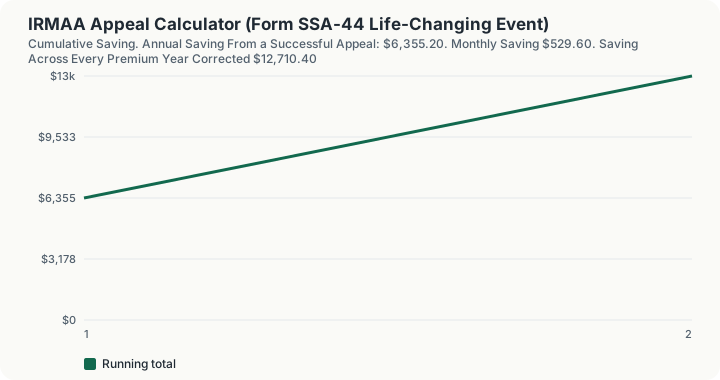
Quick Answer: A retiree whose premium is priced off $210,000 of MAGI from their last working year, but who now lives on $95,000, saves $6,355.20 a year with a successful Form SSA-44. That is a drop of four IRMAA brackets, from $732.50 a month to $202.90, and across the two premium years the correction covers it is worth $12,710.40.
What does this calculator do?
Medicare's income-related monthly adjustment amount is set from the tax return filed two years before the premium year. Your 2026 premium comes from your 2024 return. For someone still working, that is a reasonable proxy. For someone who has just retired, it is close to the worst possible measure: the year that prices your Medicare premium is usually your last full year of work, the highest-income year of your life, billed to you after the income has stopped.
Form SSA-44 is the mechanism for asking SSA to use a more recent year instead. It is not a general appeal right, and this is the single most important thing to understand before filing. SSA will make a new initial determination only where the income reduction was caused by one of eight enumerated life-changing events set out in POMS HI 01120.005: death of spouse, marriage, divorce or annulment, work reduction, work stoppage, loss of income-producing property, loss of employer pension, or receipt of a settlement payment from a current or former employer. The list is exclusive. A fall in income caused by anything else (a bad year in the market, lower dividends, a business downturn, selling a rental at a loss) is not a basis for a new initial determination, however large the drop.
There is a second condition that has nothing to do with eligibility. Because the schedule is a step function, a reduction that does not cross a bracket threshold buys nothing at all, even with a perfectly valid qualifying event.
How is this calculated?
The saving is the difference between two household premium calculations, and it is zero unless a qualifying event applies:
Annual Saving = max(0, Household (Look-back MAGI) − Household (Post-Event MAGI))
Step 1: Price the premium on the income SSA is currently using. $210,000 of single MAGI falls above the $205,000 threshold, in tier 5 of six. Part B: $202.90 standard + $446.30 surcharge = $649.20 a month Part D surcharge: $83.30 a month $649.20 + $83.30 = $732.50 a month per enrollee
Step 2: Annualise it for the household. $732.50 x 12 x 1 enrollee = $8,790.00 a year
Step 3: Price the premium on the post-event income. $95,000 of single MAGI sits below the $109,000 first threshold, in tier 1, where both surcharges are zero. $202.90 + $0.00 = $202.90 a month per enrollee
Step 4: Annualise that. $202.90 x 12 x 1 = $2,434.80 a year
Step 5: Confirm a qualifying event applies. Without one, SSA substitutes nothing and the appealed figure is set equal to the current figure, making the saving zero. At the defaults, work stoppage applies. Eligible
Step 6: Difference the two annual household figures. This is the headline. $8,790.00 - $2,434.80 = $6,355.20 a year
Step 7: Express it monthly. $6,355.20 / 12 = $529.60 a month
Step 8: Count the brackets dropped. Tier 5 - Tier 1 = 4 brackets
Step 9: Multiply by the premium years the correction covers. $6,355.20 x 2 = $12,710.40
Worked Example
A single filer retired last year. Her final full working year showed $210,000 of MAGI, and that is the return SSA is using to price her 2026 Medicare premium. Her actual income now is $95,000 from a pension and modest portfolio income. She files Form SSA-44 citing work stoppage.
Step 1: What she is being charged. Tier 5: $732.50 a month across the Part B premium and the Part D surcharge, or $8,790.00 a year.
Step 2: What she should be charged. At $95,000 she belongs in tier 1: $202.90 a month, or $2,434.80 a year.
Step 3: The annual saving. $8,790.00 - $2,434.80 = $6,355.20.
Step 4: The monthly saving. $529.60, which for most retirees is a materially larger number than they expect from a single form.
Step 5: How many years it corrects. A retirement that drops income permanently usually corrects more than one premium year before the tax data catches up on its own. Over two years the form is worth $12,710.40.
Two variations show where the value disappears. First, if the income fell for a reason not on SSA's list (a portfolio loss, or lower dividends) SSA will not substitute a more recent year, the higher premium stands, and the saving is zero. Second, a drop from $400,000 to $260,000 is a $140,000 reduction and buys absolutely nothing, because both figures sit in the same top bracket. A step function pays nothing for a fall that crosses no threshold.
Working in the other direction, a married couple with both spouses enrolled is worth appealing twice over: both are surcharged separately off the same joint return, so a successful SSA-44 is worth double.
What does this calculator not account for?
- Whether SSA will accept your evidence. The calculator assumes the event you assert is genuine and documented. SSA requires supporting evidence and will make its own determination.
- The timing of the refund. Premiums already paid at the higher rate are adjusted, but the mechanics and timing of the correction are handled by SSA and are not modelled.
- Your Part D plan premium. Only the Part D IRMAA surcharge is priced. The drug plan's own premium is set by the insurer.
- Whether more than one event applies, or how SSA treats successive events in consecutive years.
- How many premium years will actually be corrected. You enter that number. In practice it depends on when the event happened and when the tax data catches up.
- Appeals of the underlying tax data, such as a corrected or amended return, which is a separate SSA process from an SSA-44 life-changing event request.
What mistakes do people make with this?
- Treating SSA-44 as a general appeal. It is not. The eight events are exclusive, and an application citing anything else will fail regardless of how large the income drop was.
- Assuming any income drop is worth appealing. If both incomes land in the same bracket, the saving is exactly zero. Check the bracket, not the size of the drop.
- Waiting for SSA to notice. SSA prices your premium from tax data automatically and will not initiate a life-changing-event determination on your behalf. The form has to be filed.
- Filing without documentation. SSA asks for evidence of the event, such as a letter from an employer confirming the work stoppage or reduction, or a death certificate or decree.
- Forgetting the second spouse. In a couple where both are enrolled, both are surcharged off the same joint return, and both premiums are corrected. The saving is doubled.
- Missing that "work reduction" and "work stoppage" are separate events. Cutting back to part-time counts, not only stopping entirely.
Frequently Asked Questions
What are the eight SSA-44 life-changing events?
Can I appeal IRMAA just because my income went down?
How much is a successful IRMAA appeal worth?
Do I file SSA-44 before or after I retire?
Does a couple get double the saving?
Why am I paying a surcharge on income I no longer earn?
Sources
- Social Security Administration POMS HI 01120.005, Life Changing Events: the exclusive list of eight events for which SSA will make a new initial determination using a more recent tax year. secure.ssa.gov/poms.nsf/lnx/0601120005
- Centers for Medicare and Medicaid Services, 2026 Medicare Parts A and B premiums and deductibles fact sheet: the $202.90 standard Part B premium and the six-tier IRMAA schedule with its Part B and Part D surcharges, carried in engine/tables/2026/irmaa.json. cms.gov/newsroom/fact-sheets/2026-medicare-parts-b-premiums-deductibles