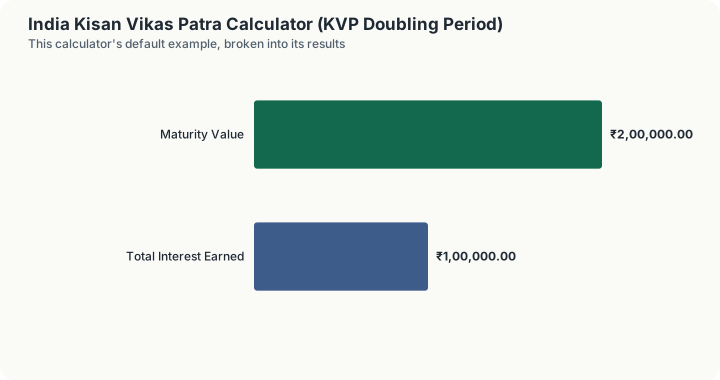
Quick Answer: A Kisan Vikas Patra (KVP) investment of ₹1,00,000, at the currently notified doubling period of 115 months (9 years, 7 months), guarantees exactly ₹2,00,000 at maturity -- your money doubling by design, not by a rate you have to calculate yourself.
Overview
This calculator is built specifically for India's Kisan Vikas Patra (KVP), a government-backed, fixed-tenure savings certificate offered through India Post, and every figure is shown in Indian Rupees (₹). It is not a generic compound-interest calculator for another country's savings bond. KVP is unusual among Indian small savings schemes in how it is marketed and notified: rather than publishing a bare interest rate and letting you compute maturity yourself, the Ministry of Finance directly notifies a doubling period -- currently 115 months (9 years and 7 months) for Q2 FY 2026-27 -- meaning your investment is guaranteed to exactly double if held for that full period, corresponding to an implied annual compounding rate of about 7.5%.
There is no maximum investment limit in KVP, unlike PPF or SSY, making it attractive for larger lump-sum deployments, though it comes with no Section 80C tax deduction and fully taxable interest -- a materially different tax profile from PPF or SSY's EEE treatment.
How This Is Calculated
Because KVP is notified as a doubling period rather than a bare rate, this calculator computes maturity directly from that period:
Maturity Value = Principal × 2^(Holding Period in Months ÷ Doubling Period in Months)
Held for exactly the notified doubling period, this formula correctly returns exactly double the principal. Held for a shorter or longer period, it interpolates (or extrapolates) using the same exponential relationship -- for example, holding for two full doubling periods quadruples the investment, since 2^(230/115) = 2² = 4.
For reference, this calculator also derives the implied annual compounding rate behind the doubling period: Implied Annual Rate = 2^(12 ÷ Doubling Period in Months) − 1, which comes out to approximately 7.5% for the current 115-month doubling period -- matching the separately-notified 7.5% p.a. rate almost exactly (the small residual difference exists because 115 months isn't an exact multiple of 12).
KVP cannot be encashed before a minimum lock-in of 30 months (2.5 years) from the date of investment, except in specific circumstances (death of the holder, forfeiture by a gazetted officer, or a court order). This calculator enforces that floor on the holding period input.
Worked Example
KVP is quoted as a doubling period rather than a rate, so the interesting arithmetic is what a partial holding is actually worth. Start with ₹1,00,000 invested at the current 115-month notified doubling period.
Step 1 -- The exponent for a full term. 115 / 115 = 1
Step 2 -- Maturity at the full doubling period. ₹1,00,000 × 2^1 = ₹2,00,000 Interest earned: ₹2,00,000 - ₹1,00,000 = ₹1,00,000
Step 3 -- The implied annual rate behind that period. 2^(12 / 115) - 1 = 7.5008%
Step 4 -- The earliest permitted encashment, 30 months. Exponent: 30 / 115 = 0.2609 Value: ₹1,00,000 × 2^0.2609 = ₹1,19,820.07 Interest: ₹19,820.07
Step 5 -- Compare that against a straight-line assumption. A linear reading would give 30/115 of the ₹1,00,000 gain, or ₹26,087. The actual ₹19,820.07 is ₹6,266.93 lower, because growth is exponential in time and the early months carry the smallest balances.
Step 6 -- Five years in, at 60 months. Exponent: 60 / 115 = 0.5217 Value: ₹1,00,000 × 2^0.5217 = ₹1,43,568.49 Interest: ₹43,568.49
The gap between month 30 and month 60 is worth noticing: the second thirty months add ₹23,748.42 of interest against the first thirty months' ₹19,820.07, on an identical elapsed period. That is the whole reason KVP rewards holding to term rather than encashing at the first legal opportunity.
Step 7 -- Two full doubling periods, 230 months. Exponent: 230 / 115 = 2 Value: ₹1,00,000 × 2^2 = ₹4,00,000 Interest: ₹3,00,000
Nineteen years and two months turns ₹1,00,000 into ₹4,00,000, and the second doubling period alone contributes ₹2,00,000 of that against the first period's ₹1,00,000. The doubling framing makes the compounding unusually easy to reason about: every 115 months multiplies the certificate by two, whatever it happens to be worth at the time.
What This Does Not Account For
- Premature encashment rate tables. India Post publishes a specific table of reduced encashment values for withdrawal between the 30-month lock-in and the full doubling period, rather than the smooth exponential curve this calculator uses for partial periods; this calculator's partial-period figures are a reasonable mathematical approximation but may not match India Post's exact published early-encashment table to the rupee.
- Tax on interest. KVP interest is fully taxable as income in the year it's deemed to accrue (or on receipt, depending on your accounting method), with no Section 80C benefit on either the investment or the interest; this calculator does not compute your personal tax liability.
- Doubling-period changes mid-holding. The doubling period notified at the time of your investment is what applies to your certificate for its full term; this calculator assumes a single doubling period throughout, which matches how KVP actually works once purchased (your certificate locks in the doubling period in force at purchase).
- Nomination and transferability. KVP certificates can be transferred between individuals and post offices under specific rules, and support nomination; not modeled here.
- TDS. Unlike SCSS or bank fixed deposits, KVP typically does not have TDS deducted at the post office level, but the interest remains fully taxable in your hands -- this calculator does not model your resulting tax liability.
Common Pitfalls
- Assuming the doubling period is a simple, fixed percentage rate. The 115-month doubling period corresponds to roughly 7.5% p.a. compounded annually -- but the Ministry of Finance notifies the doubling period directly, which is what actually governs your certificate's maturity value, not a separately-computed rate.
- Expecting linear interpolation for partial periods. Withdrawing at half the doubling period does not return 1.5× your principal -- compounding is exponential, so at exactly half the doubling period (57.5 months), the value is only about 1.41× principal (the square root of 2), not 1.5×.
- Overlooking the lack of any tax deduction. Unlike PPF, SSY, or the 5-year Post Office Time Deposit, KVP offers no Section 80C benefit on the amount invested -- a common assumption that trips up first-time investors comparing schemes.
- Missing the 30-month lock-in. KVP cannot be encashed before 30 months under normal circumstances; treating it as a fully liquid instrument before that point is a mistake.
- Confusing the notified doubling period across different purchase dates. If you hold multiple KVP certificates purchased at different times, each one locks in the doubling period notified at ITS purchase date -- a certificate bought when the doubling period was longer (lower implied rate) does not benefit from a shorter period notified later.
Frequently Asked Questions
How long does it take for Kisan Vikas Patra to double my money?
Is there a maximum investment limit for KVP?
Is KVP interest taxable?
Can I withdraw my KVP investment early?
What is the current KVP interest rate and doubling period?
Sources
- Income Tax Department, Government of India, the official authority for the national tax authority this calculator relates to. incometax.gov.in/iec/foportal
Also consulted: National Savings Institute, nsiindia.gov.in, Kisan Vikas Patra scheme page -- doubling period, minimum investment, no maximum limit, 30-month lock-in, fetched directly; Dept. of Economic Affairs, Ministry of Finance, Office Memorandum F.No.1/4/2019-NS (dated 2026-06-30) -- Q2 FY 2026-27 (1 July - 30 September 2026) small savings interest rate notification, confirming the 115-month doubling period at 7.5% p.a.