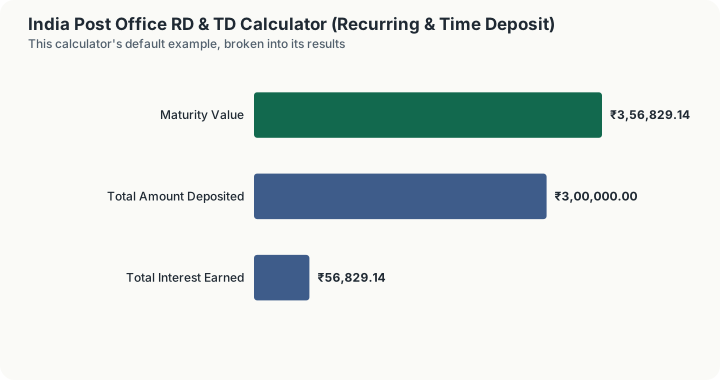
Quick Answer: A Post Office Recurring Deposit (RD) of ₹5,000/month at the current 6.7% p.a. rate matures to approximately ₹3,56,829 after the standard 5-year (60-month) tenure, from ₹3,00,000 in deposits. A one-time Time Deposit (TD) of ₹1,00,000 for 5 years at the current 7.5% p.a. rate (quarterly compounded) matures to approximately ₹1,44,995.
Overview
This calculator is built specifically for India Post's Recurring Deposit (RD) and Time Deposit (TD) schemes, and every figure is shown in Indian Rupees (₹). It is not a US CD or savings-bond calculator. Both are government-backed, fixed-rate deposit products offered through post offices (and, for TD, many banks under similarly structured schemes) -- RD for building savings through monthly installments, TD for a one-time lump-sum deposit, similar in spirit to a fixed deposit or CD but government-guaranteed through India Post.
Both products use quarterly compounding, but only TD is a single-deposit product where quarterly compounding is straightforward to model. RD is a monthly-deposit product where India Post applies a specific published maturity formula that accounts for each month's deposit compounding at a quarterly rate for a fractional number of periods -- a formula this calculator implements directly, since a naive "simple compound interest" approximation would understate real RD maturity values.
How This Is Calculated
Recurring Deposit (RD). India Post's own published RD maturity formula is:
Maturity Value = R × [(1 + i)ⁿ − 1] ÷ [1 − (1 + i)^(−1/3)]
where R is the monthly deposit, i is the quarterly interest rate (annual rate ÷ 4), and n is the number of quarters (tenure in months ÷ 3). This formula -- used by India Post's own online RD calculator and every major bank's RD calculator -- correctly accounts for monthly deposits compounding at a quarterly-credited rate, which a simple "monthly deposit × months × rate" approximation would get wrong.
Time Deposit (TD). A standard one-time lump-sum deposit compounding quarterly and paid annually:
Maturity Value = Principal × (1 + Annual Rate ÷ 4)^(Number of Quarters)
TD is offered across four tenures -- 1, 2, 3, and 5 years -- each with its own notified rate; only the 5-year TD qualifies for a Section 80C tax deduction on the deposit.
Worked Example
The two products behave very differently as the tenure lengthens, so it is worth walking a recurring deposit first and then the same money in a time deposit.
Recurring Deposit: ₹5,000 a month at 6.7% p.a.
Step 1 -- The quarterly rate. 6.7% / 4 = 1.675% per quarter
Step 2 -- One year, 12 months / 4 quarters. Deposited: ₹5,000 × 12 = ₹60,000 Maturity value: ₹62,210.16 Interest: ₹2,210.16
Step 3 -- Two years, 24 months. Deposited: ₹1,20,000 Maturity value: ₹1,28,694.30 Interest: ₹8,694.30
Year 2 contributes ₹6,484.14 of interest against year 1's ₹2,210.16 on identical deposits, because in year 2 the whole of year 1's balance is earning for the full period rather than accumulating from zero.
Step 4 -- Three years, 36 months. Deposited: ₹1,80,000 Maturity value: ₹1,99,746.04 Interest: ₹19,746.04
Step 5 -- The standard 5-year tenure, 60 months / 20 quarters. Deposited: ₹5,000 × 60 = ₹3,00,000 Maturity value: ₹3,56,829.14 Interest: ₹56,829.14
The last two years of the RD produce ₹37,083.10 of the ₹56,829.14 total interest. An RD closed early is not simply "the same deal, shorter"; it forfeits the years where the accumulated balance is doing the most work.
Time Deposit: ₹1,00,000 lump sum
Step 6 -- The 5-year TD rate and quarterly rate. 7.5% p.a., so 7.5 / 4 = 1.875% per quarter
Step 7 -- Maturity after 5 years, 20 quarters. ₹1,00,000 × (1.01875)^20 = ₹1,44,994.80 Interest: ₹44,994.80
Step 8 -- The same ₹1,00,000 at each shorter tenure. 1 year at 6.9%: ₹1,07,080.60 (interest ₹7,080.60) 2 years at 7.0%: ₹1,14,888.18 (interest ₹14,888.18) 3 years at 7.1%: ₹1,23,507.50 (interest ₹23,507.50)
Step 9 -- What the extra tenure is worth. 5-year TD interest: ₹44,994.80 One-year TD interest taken five times over, without reinvesting: 5 × ₹7,080.60 = ₹35,403.00 Difference: ₹9,591.80 on the same ₹1,00,000
Two things separate the tenures. The notified rate itself climbs from 6.9% to 7.5% as the term lengthens, and only the 5-year TD attracts a Section 80C deduction on the original deposit. Against that, the shorter tenures leave you free to redeploy at whatever rate is notified next quarter, which is worth something in a rising-rate quarter and nothing in a falling one.
What This Does Not Account For
- Premature closure. Both RD and TD permit premature withdrawal under specific conditions (RD generally after 3 years, at the Post Office Savings Account rate; TD with a rate reduction depending on how early the closure happens); this calculator only models the full-tenure maturity scenario.
- RD extension. A standard 5-year RD can typically be extended for a further period with or without continued deposits; not modeled here.
- Rate changes mid-tenure. Once opened, an RD or TD account generally locks in the rate in force at account opening for that tenure; this calculator assumes the entered rate applies for the full period, which matches reality for an account opened today, but a rate you enter for a hypothetical future scenario would need updating against the actual notified rate at that time.
- Tax on interest. RD interest is fully taxable as income, with TDS potentially applicable; 5-year TD interest is also taxable (only the deposit itself, not the interest, benefits from Section 80C), and this calculator does not model your personal tax liability on the interest earned.
- Monthly deposit timing/defaults. The RD formula assumes disciplined, on-time monthly deposits for the full tenure; missed installments in reality typically incur a small default penalty and can affect the actual maturity value.
Common Pitfalls
- Applying simple interest logic to an RD. RD maturity is meaningfully higher than "monthly deposit × months × average rate" would suggest, because of the specific quarterly-compounding formula India Post actually uses -- always use the official formula, not a rough approximation.
- Assuming all TD tenures earn the same rate. India Post notifies a separate rate for each of the four TD tenures (1, 2, 3, and 5 years), and they are not the same -- the 5-year TD typically (though not always) offers the highest rate among the four.
- Forgetting only the 5-year TD gets the 80C deduction. Depositing into a 1, 2, or 3-year TD expecting a tax deduction is a common and costly mistake -- only the 5-year tenure qualifies.
- Confusing RD with a SIP or mutual fund. RD is a fixed-rate, government-guaranteed deposit product with no market risk and no potential for higher-than-notified returns, unlike a market-linked SIP.
- Overlooking TDS on interest. Interest from both RD and TD is taxable, and banks/post offices may deduct TDS if your interest income crosses the applicable threshold -- factor this into your actual take-home return expectations.
Frequently Asked Questions
What is the maturity value of a Post Office RD?
What are the current Post Office Time Deposit rates?
Which is better for tax purposes, RD or TD?
Can I withdraw my RD or TD before maturity?
Is the RD maturity formula the same as simple compound interest?
Sources
- Income Tax Department, Government of India, the official authority for the national tax authority this calculator relates to. incometax.gov.in/iec/foportal
Also consulted: National Savings Institute, nsiindia.gov.in -- Recurring Deposit scheme page (rate, tenure, minimum deposit, premature closure rules) and Time Deposit scheme page (rates by tenure, minimum deposit, Section 80C eligibility for the 5-year tenure); Dept. of Economic Affairs, Ministry of Finance, Office Memorandum F.No.1/4/2019-NS (dated 2026-06-30) -- Q2 FY 2026-27 (1 July - 30 September 2026) small savings interest rate notification; India Post's official Recurring Deposit maturity formula: A = R × [(1+i)ⁿ−1] ÷ [1−(1+i)^(−1/3)], the formula published and used by India Post's own RD calculator and standard across the banking industry.