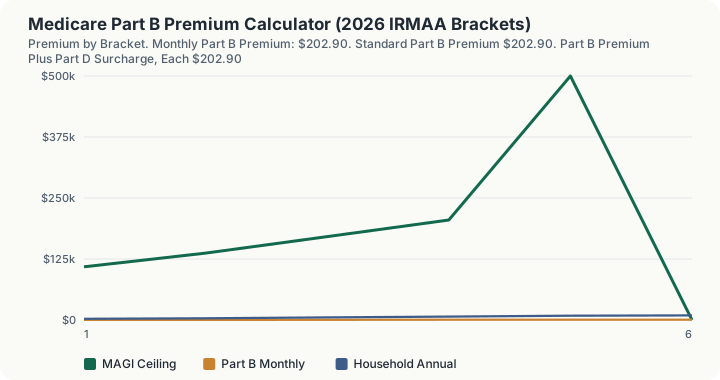
Quick Answer: $108,000 of MAGI on a single 2024 return puts the 2026 Part B premium at $202.90 a month, the standard premium with no income-related surcharge. But that sits only $1,001 below the first IRMAA cliff, and the $1,500 of extra income entered would push past it, costing $1,148.40 a year: an effective 76.56% marginal rate on that extra income.
What does this calculator do?
Medicare Part B has a standard premium that everyone in the bottom income bracket pays, and an income-related monthly adjustment amount (IRMAA) layered on top for everyone above it. For 2026 the standard Part B premium is $202.90 a month, and the first single-filer threshold is $109,000 of modified adjusted gross income.
Two features of the design cause almost all the surprise. The first is that IRMAA is a cliff, not a taper. Each bracket's surcharge applies in full to the first dollar above its threshold. There is no phase-in across a bracket, so a single dollar of MAGI can cost the entire annual step, and twice that for a married couple, because the surcharge is billed to each enrolled spouse individually off the same joint MAGI.
The second is the two-year lag. Your premium for a given year is set from the MAGI on the tax return filed two years earlier. Your 2026 premium comes from your 2024 return. That is why a newly retired person so often pays a surcharge priced off their last full year of work, the highest-income year of their life, billed to them after the income has stopped.
This calculator prices both effects: where you sit today, how far you are from the next cliff, and what a specific slice of extra income (a Roth conversion, a capital gain, a property sale) would actually cost you in premiums.
How is this calculated?
The premium is a step function of MAGI, and the marginal cost of extra income is a difference of two evaluations of that function:
Part B = Standard Premium + Surcharge (MAGI, Filing Status)
Added Cost = Household (MAGI + Extra) − Household (MAGI)
Step 1: Locate the bracket. The 2026 single ceilings are $109,000, $137,000, $171,000 and $205,000, each inclusive; the fifth bracket runs up to but not including $500,000, and the sixth starts at $500,000 or more. $108,000 falls in the first. Tier 1 of 6
Step 2: Look up the Part B surcharge for that bracket. $0.00 a month
Step 3: Add it to the standard premium. This is the headline. $202.90 + $0.00 = $202.90 a month
Step 4: Look up the Part D surcharge for the same bracket. The thresholds are identical for both parts, so a household that crosses one crosses both. $0.00 a month
Step 5: Total the monthly cost for one enrollee. $202.90 + $0.00 = $202.90
Step 6: Annualise it for the household. $202.90 x 12 x 1 enrollee = $2,434.80 a year
Step 7: Measure the headroom before the next cliff. The bracket ends at $109,000, so the headroom is the dollars that would still keep you inside it. $109,000 - $108,000 + $1 = $1,001
Step 8: Price the cost of crossing. The tier 2 surcharges are $81.20 for Part B and $14.50 for Part D. ($81.20 - $0.00) x 12 = $974.40 of Part B ($14.50 - $0.00) x 12 = $174.00 of Part D $974.40 + $174.00 = $1,148.40 a year for the household
Step 9: Re-evaluate the whole premium with the extra income added. $108,000 + $1,500 = $109,500 of MAGI, which lands in tier 2 ($202.90 + $81.20 + $14.50) x 12 = $3,583.20 a year
Step 10: Difference the two household annual figures. $3,583.20 - $2,434.80 = $1,148.40 of added annual cost
Step 11: Express that as a rate on the extra income. $1,148.40 / $1,500 = 76.56%
That last figure is the whole point of the page. The marginal cost of a dollar of MAGI is exactly zero everywhere inside a bracket and enormous at the single dollar that crosses one.
Worked Example
A single retiree filed a 2024 return showing $108,000 of MAGI. In 2026 she is enrolled in Medicare and is considering realising $1,500 of capital gains in the look-back year.
Step 1: Where she sits. Tier 1, paying the standard $202.90 a month with no surcharge.
Step 2: Her annual cost. $202.90 x 12 = $2,434.80.
Step 3: How close she is to the edge. The first threshold is $109,000. She has $1,001 of headroom.
Step 4: What the extra $1,500 does. It takes her to $109,500, past the threshold, into tier 2.
Step 5: Her new annual cost. $298.60 a month across Part B and the Part D surcharge, or $3,583.20 a year.
Step 6: What the $1,500 cost her. $1,148.40, which is 76.56% of the gain.
Step 7: What $999 would have cost her. Nothing at all.
Change one input and the asymmetry sharpens further. A married couple at $217,000 joint MAGI with both spouses enrolled faces the same $1,500 crossing the first joint threshold of $218,000, but the surcharge is billed to each spouse separately off the same joint return, so the crossing costs twice as much. Joint thresholds are double the single ones; joint costs are double too, which means the joint brackets are not more generous per person at all.
What does this calculator not account for?
- Your Part D plan premium. Only the Part D IRMAA surcharge is priced. The premium for the drug plan itself is set by the insurer and varies widely.
- The Part B deductible, coinsurance, and any Medigap or Medicare Advantage premium. None of these are income-related and none are modelled.
- The hold-harmless provision, which limits Part B premium increases for some beneficiaries whose premiums are deducted from a Social Security benefit.
- Late enrolment penalties for Part B or Part D, which are permanent additions unrelated to income.
- What actually counts in MAGI. The calculator takes the figure you enter. The MAGI used for IRMAA includes tax-exempt interest, which catches many people out.
- Any appeal. A drop in income does not change the premium on its own. See the IRMAA appeal calculator for the eight life-changing events that allow SSA to use a more recent year.
What mistakes do people make with this?
- Entering this year's income. The premium is set from the return filed two years earlier. For 2026 premiums, enter your 2024 MAGI.
- Forgetting tax-exempt interest. Municipal bond interest is added back for IRMAA purposes even though it is not taxable income. A portfolio built for tax-free income can still trigger a surcharge.
- Assuming the surcharge phases in. It does not. There is no gradual increase across a bracket, which means the last dollar before a threshold is free and the first dollar after it costs the whole step.
- Assuming a couple's thresholds are more generous. The first four are exactly double the single thresholds, and the surcharge is billed twice, once to each enrolled spouse, so per person they are identical. The top threshold is not doubled: it is $750,000 joint against $500,000 single, so a couple reaches the top bracket at less per person.
- Timing a Roth conversion without checking the cliff. A conversion that makes excellent income tax sense can cost more than it saves once the Medicare surcharge two years later is counted.
- Ignoring the one-year-only nature of the damage. A one-off income spike raises the premium for one year, then the surcharge falls away once the tax data catches up. That is often worth accepting, but it should be a decision rather than a surprise.
Frequently Asked Questions
What is the standard Medicare Part B premium for 2026?
What income triggers IRMAA in 2026?
Why is my Medicare premium based on income from two years ago?
How much does crossing one IRMAA bracket cost?
Does tax-exempt interest count toward IRMAA?
Can I get the surcharge removed if my income dropped?
Sources
- Centers for Medicare and Medicaid Services, 2026 Medicare Parts A and B premiums and deductibles fact sheet: the $202.90 standard Part B premium and the six-tier IRMAA schedule with its Part B and Part D surcharges, carried in engine/tables/2026/irmaa.json. cms.gov/newsroom/fact-sheets/2026-medicare-parts-b-premiums-deductibles
- Social Security Administration POMS HI 01120.005, Life Changing Events: the exclusive list of events for which SSA will use a more recent tax year. secure.ssa.gov/poms.nsf/lnx/0601120005