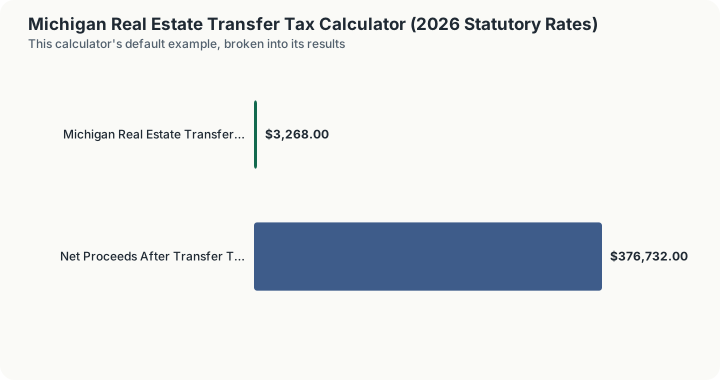
Quick Answer: Michigan charges a combined state and county real estate transfer tax of 0.86% of the sale price ($3.75 per $500 state plus $0.55 per $500 county), so a $380,000 home sale owes $3,268 in transfer tax.
Overview
Michigan combines two statutory layers into its transfer tax: a state real estate transfer tax of $3.75 per $500, or 0.75%, under MCL 207.523, plus a county transfer tax of $0.55 per $500, or 0.11%, under MCL 207.502, for a combined rate of roughly 0.86% in a typical Michigan county. That combined rate is meaningfully higher than neighboring Indiana's $0, neighboring Ohio's roughly 0.4% combined, or neighboring Wisconsin's flat 0.3%.
The seller is responsible under Michigan law by default, and while the purchase agreement can negotiate a different allocation, the statutory default and market norm is seller-paid. Michigan does provide statutory exemptions in certain circumstances, including some transfers where the state equalized value has not increased, that can reduce or eliminate the state portion, though this calculator applies the standard combined rate to a typical arm's-length sale.
On the calculator's $380,000 baseline, that combined 0.86% produces $3,268 in total tax due, roughly $2,850 from the state layer and $418 from the county layer, a two-line breakdown a Michigan closing statement typically itemizes separately rather than presenting as one figure.
How This Is Calculated
Michigan stacks two flat rates that are set by two different statutes: $3.75 per $500 to the state and $0.55 per $500 to the county.
The engine applies the 0.75% state rate under MCL 207.523 and the 0.11% county rate under MCL 207.502 to the entire consideration stated on the deed, then sums them for a combined 0.86%. Neither component is bracketed and there is no high-value threshold, so the shape of the calculation does not change as the price rises.
Worked Example
Michigan's transfer tax comes from two statutes with two different rates, applied to the same sale price.
Step 1 -- The consideration. Contract sale price = $380,000
Step 2 -- The state real estate transfer tax. MCL 207.523, $3.75 per $500 (0.75%): $380,000 x 0.0075 = $2,850.00
Step 3 -- The county real estate transfer tax. MCL 207.502, $0.55 per $500 (0.11%): $380,000 x 0.0011 = $418.00
Step 4 -- Total transfer tax due. $2,850.00 + $418.00 = $3,268.00
Step 5 -- Net proceeds after tax. $380,000.00 - $3,268.00 = $376,732.00
Step 6 -- The effective rate. $3,268.00 / $380,000 = 0.860%
Now the calculator's $1,500,000 scenario, with the same two components.
Step 7 -- State portion on the luxury sale. $1,500,000 x 0.0075 = $11,250.00
Step 8 -- County portion on the luxury sale. $1,500,000 x 0.0011 = $1,650.00
Step 9 -- Total on the luxury sale. $11,250.00 + $1,650.00 = $12,900.00
Unlike Maryland's or Pennsylvania's county add-ons, Michigan's $0.55 per $500 county tax is set by statute rather than by each county, so Step 3 is a real statewide figure rather than an average concealing a wide range. Both components fall on the seller in a typical Michigan sale, which makes Step 5 directly meaningful. Michigan's principal-residence exemption from the state portion is worth noting because it is genuinely large: a seller who has occupied the property as a principal residence and whose sale price does not exceed the property's true cash value can be exempt from the entire $2,850 in Step 2, leaving only the county tax. The engine assumes the fully taxable case and does not test exemption eligibility.
Two Rates, One Sweep: Marginal Cost and the Exemption the Engine Ignores
Michigan's sweep is a straight line with two components stacked inside it, and separating them is what makes the marginal figure useful.
The marginal cost of the next unit. Raising the price from $380,000 to $390,000 moves the computed total from $3,268.00 to $3,354.00. That is $86.00 per additional $10,000, made up of $75.00 of state tax and $11.00 of county tax, or $8.60 per $1,000 combined. The proportion never shifts: the state component is always 87.2% of the bill and the county component always 12.8%, at $250,000 ($2,150.00), at $500,000 ($4,300.00), at $1,000,000 ($8,600.00) and at $1,500,000 ($12,900.00).
The reverse question. Sellers pricing against a transfer tax budget can invert the combined 0.86%. A total bill capped at $4,300.00 corresponds to a price of $500,000, which the engine confirms exactly, and each further $1,000 of tax buys about $116,279 of price. Michigan's slope is roughly twice Minnesota's and nearly double Maine's, so the same $1,000 of transfer tax budget buys markedly less price here than in either neighbouring deed-tax state.
Right method against wrong method, priced. The characteristic Michigan error is quoting only the state statute. Applying MCL 207.523 alone at $3.75 per $500 gives $2,850.00 on the baseline sale against the engine's $3,268.00, understating the closing figure by $418.00. On the $1,500,000 scenario the same omission understates by $1,650.00. The county tax under MCL 207.502 is statewide and statutory rather than a county-by-county average, so it is never safe to drop it as a rounding convenience.
Where the sweep overstates. The principal-residence exemption from the state portion is not modelled anywhere in the code path; the engine multiplies price by the full 0.0086 with no eligibility test. An exempt seller on the baseline sale owes only the $418.00 county component, so the calculator's $3,268.00 overstates that seller's actual liability by $2,850.00, which is the single largest gap between computed and payable on this page.
What This Does Not Account For
- The MCL 207.526(u) exemption. Michigan allows sellers to claim an exemption from the state portion of the transfer tax (though not the county portion) when the property's state equalized value at sale is equal to or less than its SEV at the time of the seller's last arm's-length purchase, a scenario common after a declining local market. This calculator computes the standard statutory rate and does not attempt to model that exemption, since it depends on assessment history the calculator does not collect.
- Discretionary county rate increases. While all counties currently charge the standard $0.55 per $500, county boards technically have some latitude under state law, and this calculator uses the uniform statutory rate.
- Recording and title fees. Register of deeds recording fees, title insurance, and survey costs are separate line items not part of the transfer tax itself.
- Land contract and lease-to-own structuring. Certain non-standard conveyance structures can shift how and when transfer tax is assessed; this calculator assumes an ordinary deed transfer.
Common Pitfalls
- Forgetting the county tax exists. Many people only remember the more commonly cited 0.75% state rate and are surprised when the closing statement shows a higher combined figure.
- Assuming the SEV exemption applies automatically. The state-portion exemption for stagnant or declining property values under MCL 207.526(u) requires an affidavit and is not automatic; absent that filing, the full 0.75% state rate applies.
- Mixing up "per $500" and percentage figures. Michigan's statutes are written in dollars-per-$500 terms, which is easy to misconvert; $3.75 per $500 is 0.75%, not 0.375%.
- Assuming buyer and seller split the tax. In Michigan, the grantor (seller) is statutorily responsible, unlike states such as New Hampshire where the tax is explicitly split.
Frequently Asked Questions
Why does Michigan charge two separate transfer taxes?
Who pays the Michigan transfer tax, buyer or seller?
Is there a way to reduce or avoid the Michigan transfer tax?
Does Michigan have a mansion tax on expensive homes?
Does the transfer tax rate vary by county?
Sources
- Michigan Department of Treasury, State Real Estate Transfer Tax (MCL 207.523) and County Real Estate Transfer Tax (MCL 207.502) michigan.gov/treasury