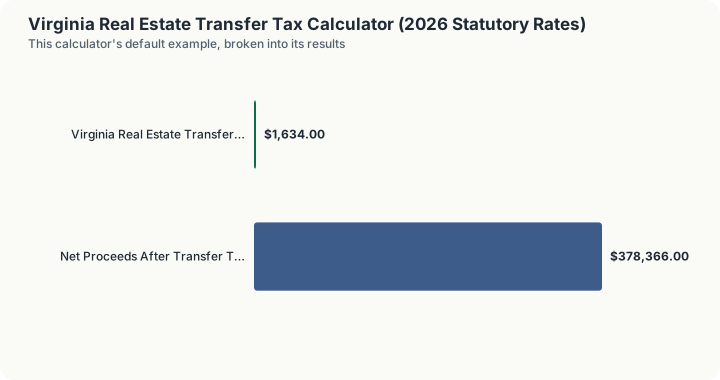
Quick Answer: A $380,000 home sale in Virginia owes $1,634.00 in combined state recordation and grantor's tax, an effective 0.43% rate combining two separate flat state taxes plus a typical local recordation add-on.
Overview
Virginia's state-level transfer tax on deeds is itself two combined levies: a recordation tax of $0.25 per $100 (0.25%) under Va. Code Section 58.1-801, plus a grantor's tax of $0.50 per $500 (0.10%) under Section 58.1-802, totaling 0.35% state tax. Localities may separately add a recordation tax equal to one-third of the state recordation tax, roughly 0.083%, and Northern Virginia carries a further regional congestion-relief recordation tax of 0.15% in certain localities that is not modeled in this calculator's statewide baseline.
Allocation between buyer and seller is a matter of local custom and the purchase contract rather than a fixed statutory rule; in many Virginia transactions, the grantor's tax is customarily associated with the seller and the recordation tax with the buyer, but this can be negotiated. A Northern Virginia transaction specifically should budget for a higher combined rate than the statewide baseline shown here, once the regional congestion-relief tax is included.
How This Is Calculated
Virginia's state charge is two separate taxes that happen to land on the same deed: a 0.25% recordation tax on the buyer's side and a 0.10% grantor's tax on the seller's.
The engine combines the two state components into 0.35% under Va. Code 58.1-801 and 58.1-802, then adds a 0.08% local figure. That local piece reflects the county recordation tax localities may levy at one third of the state recordation rate, roughly 0.083%. Both components are flat, so the combined 0.43% applies to the whole price with no bracket to cross. Northern Virginia's regional congestion-relief recordation tax, an extra 0.15% in certain localities, is not modeled here.
Worked Example
Virginia's recording charge is really two state taxes plus a local share, and the engine treats the two state pieces as one combined rate.
Step 1 -- The consideration. Contract sale price = $380,000
Step 2 -- The combined state rate. Recordation tax $0.25 per $100 (0.25%, Va. Code 58.1-801) plus grantor's tax $0.50 per $500 (0.10%, Va. Code 58.1-802) = 0.35%
Step 3 -- Apply the state rate. $380,000 x 0.0035 = $1,330.00
Step 4 -- The typical local recordation share. Localities may add roughly one third of the state recordation tax; modelled at 0.08%: $380,000 x 0.0008 = $304.00
Step 5 -- Total transfer tax due. $1,330.00 + $304.00 = $1,634.00
Step 6 -- Net proceeds after tax. $380,000.00 - $1,634.00 = $378,366.00
Step 7 -- The effective rate. $1,634.00 / $380,000 = 0.430%
The calculator's $1,500,000 scenario, run through the same two rates.
Step 8 -- State portion on the luxury sale. $1,500,000 x 0.0035 = $5,250.00
Step 9 -- Local portion on the luxury sale. $1,500,000 x 0.0008 = $1,200.00
Step 10 -- Total on the luxury sale. $5,250.00 + $1,200.00 = $6,450.00
Two cautions on reading these steps. First, the 0.08% in Step 4 is the engine's rounded stand-in for the statutory one third of the state recordation tax, which works out closer to 0.0833%; the difference is about $12 on the baseline sale and about $48 on the luxury one. Second, Steps 2 and 3 combine a buyer-side tax and a seller-side tax into a single rate. The recordation tax is customarily the buyer's, the grantor's tax the seller's, so no single party owes the whole of Step 3, and the Step 6 net-proceeds figure nets the transaction rather than the seller. Northern Virginia's regional congestion-relief recordation tax, an additional 0.15% in certain localities, is not included anywhere above.
What This Does Not Account For
- The Northern Virginia congestion-relief regional recordation tax. Several Northern Virginia localities impose an additional recordation tax of roughly 0.15% dedicated to regional transportation funding, which would raise the effective total rate above this calculator's 0.43% baseline for sales in those specific counties and cities.
- Variation in local recordation tax rates across counties. The 0.08% average local rate modeled here approximates a typical Virginia county's add-on; actual local rates can differ modestly from county to county, and buyers should confirm the exact local rate with the circuit court clerk in the relevant jurisdiction.
- Exemptions for certain transfer types. Virginia exempts certain transfers, including those between spouses, into revocable trusts, and by operation of law, from some or all of the recordation and grantor's taxes. This calculator assumes a standard taxable arm's-length sale.
- Deed of trust (mortgage) recordation tax. Virginia separately taxes the recording of a deed of trust securing a loan, a distinct tax from the deed transfer taxes modeled here and based on the loan amount rather than the sale price.
Common Pitfalls
- Treating Virginia's tax as a single line item. Virginia's transfer costs are actually two separate state taxes (recordation tax and grantor's tax) plus a local add-on; understanding the components helps when a closing statement itemizes them separately rather than as one combined figure.
- Forgetting the Northern Virginia regional tax. Buyers and sellers in Arlington, Fairfax, Loudoun, or other Northern Virginia localities subject to the congestion-relief tax often underestimate total transfer costs by using a statewide average rate instead of the higher regional figure.
- Confusing the grantor's tax with a seller-only obligation implied by its name. Despite the name, Virginia's grantor's tax and recordation tax allocation between buyer and seller is a matter of local custom and contract, not a strict statutory assignment tied to the tax's label.
- Mixing up the deed transfer taxes with the deed of trust recordation tax. The taxes modeled in this calculator apply to the property's sale price; a separate tax applies to any loan secured by a deed of trust recorded at the same closing, based on the loan amount instead.
Frequently Asked Questions
What is Virginia's real estate transfer tax rate?
Who pays the transfer tax in Virginia?
Why is Virginia's rate higher in Northern Virginia?
Does Virginia have a mansion tax on expensive homes?
Is the local recordation tax the same in every Virginia county?
Sources
- Virginia Department of Taxation, the official state tax authority for Virginia rates, rules and forms. tax.virginia.gov
Also consulted: Code of Virginia Title 58.1, Chapter 8: State recordation tax (Section 58.1-801) and grantor's tax (Section 58.1-802).