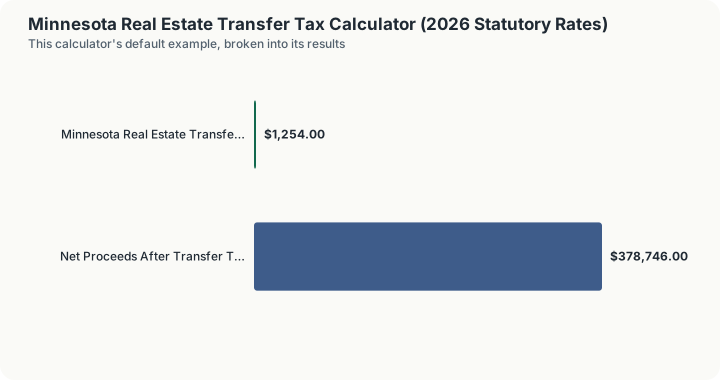
Quick Answer: Minnesota charges a state deed tax of 0.33% of the sale price ($1.65 per $500), so a $380,000 home sale owes $1,254 in state transfer tax.
Overview
Minnesota's state deed tax under Minn. Stat. Section 287.21 runs $1.65 per $500 of value, 0.33% of the sale price, applied uniformly with no bracket schedule statewide. Hennepin and Ramsey counties, home to Minneapolis and St. Paul respectively, separately levy their own environmental response fund tax on qualifying transfers, a distinct environmental-cleanup-funding charge layered on top of the state deed tax rather than a general local transfer tax add-on.
By market custom, the seller pays the deed tax at closing, since the tax attaches to recording the seller's deed, though the purchase agreement can reallocate this cost. Minnesota's 0.33% rate lands almost exactly between neighboring Wisconsin's 0.3% and Arkansas's identical-sounding 0.33%, two states charging a broadly similar flat rate despite very different statutory citations and histories.
A $380,000 Minnesota sale outside Hennepin or Ramsey County owes exactly $1,254 in state deed tax; a comparable sale inside either county owes that same base amount plus the separate environmental response fund charge, which is assessed independently of the deed tax calculation modeled here.
How This Is Calculated
Minnesota's deed tax is $1.65 per $500 of value, a single flat rate under Minn. Stat. 287.21 with no county layer in the general case.
The engine multiplies the full consideration stated on the deed by 0.0033 and rounds to the cent. Because there is one rate and no brackets, the effective rate equals the marginal rate at every price. Hennepin and Ramsey counties add a separate environmental response fund tax that is not part of this figure and has to be added for a Minneapolis or Saint Paul closing.
Worked Example
Minnesota's deed tax on the calculator's baseline sale, isolated step by step.
Step 1 -- The consideration. Contract sale price = $380,000
Step 2 -- The statutory rate. Minn. Stat. 287.21, $1.65 per $500 of value = 0.33%
Step 3 -- Apply the rate. $380,000 x 0.0033 = $1,254.00
Step 4 -- Net proceeds after the deed tax. $380,000.00 - $1,254.00 = $378,746.00
Step 5 -- The effective rate. $1,254.00 / $380,000 = 0.330%
Raise the price to the calculator's $1,500,000 scenario.
Step 6 -- The luxury sale. $1,500,000 x 0.0033 = $4,950.00
Step 7 -- The effective rate at $1.5M. $4,950.00 / $1,500,000 = 0.330%
Minnesota's 0.33% happens to land on exactly the same effective rate as Arkansas, arrived at from a completely different statutory convention: $1.65 per $500 here against $3.30 per $1,000 there. What the flatness in Steps 5 and 7 conceals is a genuine local add-on the engine does not model. Hennepin and Ramsey counties, which between them cover Minneapolis and Saint Paul and a large share of the state's transaction volume, levy a separate environmental response fund tax on top of the deed tax. A Twin Cities closing will therefore run above the figures in Steps 3 and 6, and the county recorder's schedule is the place to confirm the surcharge rather than this baseline.
What a Price Change Actually Costs, and Where the Twin Cities Break the Line
Minnesota's deed tax has the lowest slope of the five Upper Midwest states that levy one, and reading the sweep is mostly an exercise in how little the number moves.
The marginal cost of the next unit. Between $380,000 and $390,000 the computed deed tax rises from $1,254.00 to $1,287.00. That is $33.00 per $10,000 of price, or $3.30 per $1,000, a quarter less per dollar than Maine charges and well under half of Michigan's $8.60. The line holds across the whole sweep: $825.00 at $250,000, $1,650.00 at $500,000, $3,300.00 at $1,000,000 and $4,950.00 at $1,500,000, each of them exactly 0.330% of price.
The reverse question. A seller who wants the deed tax held to $1,650.00 is asking for a sale price of $500,000, and every additional $1,000 of deed tax accommodates about $303,030 of further price. Put the other way, moving from a $380,000 sale to a $1,500,000 sale, nearly four times the price, adds only $3,696.00 of deed tax. Minnesota's statute is close to irrelevant as a pricing constraint at residential values, which is exactly why the county surcharge below matters more than the state rate does.
Right method against wrong method, priced. The frequent error is reading $1.65 per $500 as $1.65 per $1,000. That halves the answer to $627.00 on the baseline against the engine's $1,254.00, an understatement of $627.00, and to $2,475.00 on the $1,500,000 scenario. The per-$500 denominator is what makes 0.33% rather than 0.165%.
Where the computed line is knowingly short. The engine reads one stateRate of 0.0033 and an avgLocalRate of zero, so the Hennepin and Ramsey County environmental response fund tax appears nowhere in any figure above. Those two counties carry a large share of Minnesota's transaction volume, which means the sweep is accurate for a greater Minnesota closing and understates a Minneapolis or Saint Paul one by the county surcharge, an amount the calculator cannot quantify because no county rate is stored.
What This Does Not Account For
- The Hennepin and Ramsey County Environmental Response Fund tax. These two counties add a separate ERF assessment that applies to most transfers, on top of the state deed tax; this calculator's baseline reflects only the statewide deed tax rate.
- Statutory exemptions. Certain deeds, including those correcting a title defect, transferring between spouses in a divorce, or conveying to a government entity, are deed-tax exempt under Minn. Stat. 287.22; this calculator assumes a standard arm's-length sale.
- Minimum tax floor. Minnesota imposes a $1.65 minimum deed tax on any taxable transfer, which only matters for extremely low-value transactions well below this calculator's minimum input.
- Mortgage registry tax. Minnesota separately taxes new mortgages recorded against a property (a different tax from the deed tax on the sale itself), which is not part of this calculator.
- Closing costs beyond the deed tax, such as title insurance, recording fees, and attorney fees.
Common Pitfalls
- Missing the Hennepin/Ramsey ERF surcharge. Sellers in the Twin Cities metro area should confirm with their closer whether the ERF tax applies to their specific transaction, since it can meaningfully change the total due beyond this statewide baseline.
- Confusing the deed tax with the mortgage registry tax. These are two separate Minnesota real estate taxes; the deed tax applies to the sale itself, while the mortgage registry tax applies separately when a new mortgage is recorded.
- Assuming the tax is negotiable in the statute. While the purchase agreement can allocate who ultimately pays, the deed tax obligation itself is fixed by statute regardless of contract terms.
- Forgetting the $1.65 statutory minimum on very low-value transfers, which is not relevant at typical Minnesota home prices but matters for nominal-consideration deeds.
Frequently Asked Questions
Who pays Minnesota's deed tax, buyer or seller?
Does Minnesota have a mansion tax for expensive homes?
Why might my Minneapolis or St. Paul closing statement show a higher transfer cost than this calculator?
Are any Minnesota real estate transfers exempt from the deed tax?
Is the deed tax the same as a mortgage tax?
Sources
- Minnesota Department of Revenue, State Deed Tax (Minn. Stat. 287.21) revenue.state.mn.us