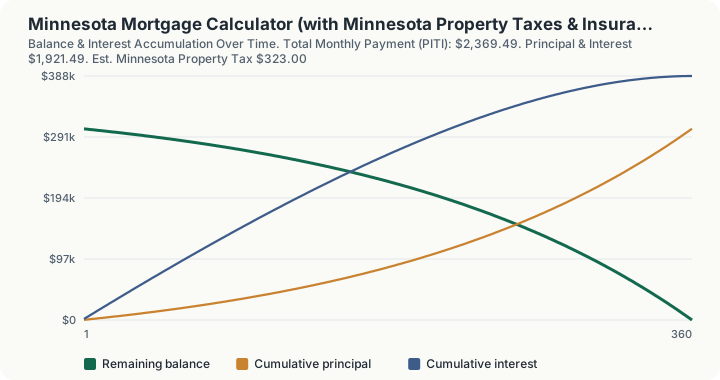
Quick Answer: On a $380,000 home with 20% down and a 6.5% rate, this calculator produces a total monthly payment (PITI) of roughly $2,369, combining $1,921.49 in principal and interest with $323.00 in estimated Minnesota property tax and a $125 insurance placeholder.
Overview
Minnesota's property tax system centers on a homestead classification: homes occupied by their owner as a primary residence get a lower classification rate than non-homestead, seasonal, or rental property, plus access to the state's Homestead Market Value Exclusion, which reduces the taxable market value on homes below a set threshold. Because of that classification structure, an owner-occupied home in Minnesota typically pays a noticeably lower effective rate than an identical rental property a few blocks away.
This calculator applies a 1.02% effective property tax rate to the home's purchase price, a figure close to Minnesota's statewide average effective rate for owner-occupied homes and close to the national average. Actual bills vary by county and city depending on local levies for schools, counties, and special taxing districts, and the homestead exclusion phases out gradually as a home's value rises, so higher-value homes see a smaller percentage benefit from the exclusion than moderately priced ones.
One state-specific detail worth knowing: Minnesota charges a Mortgage Registry Tax (MRT) of 0.23% of the loan amount when a mortgage is recorded, plus a separate Deed Tax of 0.33% of the sale price paid typically by the seller. Both are one-time closing costs tied to the transaction rather than recurring costs, so neither appears in this calculator's monthly PITI output, but they matter for anyone budgeting total cash needed to close.
How This Is Calculated
- Down payment and loan principal.
loanPrincipal = homePrice × (1 − downPaymentPercent). - Principal and interest. The principal is amortized over 360 months at the entered annual rate:
where $P$ is the loan principal, $r$ is the monthly interest rate, and $n$ is 360 months.
- Property tax escrow.
monthlyTax = homePrice × 1.02% ÷ 12, applying Minnesota's approximate statewide owner-occupied effective rate. - Insurance. A flat $125 monthly placeholder.
- Total PITI. The four components are summed.
Worked Example
Using the calculator's default inputs:
- Home price: $380,000.00
- Down payment: 20%
- Interest rate: 6.5%
Down payment and principal: $380,000.00 × 20% = $76,000.00 down; loan principal = $304,000.00.
Principal and interest: amortizing $304,000.00 over 360 months at 6.5% APR gives a payment of $1,921.49, with total interest over the full term of approximately $387,733.
Property tax: $380,000.00 × 1.02% ÷ 12 = $323.00 per month.
Insurance: $125.00 per month.
Total PITI: $1,921.49 + $323.00 + $125.00 = $2,369.49 per month.
Moving the Three Inputs: Rate, Down Payment and Price, Priced
This calculator exposes three parameters, and each one moves the payment by a different amount. Sweeping them one at a time is the only way to see which is worth negotiating.
The marginal cost of the next rate step. One eighth of a point is the smallest increment a lender quotes, and it is worth $25.06 a month here. At 6.5% the engine returns a monthly principal and interest of $1,921.49 and a total PITI of $2,369.49; at 6.625% those become $1,946.55 and $2,394.55, and at 6.375%, $1,896.56 and $2,344.56. Over the full term the same eighth of a point is worth far more: total interest moves from $387,732.82 at 6.5% to $396,756.31 at 6.625%, a difference of $9,021.08 on a $304,000 loan. A full point matters correspondingly more: at 5.5% total interest is $317,388.26 and at 7.5% it is $461,220.45, a spread of $143,832.19 on the same house.
The marginal cost of the next unit of down payment. Moving from 20% down to 10% raises the loan from $304,000.00 to $342,000.00 and the PITI from $2,369.49 to $2,609.67, a monthly increase of $240.18, with total interest rising from $387,732.82 to $436,202.14. Going the other way, 25% down cuts the loan to $285,000.00 and the PITI to $2,249.39. At 0% down the engine returns a PITI of $2,849.86 and lifetime interest of $484,667.97.
The reverse question. Buyers usually start from a payment ceiling. Holding total PITI at or below $2,133.23 a month means a purchase price of $340,000 at 20% down and 6.5%, and a ceiling near $1,896.96 corresponds to $300,000. Each $40,000 of price is worth about $236 a month of PITI at these terms, of which roughly $202 is principal and interest and $34 is Minnesota property tax.
Two figures the engine holds constant that a real quote would not. Hazard insurance is a hard-coded $125.00 a month at every price, every rate and every down payment, so the $2,369.49 PITI carries the same insurance line on a $300,000 house as on a $2,000,000 one. And no mortgage insurance is computed at any down payment: the $2,609.67 figure for a 10%-down purchase contains no PMI, which on a $342,000 loan would realistically add a further $100 to $250 a month. The 10%-versus-20% comparison above therefore understates the true gap.
Where the Minnesota tax figure comes from. The config multiplies the purchase price by a hard-coded 1.02% and divides by twelve, giving $323.00 a month at $380,000 and $340.00 at $400,000. It applies the rate to price rather than to a county assessed value, applies no homestead classification, and never reassesses: the same $323.00 appears in month 1 and month 360. The Mortgage Registry Tax described above is not computed anywhere on this page either; the engine produces no closing-cost line of any kind.
What This Does Not Account For
- The Homestead Market Value Exclusion. Minnesota reduces the taxable market value of an owner-occupied home below a set threshold, with the exclusion amount shrinking as home value rises. This calculator applies a flat 1.02% rate to the full purchase price and does not separately model the exclusion, so the actual homestead-classified bill on a moderately priced home could be somewhat lower than shown.
- County and city levy variation. Minnesota's roughly 87 counties and hundreds of cities and school districts each set their own levies, producing effective rates that can run meaningfully above or below the 1.02% statewide average used here.
- The Mortgage Registry Tax and Deed Tax. Minnesota's 0.23% Mortgage Registry Tax (on the loan amount, generally paid by the buyer) and 0.33% Deed Tax (on the sale price, generally paid by the seller) are one-time closing costs, not part of this calculator's recurring monthly figure.
- Private mortgage insurance (PMI). At 20% down, PMI is typically not required, but the calculator does not add it for the lower-down-payment scenario toggle.
- Non-homestead classification differences. Second homes, cabins, and rental property in Minnesota are taxed at a higher classification rate than owner-occupied homes, which this calculator's flat rate does not distinguish.
Common Pitfalls
- Forgetting the Mortgage Registry Tax when budgeting closing cash. Minnesota's 0.23% MRT on the loan amount is a real, state-specific closing cost that many out-of-state buyers do not anticipate, since it is unusual compared to most other states' closing cost structures.
- Assuming a cabin or rental property will carry the same tax rate as a primary residence. Minnesota's homestead classification gives owner-occupied homes a meaningfully lower rate than non-homestead property, so using this calculator for a lake cabin or rental purchase will understate the actual tax bill.
- Not accounting for the exclusion phase-out on higher-value homes. The Homestead Market Value Exclusion shrinks as a home's value increases, so buyers of higher-priced homes should not assume the same proportional tax break enjoyed by lower-value homes.
- Ignoring PMI on the 5%-down comparison scenario. The built-in low-down-payment toggle changes the loan principal but does not add mortgage insurance to the monthly total.
- Overlooking the Deed Tax when negotiating who pays closing costs. Minnesota convention generally has the seller pay the Deed Tax, but this is negotiable and worth clarifying in a purchase agreement rather than assumed.
Frequently Asked Questions
What is the Minnesota Mortgage Registry Tax?
Does this calculator account for Minnesota's homestead classification?
Why would a cabin or rental property have a higher tax bill than this calculator shows?
Is the Deed Tax the buyer's or seller's responsibility in Minnesota?
How does the "Higher Price (+25%)" scenario change my numbers?
Sources
- Minnesota Department of Revenue: Property Tax Class Rates and Homestead Market Value Exclusion guidance. revenue.state.mn.us
- Consumer Financial Protection Bureau (CFPB): TILA-RESPA Integrated Disclosure (TRID) rules for mortgage cost disclosure. consumerfinance.gov
Also consulted: Minnesota Department of Revenue: Mortgage Registry Tax and Deed Tax Fact Sheets; Minnesota Statutes, Chapter 287: Mortgage Registry Tax and Deed Tax.