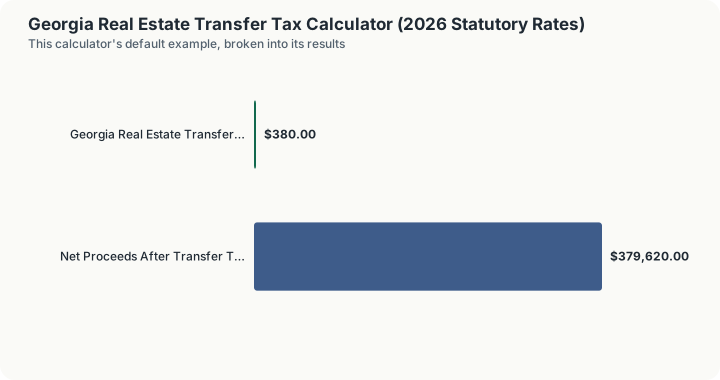
Quick Answer: A $380,000 home sale in Georgia owes $380.00 in state real estate transfer tax, a flat 0.1% rate applied uniformly to the full sale price with no brackets or high-value surcharge.
Overview
Georgia's transfer tax works out to a clean $1.00 per $1,000 of value under O.C.G.A. Section 48-6-1, an even 0.1% of the sale price with no bracket schedule, no local add-on, and no surcharge at any value. A $380,000 Atlanta-area sale owes exactly $380, and a $3,800,000 sale owes exactly $3,800, since the rate never shifts with price the way New York's or New Jersey's does once a sale crosses $1 million.
Georgia custom places responsibility for the tax with the seller, though this is not required by statute, and the specific allocation is generally addressed in the purchase contract and can be negotiated between the parties. Buyers and sellers relocating from Alabama or South Carolina will recognize the shape of Georgia's tax immediately: all three states share a similarly low, flat, no-bracket structure, though the exact statutory rate and citation differ state to state.
How This Is Calculated
Georgia's transfer tax is $1.00 per $1,000 of value, a flat 0.1% with no county or municipal surcharge permitted on top of it.
The engine reads the statutory rate under O.C.G.A. 48-6-1 and multiplies the full sale price by it, reporting tax due, effective rate, and net proceeds. There is no bracket schedule and no high-value threshold, so the effective rate reads 0.100% whether the deed records at $100,000 or $10,000,000.
Worked Example
A seller in Cobb County has accepted $380,000 and wants the transfer tax line on the settlement statement before it arrives. Here is that line, built one operation at a time.
Step 1 -- The consideration. Contract sale price = $380,000
Step 2 -- The statutory rate. O.C.G.A. 48-6-1, $1.00 per $1,000 of value = 0.1%
Step 3 -- Apply the rate. $380,000 x 0.001 = $380.00
Step 4 -- Net proceeds after the transfer tax. $380,000.00 - $380.00 = $379,620.00
Step 5 -- The effective rate. $380.00 / $380,000 = 0.100%
The calculator's second scenario raises the price to $1,500,000, which in Georgia changes the size of the number and nothing about its shape.
Step 6 -- The same rate on the luxury sale. $1,500,000 x 0.001 = $1,500.00
Step 7 -- The effective rate, unchanged. $1,500.00 / $1,500,000 = 0.100%
Georgia's rate is expressed per $1,000 while Alabama's is expressed per $500, and the two conventions land on the identical 0.1%, which is a useful reminder that a rate quoted per unit of value tells you nothing until you normalise it. Because there is no bracket and no high-value surcharge anywhere in the schedule, the $1,500 figure in Step 6 is the whole of the state tax on a million-and-a-half-dollar sale, less than many buyers pay for the appraisal. Georgia custom puts the tax on the seller, so Step 4's net proceeds figure is the one that actually matters to the party writing the cheque.
What a Dollar Per Thousand Actually Buys
No tier schedule is generated on this page. The engine returns an empty schedule array, so there are no twelve rows to walk; the price is the only variable, and each figure below is that one multiplication run again.
The marginal figure. Each additional $1,000 of Georgia consideration costs $1.00 of transfer tax, which is the statute read literally. The engine returns $381.00 on a $381,000 sale against $380.00 on $380,000. Each additional $100,000 costs $100.00.
There is no threshold, at any price. At $999,999 the engine returns $1,000.00; at $1,000,000 it returns $1,000.00; at $1,000,100 it returns $1,000.10. Nothing happens at a million dollars, and nothing happens anywhere else: the Mansion Tax output returns $0.00 at every price, including $5,000,000, where the total Georgia transfer tax is $5,000.00. That zero means Georgia's schedule contains no high-value tier, not that a surcharge was evaluated and came out at nothing.
The reverse question, which barely constrains anything. A seller budgeting $1,000 for Georgia transfer tax can convey $1,000,000 of real estate; the engine returns exactly $1,000.00 there. At Florida's 0.7% the same $1,000 budget covers only $142,857 of property. That ratio, seven to one, is the whole difference between the two states on this line of the settlement statement.
The rounding convention this engine does not implement. O.C.G.A. 48-6-1 charges $1.00 for the first $1,000 of value and 10 cents for each additional $100 or fraction thereof, so a real Georgia bill rounds up to the next $100 increment. This calculator multiplies the price by 0.001 continuously with no rounding step, which is why it returns $1,000.10 on a $1,000,100 sale where the statutory figure would land on a round increment. The difference is never more than about ten cents, but it is a difference in method rather than in data.
What is not in the $380.00. The intangible recording tax Georgia charges on long-term notes secured by real estate, at $1.50 per $500 of the loan amount, is a separate levy on the borrower and is absent from this code path. So are county recording fees per page, and any city or county transfer levy. The engine holds one statewide rate and one input.
What This Does Not Account For
- County intangible recording tax on mortgages. Georgia levies a separate intangible recording tax of $1.50 per $500 of the loan amount (roughly 0.3%) on any security deed recorded to finance the purchase. This is a distinct tax from the real estate transfer tax modeled here and applies to the buyer's financing amount, not the sale price.
- County recording fees. Georgia county clerks of superior court charge separate flat recording fees to file a deed, unrelated to sale price and not included in this calculator's output.
- Exemptions for certain transfer types. Georgia exempts certain transfers, including those between spouses, into revocable trusts, and by will or intestate succession, from the transfer tax. This calculator assumes a standard taxable arm's-length sale.
- Title insurance and attorney fees. Georgia closings are traditionally handled by attorneys, and attorney fees along with title insurance premiums are separate line items not captured by this transfer tax calculator.
Common Pitfalls
- Confusing the transfer tax with the intangible recording tax on a mortgage. These are two separate Georgia taxes with different bases (sale price versus loan amount, roughly 0.1% versus 0.3%) and conflating them produces an incorrect total closing cost estimate.
- Assuming Georgia has no transfer tax at all. Because the rate is so low, some buyers and sellers mistakenly believe Georgia charges nothing, only to see a small but real line item on the closing statement.
- Forgetting who customarily pays. Georgia law does not mandate a specific party to pay the transfer tax; it is typically the seller's responsibility by local custom, but this is set by the purchase contract and can be negotiated.
- Overestimating based on out-of-state experience. Buyers relocating from states with meaningfully higher rates, like Delaware or Connecticut, sometimes budget for a much larger transfer tax bill than Georgia's flat 0.1% actually produces.
Frequently Asked Questions
What is Georgia's real estate transfer tax rate?
Who pays the real estate transfer tax in Georgia?
Does Georgia have a mansion tax on expensive homes?
Is the Georgia transfer tax the same as the intangible recording tax?
Are any property transfers exempt from Georgia's transfer tax?
Sources
- Georgia Department of Revenue: Real Estate Transfer Tax guidance, O.C.G.A. Section 48-6-1. dor.georgia.gov