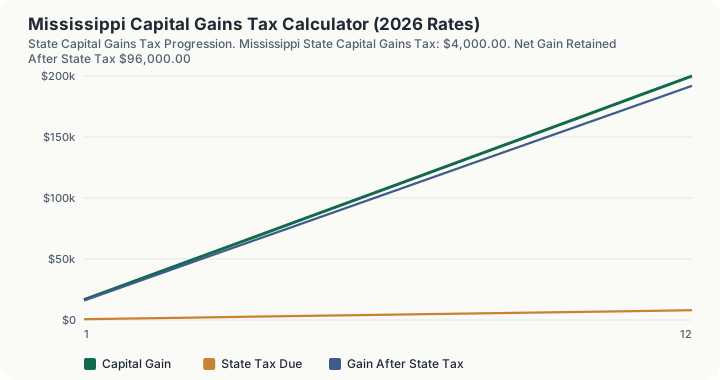
Quick Answer: On a $100,000 capital gain, Mississippi's flat 4.00% state tax adds $4,000.00 to your bill, leaving $96,000.00 after state tax.
One Rate Above a Zero Band
Mississippi taxes capital gains as ordinary income at a single statutory individual income tax rate of 4.00%, with the first $10,000 of taxable income exempt. Above that threshold the 4.00% rate applies uniformly to all realized investment profits, regardless of holding period.
Capital gains from stock sales, business equity, real estate, and digital assets get added to gross income and taxed at the state's 4.00% rate once the $10,000 zero-rate band is used up. Because most filers with salary or business income have already absorbed that band, gains typically face the full 4.00%. No preferential rate distinction exists between short-term and long-term gains at the state level.
How This Is Calculated
Mississippi has flattened its schedule to a zero band and a single rate: no tax on the first $10,000 of taxable income, then 4% on everything above it. For anyone with ordinary income the $10,000 band is already used up, so a capital gain is taxed at a flat 4% in practice.
The gain is stacked on top of your other income and walked through the bands from there.
Step by step, with your numbers:
- Start with the net gain. Capital losses and loss carryforwards are netted against the gain before anything else happens.
- Stack the gain on your other income. Ordinary income fills the lower brackets first and the gain sits on top of it, so the gain is taxed at whatever rates are still open above your salary. The same gain costs a high earner more than it costs a low earner. Enter other income as a taxable-income figure: the calculator does not subtract a standard deduction or personal exemption for you.
- Walk the brackets. The slice of the gain that falls in each band is multiplied by that band's rate, and the pieces are added together.
- Effective rate. Total Mississippi tax divided by the whole realized gain. On a graduated schedule this sits below the top marginal rate, because the lower slices were taxed at lower rates.
- Net proceeds. Subtract the state tax from the gain to get what you keep before federal tax.
Worked Example
Consider an investor in Mississippi who realizes $100,000 in capital gains from a single asset sale on top of $75,000 in baseline ordinary income for the year.
- Identify the gain. The full $100,000 capital gain is added to gross income, since Mississippi taxes capital gains at the same statutory rate as wages and other ordinary income, with no separate preferential rate for long-term holdings.
- Apply the rate. Mississippi's statutory individual income tax rate is 4.00% above a $10,000 zero-rate band. With $75,000 of other income already filling that band, the entire gain is taxed at 4.00%.
- Compute the tax due. $100,000 × 4.00% = $4,000.00, the state tax liability on this sale.
- Net proceeds. Subtracting the $4,000.00 state tax from the $100,000 gain leaves the investor with $96,000.00 in state after-tax proceeds, before any federal capital gains tax is applied separately.
Because the $10,000 zero-rate band is already consumed by other income, every dollar of this gain is taxed at 4.00%, so the effective state rate on the gain equals the marginal rate: 4.00%. A filer with little or no other income would see a lower effective rate, since the first $10,000 would be untaxed.
The $10,000 Zero Band: Who Gets It and What It Is Worth
Mississippi's schedule has a single edge, at $10,000 of taxable income, and whether a gain benefits from it depends entirely on how much other income is already stacked underneath.
The threshold walk, done on the other-income axis. With no other income at all, a gain of $10,000 computes to $0.00 and a gain of $20,000 computes to $400.00, so the first $10,000 is genuinely free and the second $10,000 costs the full 4.00%. Add $5,000 of other income and the same $100,000 gain moves from $3,600.00 to $3,800.00. Add the calculator's default $75,000 of salary and the band is gone entirely: the $100,000 gain computes to $4,000.00 at a flat 4.00% effective rate. The zero band is worth $400.00 and no more, but it is consumed by ordinary income before the gain is reached, which is the stacking rule doing the work.
The marginal cost of the next unit. Above the band each additional $1,000 of gain costs $40.00 with no further steps: the engine returns $4,000.00 at a $100,000 gain and $4,040.00 at $101,000, and $20,000.00 on the $500,000 scenario. The cost per unit never changes again once $10,000 of total income is passed, which makes Mississippi the flattest graduated schedule in this set.
The reverse question. How much gain can be realised tax free? Exactly $10,000, and only for a filer with no other taxable income; the engine returns $0.00 at a $9,000 gain and at a $10,000 gain, and $400.00 at $20,000. For anyone with a salary above $10,000 the answer is $0.00, because the band is already spent. Timing a disposition across tax years therefore recovers at most $400.00 per year in Mississippi, against $20.00 per $1,000 shifted in Minnesota.
A limitation this calculator cannot work around. Mississippi lets each spouse on a combined return compute separately, so a two-earner couple can reach $20,000 at the 0% rate rather than $10,000. The engine applies one $10,000 zero band to the combined figure, which overtaxes such a couple by up to $400.00. The married filing jointly option in the input panel selects the same single schedule, because Mississippi publishes no separate joint rate table.
One more figure the engine holds and should be re-read annually. The stored rate is the tax-year 2026 figure of 4.00%. The scheduled rate for 2027 is 3.75% and for 2025 was 4.4%, so the same $100,000 gain that computes to $4,000.00 here would compute to $3,750.00 under the 2027 schedule. The calculator does not project forward.
What This Does Not Account For
While this calculator provides penny-exact state statutory modeling, additional federal and transactional complexities warrant supplementary review: - Federal Capital Gains Taxes: Federal long-term brackets (0%, 15%, 20%) and short-term ordinary rates up to 37% under IRC § 1. - Net Investment Income Tax (NIIT): The 3.8% surtax on net investment income under IRC § 1411 for single filers over $200,000 (married joint over $250,000). - Alternative Minimum Tax (AMT): Federal AMT calculations under IRC § 55 impacting incentive stock option (ISO) exercise spread. - Section 1031 Like-Kind Exchanges: Tax deferral mechanisms for real property held for productive use in trade, business, or investment. - Qualified Small Business Stock (QSBS): Federal Section 1202 gain exclusions where state conformity varies significantly.
Common Pitfalls
- Assuming Federal Rate Parity: Most states do not offer preferential long-term capital gains rates; gains are taxed at standard ordinary income rates.
- Failing to Track Holding Periods: Short-term gains (assets held ≤1 year) generate higher federal tax liabilities even if state rates treat both holding periods identically.
- Underestimating Multi-State Apportionment: Selling real estate or business assets located in other jurisdictions triggers multi-state non-resident return filing obligations.
- Neglecting Underpayment Penalties: Substantial one-time liquidity events require prompt estimated tax payments within the quarter of sale to avoid statutory penalties.
- Mismatched Cost Basis Records: Failure to document reinvested dividends, stock splits, or structural return-of-capital distributions leads to inflated taxable gain calculations.
Frequently Asked Questions
Does Mississippi have a state capital gains tax?
How are short-term and long-term capital gains taxed in Mississippi?
Are retirement account distributions subject to capital gains tax in Mississippi?
Can capital losses offset capital gains in Mississippi?
When are estimated state tax payments required on capital gains?
Does filing status change the Mississippi tax on a capital gain?
Sources
- Mississippi Department of Revenue: 2026 Statutory Individual Income Tax Rate Schedules. dor.ms.gov
- Internal Revenue Service (IRS): Publication 544 (Sales and Other Dispositions of Assets) and Publication 550 (Investment Income and Expenses). irs.gov/publications/p544