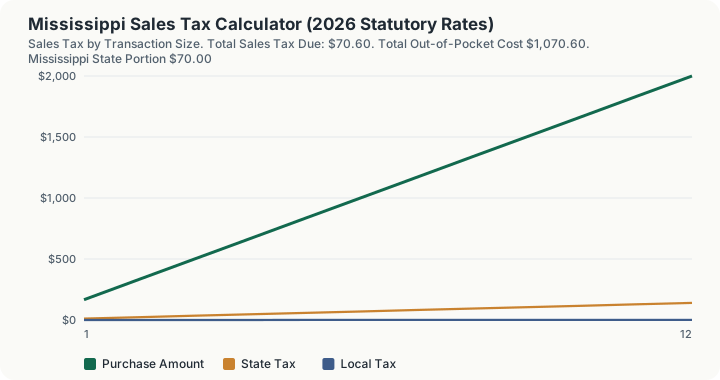
Quick Answer: A $1,000 taxable purchase in Mississippi costs $70.60 in combined state and local sales tax, for a total of $1,070.60 out the door.
The Highest State Rate, With Almost No Local Layer
Retailers doing business in Mississippi collect sales tax in two pieces at once: the state's 7.00% statutory rate, and whatever the local jurisdiction adds on top. Local jurisdictions are technically permitted to add their own surtaxes, but few do so at scale: the statewide average local add-on is a thin 0.06%, which keeps the average combined rate of 7.06% only marginally above the 7.00% base rate.
Getting that combined figure wrong, even by a fraction of a percentage point, creates exposure at audit time, since the state and any local taxing authority both expect their share to be collected and remitted correctly. That leaves Mississippi a bit below the roughly 7.3% average combined rate seen across the states that levy a general sales tax. New sellers registering to collect tax in Mississippi for the first time typically need the state-level number to open an account with the revenue department, and the local add-on on top of it to actually invoice customers correctly from day one.
How This Is Calculated
Mississippi charges 7.00%, among the highest state rates in the country, and almost nothing on top: the average local rate is 0.06%, because Mississippi permits local sales taxes only in narrow circumstances rather than granting general local option authority. A $1,000 purchase therefore produces $70.60 of tax, $70.00 of it state. Mississippi is also one of the very few states that taxes groceries at the full general rate with no reduction and no exemption, which makes its effective burden on household spending higher than the headline rate alone suggests.
With the local term this small, the combined rate is nearly the state rate:
The steps are:
- Establish the taxable base. The calculator uses the pre-tax price exactly as entered.
- No item-level exemption filtering. Because Mississippi taxes groceries at the full rate, the unfiltered treatment matches reality for food; prescription drugs are exempt and that exemption is not applied.
- Apply the state rate to the base. That gives the state share of the tax.
- Apply the local surcharge. The 0.06% average reflects the limited local taxes Mississippi allows, including the Jackson infrastructure levy, rather than a general local option.
- Combine into a total. State and local tax are added, then the combined tax is added to the purchase price for the final transaction amount.
Worked Example
For a $1,000 taxable purchase in Mississippi:
- Starting purchase price. The buyer rings up a $1,000.00 taxable retail purchase in Mississippi, the baseline amount before any tax is applied.
- State portion. Mississippi's statutory state sales tax rate of 7.00% applies to the full purchase amount: $1,000.00 × 7.00% = $70.00 owed to the state.
- Local portion. Local municipal, county, and special-district surcharges add an average of 0.06% on top of that: $1,000.00 × 0.06% = $0.60 more.
- Combined tax due. Summing the two pieces, $70.00 in state tax plus $0.60 in local surcharge comes to $70.60 in total sales tax owed on the transaction.
- Total out-of-pocket cost. Adding that $70.60 in tax to the $1,000.00 purchase price brings the buyer's total out-of-pocket cost to $1,070.60.
This example uses Mississippi's statewide average local rate of 0.06%; actual combined rates vary by city and county, so a real receipt could show a combined rate above or below the 7.06% average used here.
Two Components, Wildly Unequal: Reading the Mississippi Sweep
Mississippi is unusual in this family because it has both the highest state rate in the set and very nearly the smallest local layer, and separating the two is the first thing the sweep is good for.
Pricing the toggle. On the $1,000 baseline the engine returns $70.60 of total sales tax with local included: $70.00 of state tax and $0.60 of local tax, for $1,070.60 out of pocket. Turn the local surcharge off and the total falls to $70.00. The entire average local layer is worth $0.60 per $1,000, or $0.06 per $100, which is less than one percent of the bill. Compare Missouri next door, where the equivalent switch moves a $1,000 purchase by $42.20.
The marginal cost of the next unit. Each additional $100 of purchase costs $7.06, of which $7.00 is state and $0.06 local. The engine returns $35.30 at $500, $141.20 at $2,000, $353.00 at $5,000 and $1,765.00 at $25,000. Mississippi's slope is the steepest state-level figure on this platform and its combined figure is still below Minnesota's $8.14 per $100, because Minnesota's local layer does twenty-one times the work Mississippi's does.
The reverse question. Holding total Mississippi sales tax to $100.00 requires a purchase of $1,416.43, which the engine confirms, splitting it $99.15 state and $0.85 local. Each $10 of tax budget corresponds to about $141.64 of purchase.
Right method against wrong method, priced. Extracting tax from a tax-inclusive total by deducting the combined rate is the error to price. A $1,070.60 receipt contains $70.60 of tax on a $1,000.00 base, which is the engine's answer. Deducting 7.06% of the $1,070.60 gross gives $75.58 of implied tax instead, overstating by $4.98. The correct extraction is 7.06/107.06 of the gross. Because Mississippi's rate is the highest state rate here, this error is also the most expensive version of it in the set: on the $26,765.00 tax-inclusive total matching the engine's $25,000 row, deducting the rate overstates the tax by $124.61.
What the two stored numbers mean and do not mean. The 7.00% state rate is exact and statutory. The 0.06% local figure is a statewide average, not any city's rate; Jackson's local infrastructure tax and the coastal tourism levies are not represented, and there is no field in which to enter a municipality. Mississippi also taxes groceries at the full state rate, which is why the general figure above is more representative of a household's real bill here than the equivalent figure would be in a state that exempts food, but the engine applies no product classification of any kind.
What This Does Not Account For
- Statutory exemptions on unprepared groceries, prescription medications, or manufacturing equipment.
- Special industry excise taxes (lodging hotel taxes, vehicle rental fees, alcohol/tobacco excise).
- Use tax compliance on out-of-state untaxed online purchases.
- B2B resale certificate exemptions or direct pay permit programs.
Common Pitfalls
- Confusing State and Combined Rates: Quoting the state base rate without factoring in local city and county add-on taxes.
- Overlooking Consumer Use Tax: Failing to self-report and remit use tax on untaxed out-of-state purchases on your state income tax return.
- Missing Annual Sales Tax Holidays: Many states offer annual tax-free weekends for back-to-school items, severe weather supplies, or energy-efficient appliances.
- Failing to Collect Resale Certificates: Selling wholesale without collecting valid exemption certificates exposes sellers to full sales tax liability upon audit.
Frequently Asked Questions
What is the sales tax rate in Mississippi?
Are groceries taxed in Mississippi?
How does use tax differ from sales tax?
Are digital goods and SaaS taxable in Mississippi?
Sources
- Mississippi Department of Revenue: 2026 Sales and Use Tax Rate Schedules. dor.ms.gov
- Streamlined Sales Tax Governing Board (SSTGB): State Taxability Matrix. streamlinedsalestax.org/for-businesses/taxability-matrix