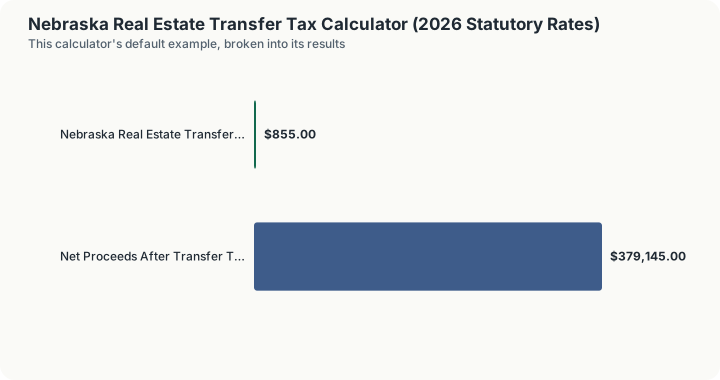
Quick Answer: Nebraska charges a documentary stamp tax of 0.225% of the sale price ($2.25 per $1,000), so a $380,000 home sale owes $855 in state transfer tax.
Overview
Nebraska's documentary stamp tax, set under Neb. Rev. Stat. Section 76-901, runs $2.25 per $1,000 of value, 0.225% of the sale price, a single flat rate with no bracket structure and no county add-on anywhere in the state. That rate sits above neighboring Iowa's 0.16% and neighboring South Dakota's 0.1%, placing Nebraska among the higher flat-rate states in its immediate region.
By market custom, the seller typically pays the documentary stamp tax at closing, though the purchase agreement can allocate the cost differently between the parties. Because the rate never changes with price, a Nebraska seller can estimate the tax on any transaction by multiplying the sale price by 0.00225, without tracking brackets or county-specific add-ons the way a Maryland or an Ohio seller would need to.
On the calculator's $380,000 baseline, that works out to $855 due regardless of which of Nebraska's 93 counties the property sits in, since no county register of deeds is authorized to add its own surcharge on top of the state figure.
How This Is Calculated
Nebraska charges a documentary stamp tax of $2.25 per $1,000 of value, a flat 0.225% under Neb. Rev. Stat. 76-901.
The engine multiplies the full consideration stated on the deed by 0.00225 and rounds to the cent. There are no brackets and no mansion-tax cliff, so the effective rate equals the marginal rate at every price and the tax scales linearly with the sale.
Worked Example
Documentary stamps on a $380,000 Omaha sale, each operation kept separate.
Step 1 -- The consideration. Contract sale price = $380,000
Step 2 -- The statutory rate. Neb. Rev. Stat. 76-901, $2.25 per $1,000 of value = 0.225%
Step 3 -- Apply the rate. $380,000 x 0.00225 = $855.00
Step 4 -- Cross-check by the per-$1,000 method. 380 x $2.25 = $855.00
Step 5 -- Net proceeds after the stamp tax. $380,000.00 - $855.00 = $379,145.00
Step 6 -- The effective rate. $855.00 / $380,000 = 0.225%
The calculator's $1,500,000 scenario, run against the same single rate.
Step 7 -- The luxury sale. $1,500,000 x 0.00225 = $3,375.00
Step 8 -- The effective rate, unchanged. $3,375.00 / $1,500,000 = 0.225%
Nebraska's documentary stamp tax is levied on the grantor, which in an ordinary sale means the seller, and it comes out of proceeds at the register of deeds rather than being collected separately. The flatness demonstrated in Steps 6 and 8 is worth contrasting with a bracketed neighbour: on the same $1,500,000 sale, Washington's graduated excise would run past $22,000 while Nebraska's stamp tax stops at $3,375. There is no minimum stamp built into the model and no high-value tier, so the tax simply tracks the price in a straight line from the smallest rural transfer to the largest commercial one.
Walking the Price Sweep and the Rounding Edge
Nebraska's documentary stamp tax has no threshold in it at all, so every question about it resolves to arithmetic. What follows is that arithmetic, taken from the calculator rather than from the statute.
Each additional $1,000 of sale price costs $2.25. Moving the price from $380,000 to $381,000 moves the tax from $855.00 to $857.25. The same $2.25 applies at $250,000, where the tax is $562.50, and at $1,500,000, where it is $3,375.00.
The reverse question: how large must a Nebraska sale be before the documentary stamp reaches $1,000? At $444,444 the tax is exactly $1,000.00. There is no bracket anywhere near that figure; it is simply where 0.225% of the price crosses the round number.
A rounding edge that surprises people. The engine multiplies the full consideration by 0.00225 and rounds the product to the cent, so $1 of extra price is worth $0.00225 of tax and disappears in the rounding. A $380,001 sale returns the same $855.00 as a $380,000 sale. A $380,500 sale returns $856.13. Whether your county register of deeds computes stamps on the exact consideration or on the price rounded to a full $1,000 of value, the calculator does not model that step: it always applies the continuous percentage, and the difference between the two methods is at most one $2.25 increment on any single deed.
There is no mansion tax here, and the output proves it. The "Mansion Tax / High-Value Surcharge" field is part of this calculator family because several states impose a high-value cliff. Nebraska does not, and the field reads $0.00 at $380,000, at $1,000,000 and at $1,500,000 alike. Contrast the same field on the New Jersey page, where a $1,000,000 sale triggers a surcharge on the entire consideration.
And no cliff means no crossing to fear at $1,000,000. A $999,999 Nebraska sale owes $2,250.00 and a $1,000,000 sale owes $2,250.00. One dollar of price changes the tax by nothing, which is exactly what a flat percentage with cent rounding should do and exactly what a cliff state would not do.
What This Does Not Account For
- The calculator applies a continuous 0.225% and does not round to $1,000 increments, so it can differ from a county computation by up to one $2.25 increment on a single deed.
- The mansion tax output is always $0.00 for Nebraska, because no high-value cliff exists in the state entry.
- Statutory exemptions. Neb. Rev. Stat. 76-902 lists a number of exempt transfer categories, including certain transfers between spouses, transfers to correct a title defect, and conveyances to or from government entities; this calculator assumes a standard taxable arm's-length sale.
- Recording fees. Nebraska county registers of deeds charge separate, modest recording fees per document that are not part of the documentary stamp tax itself.
- Any city- or county-level add-on. Nebraska's documentary stamp tax is uniform statewide, with no local option surcharge currently authorized, but this calculator does not attempt to anticipate future local legislation.
- Capital gains and other income tax owed on the seller's profit from the sale, which is entirely separate from the one-time documentary stamp tax.
Common Pitfalls
- Confusing the rate's two common expressions. Nebraska's tax is quoted both as "$2.25 per $1,000" and as "0.225%"; these are identical, but people sometimes miscalculate by treating $2.25 per $1,000 as if it were 2.25%, an order-of-magnitude error.
- Assuming a mansion-tax surcharge exists. Nebraska does not add any additional tax at high sale prices, unlike New York, New Jersey, and a handful of other states.
- Overlooking statutory exemptions on family transfers. Deeds within a family, such as those correcting a title or settling an estate, may not owe the documentary stamp tax at all; assuming the full 0.225% always applies can overstate the cost in these situations.
- Forgetting county recording fees are separate. These are a distinct line item from the documentary stamp tax and vary somewhat by county.
Frequently Asked Questions
Who pays the Nebraska documentary stamp tax, buyer or seller?
Does Nebraska have a mansion tax on high-value home sales?
Is Nebraska's documentary stamp tax the same in every county?
Are any real estate transfers in Nebraska exempt from this tax?
How does Nebraska's rate compare to neighboring states?
Sources
- Nebraska Department of Revenue, Documentary Stamp Tax (Neb. Rev. Stat. 76-901) revenue.nebraska.gov