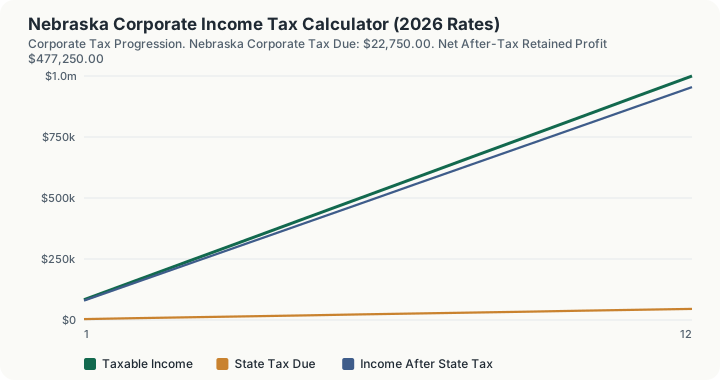
Quick Answer: On $500,000 of pre-apportioned taxable income, Nebraska's flat 4.55% corporate income tax rate produces $22,750.00 in state tax due and $477,250.00 in net after-tax profit.
One Rate, Twelve Rows, No Step
Nebraska taxes C-corporation income at a single flat rate of 4.55%. The state spent years running a two-bracket schedule with a higher top tier, and the legislated reductions that followed collapsed it into one rate applied to every dollar of apportioned income, so the calculator performs no bracket lookup.
The consequence shows up directly in the tier schedule. Row 1 sits at $83,333.33 of apportioned income and $3,791.67 of Nebraska tax. Row 6 is your own entry, $500,000 and $22,750.00. Row 12 is $1,000,000 and $45,500.00, exactly twelve times row 1 in both columns. A graduated state cannot produce that pattern; Nebraska does, because its corporate entry in the rate table holds one band from $0 upward.
The same flatness makes the two rate outputs redundant. The effective rate and the marginal rate both read 4.55% at $50,000 of income and at $50,000,000, and neither moves until a credit is entered.
How This Is Calculated
The calculator multiplies the apportioned taxable income you supply by 4.55%, subtracts the credits you supply, and floors the answer at zero. Everything that produces the income figure happens before the calculator sees it.
- Read the apportioned taxable income you entered. It is treated as already apportioned to Nebraska and already net of state additions, subtractions and net operating loss carryforwards.
- Apply the flat 4.55% rate. Nebraska's rate-table entry is a single unbounded band, so there is nothing to walk.
- Subtract the entered credits from the computed tax, dollar for dollar.
- Floor the result at zero, so the tax due never prints negative.
- Divide net tax by income for the effective rate. With no credits this is always 4.55%.
- Build the twelve-row tier schedule by re-running step 2 on your income times the row number divided by six.
Worked Example
Using this calculator's baseline scenario: a corporation with $500,000 in taxable income apportioned to Nebraska.
- Start with apportioned taxable income. $500,000 has already been apportioned to Nebraska before any state-level tax is applied.
- Apply Nebraska's flat statutory rate. $500,000 x 4.55% = $22,750.00, with no bracket lookup required.
- Nebraska corporate tax due: $22,750.00.
- Net retained profit. $500,000 - $22,750.00 = $477,250.00 retained after state tax, before any separate federal liability.
Where the Nebraska Number Actually Moves
Because the rate schedule contains no threshold, the only discontinuity in this model sits in the credit field, and it is a hard one.
At $22,749 of entered credits. The $22,750.00 of computed tax less $22,749 leaves $1.00 due.
At $22,750 of entered credits. Liability is $0.00 exactly.
At $22,751 of entered credits. Liability is still $0.00, and the extra dollar of credit has been discarded.
The maximum-against-zero is the whole mechanism. Below $22,750 every credit dollar is worth one dollar of Nebraska tax; above it, nothing. The calculator does not carry the surplus into a later year, does not refund it, and does not report the unused amount anywhere on the page, so a $0.00 headline here means "credits met or exceeded the tax", not "credits matched it".
Each additional $1,000 of apportioned income costs $45.50. That figure holds everywhere on the curve, which is why row 12 of the schedule is precisely double row 6.
The reverse question: how much Nebraska income can a corporation report before the state tax reaches $10,000? At $219,780 the tax is $9,999.99; at $219,781 it is $10,000.04. The crossing point is arithmetic, not statute, because Nebraska's schedule has no tier boundary to cross.
One detail about how the schedule is built matters if you plan to reconcile against it. Every row is computed independently from the income you entered, not carried forward from the row above, so no rounding error accumulates down the table: row 1 shows $83,333.33 of income against $3,791.67 of tax and $79,541.66 retained, and row 12 shows $1,000,000 against $45,500.00 and $954,500.00, each derived directly from the $500,000 you typed.
Set against Nebraska's old two-tier schedule, this matters in one direction that is easy to get wrong. A model still applying a repealed higher top rate to income above roughly $100,000 will overstate the $500,000 answer, because everything above that line is now taxed at 4.55% along with everything below it.
What This Does Not Account For
- No minimum or franchise floor is applied. The calculator floors liability at $0.00. Entity fees and annual report charges are outside the model entirely.
- No apportionment is performed. Nebraska's single sales factor with market-based sourcing determines the number you type in; type in unapportioned income and the $45.50 per $1,000 error scales with it.
- No state modifications or NOL carryforwards are computed. The add-back of federally deducted Nebraska tax, state depreciation differences and NOL usage limits all change the base before the 4.55% applies.
- Credits are taken at face value. ImagiNE and similar program benefits are not tested for eligibility, capped, ordered against one another, or carried forward. A dollar entered is a dollar subtracted, until the zero floor.
- The rate is read for 2026 only. Nebraska's enacted schedule continues downward in later years, and this calculator holds the 2026 figure fixed.
- Federal corporate income tax (21% under IRC § 11) is a separate computation.
- BEAT and GILTI provisions under the federal international regime are not reflected.
- Local municipal corporate earnings taxes are not modelled.
Common Pitfalls
- Carrying forward a retired bracket schedule. Applying Nebraska's older two-tier rates to a 2026 return overstates the liability against the flat 4.55% that now applies to the whole base.
- Entering total company income rather than the Nebraska share. A filer with 20% of its sales in Nebraska that types $2,500,000 instead of $500,000 sees $113,750.00 instead of $22,750.00.
- Reading $0.00 as "nothing to file". The calculator returning zero once credits reach $22,750 says nothing about whether a Nebraska return is due.
- Expecting the effective rate to differ from the marginal rate. With no credits entered they are the same 4.55% at every income level, because there is only one band.
Frequently Asked Questions
Does Nebraska have a corporate income tax?
What does each extra $1,000 of Nebraska income cost?
How much income can I report before Nebraska tax hits $10,000?
When are Nebraska corporate tax returns due?
Does Nebraska tax S-corporations and LLCs?
Sources
- Nebraska Department of Revenue: Corporate Tax Statutes and Guidance (2026). revenue.nebraska.gov
- Multistate Tax Commission (MTC): Uniform Apportionment and Allocation Guidelines. mtc.gov