Quick Answer: A $380,000 home sale in Iowa at the statutory rate of $1.60 per $1,000 of consideration (0.16%) generates $608 in real estate transfer tax due.
Overview
Iowa's real estate transfer tax, set under Iowa Code Section 428A.1, runs $1.60 per $1,000 of consideration, 0.16% of the sale price, with the first $500 of value exempt from the tax entirely. That exemption is a small but real detail: it means the tax base is technically sale price minus $500, though at typical Iowa home values the exemption barely moves the total due.
By custom and county recorder practice, the seller pays Iowa's transfer tax at closing, and payment is required before the county recorder will accept the deed for recording, making it a hard prerequisite rather than a bill that can be deferred. Iowa's 0.16% rate sits below neighboring Wisconsin at 0.3% and Minnesota at 0.33%, though it is higher than neighboring Missouri, which charges no transfer tax at all, and neighboring South Dakota's flat 0.1%.
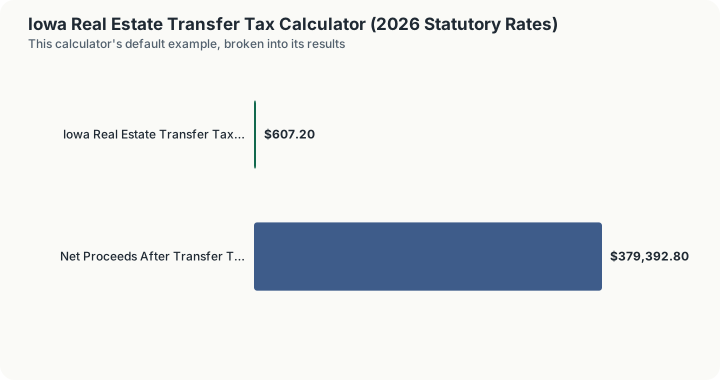
This calculator applies that $500 exemption. calculateStateRealEstateTransferTax subtracts the exempt slice before applying the rate, so a $380,000 sale is taxed on a statutory base of $379,500 and returns $607.20. The exemption is worth a flat $0.80 at every price, because it removes the same $500 from the base whether the sale is $380,000 or $3,800,000.
How This Is Calculated
Iowa's transfer tax is $1.60 per $1,000 of consideration, which converts to a flat 0.16% multiplier.
The engine subtracts the statutory $500 exemption and applies the rate to what remains, in exact decimal arithmetic. At $380,000 that is $607.20; at $1,000,000 it is $1,599.20. Because the exemption removes a fixed $500 rather than a share, its value is the same $0.80 at every price, which is why the effective rate creeps from 0.1598% toward 0.1600% as the sale grows without ever reaching it. The arithmetic is easy to check by hand: subtract $500, divide by 1,000, multiply by 1.60.
Worked Example
An Iowa transfer at the calculator's default price, with each operation on its own line.
Step 1 -- The consideration. Contract sale price = $380,000
Step 2 -- The statutory rate. Iowa Code 428A.1, $1.60 per $1,000 of consideration = 0.16%
Step 3 -- Apply the rate. ($380,000 - $500) x 0.0016 = $607.20
Step 4 -- Cross-check by the per-$1,000 method. 379.5 x $1.60 = $607.20
Step 5 -- Net proceeds after the transfer tax. $380,000.00 - $607.20 = $379,392.80
Step 6 -- The effective rate. $607.20 / $380,000 = 0.1598%
The calculator's higher scenario, $1,500,000, tests for a bracket that does not exist.
Step 7 -- The luxury sale. $1,500,000 x 0.0016 = $2,400.00
Step 8 -- The effective rate, unchanged. $2,400.00 / $1,500,000 = 0.160%
The $500 exemption in Step 6 is the only structural detail in Iowa's tax, and it is worth the same $0.80 whether the sale is $380,000 or $1,500,000, because it removes a fixed slice rather than a percentage. Everything else is as flat as Steps 7 and 9 suggest: no brackets, no high-value surcharge, no county add-on.
Walking the Price, and the One Constant That Never Scales
This page has no twelve-row sweep to read: the Iowa transfer tax configuration returns an empty schedule, because a single flat rate on a single input produces nothing a table would add. The sweep has to be walked by hand through the price field, and that is worth doing because one of the two figures in play does not scale.
Marginal cost of the next unit. Each additional $1,000 of consideration costs $1.60, at every price above the exempt slice. Moving the entry from $380,000 to $381,000 lifts the tax from $607.20 to $608.80. A $1,000,000 Iowa sale returns $1,599.20 and leaves $998,400.80 of proceeds, at a 0.1599% effective rate.
There is no threshold anywhere in the Iowa schedule. No mansion band, no first-time-buyer relief, no cliff and no graduated bracket. The effective-rate output reads 0.160% on a $500 sale and on a $50,000,000 one, which is unusual: most transfer-tax states in this engine carry at least one bracket edge, and several carry a mansion cliff that re-rates the entire price at once. Iowa carries neither.
The one place the arithmetic visibly breaks from the statute. Iowa Code 428A.1 exempts the first $500 of consideration. The engine does not. At a $500 sale price the calculator returns $0.80 where the statute produces $0.00; at $1,000 it returns $1.60 where the statute produces $0.80. The error is a flat $0.80 at every price above $500, which is 0.0002% of a $380,000 sale and 100% of the tax on a $500 one. It matters for a nominal-consideration transfer and it is invisible on a residential closing statement.
Right base against wrong base, priced. The larger risk on this page is not the eighty cents, it is the base. The tax is charged on consideration, not on assessed value and not on the mortgage amount. A $380,000 sale of a property assessed at $310,000 owes $607.20; entering the assessed value returns $495.20 and understates by $112.00. In the other direction, entering a $450,000 gross figure that includes buyer credits returns $719.20, overstating by $112.00. The calculator takes any number as consideration and cannot tell which one you handed it.
What This Does Not Account For
- The statutory $500 exemption: Iowa Code 428A.1 exempts the first $500 of consideration from tax. At typical residential sale prices, this represents a difference of well under $1.00 from the figures this calculator produces, and is not separately modeled here.
- County recorder filing fees: Recording the deed and the accompanying Declaration of Value carries its own flat filing fee, separate from and in addition to the transfer tax itself.
- Groundwater hazard statement fees: Iowa requires a Groundwater Hazard Statement to accompany most deed transfers, which carries a modest separate filing fee unrelated to the transfer tax calculation.
- Exempt transfer categories: Iowa law exempts certain transfers, including many transfers between spouses, transfers by will or inheritance, and certain government transactions, from the tax entirely; these are not captured by a simple sale-price calculation.
- Agricultural and specialty property considerations: Farm transfers and certain other specialty property types can carry additional disclosure requirements that are separate from, and not reflected in, the transfer tax rate itself.
Common Pitfalls
- Forgetting that the tax is paid before the deed can be recorded. Iowa county recorders will not record a deed without proof the transfer tax and Declaration of Value have been satisfied, so this is a hard closing-day requirement, not an optional or deferred payment.
- Confusing the Declaration of Value form with the tax itself. The declaration is a disclosure document filed alongside the tax payment; it does not itself impose additional tax beyond the $1.60-per-$1,000 rate.
- Overlooking the Groundwater Hazard Statement fee. This is a small but real separate filing requirement and fee that frequently surprises first-time Iowa sellers who expect the transfer tax to be the only closing-related government charge.
- Assuming the $500 statutory exemption produces a meaningful discount. At normal residential sale prices, the exemption changes the tax due by less than a dollar, so treating it as a significant planning factor is generally not worthwhile.
- Applying an out-of-state bracket mentality. Unlike Hawaii's marginal system, Iowa's rate is flat and proportional across the entire sale price with no bracket thresholds to track.
Frequently Asked Questions
What is Iowa's real estate transfer tax rate?
Is Iowa's transfer tax bracketed like Hawaii's, or flat?
Who pays Iowa's transfer tax, the buyer or the seller?
Does the $500 statutory exemption change my tax bill in a meaningful way?
What other fees should I expect at an Iowa closing besides the transfer tax?
Sources
- Iowa Department of Revenue, real estate transfer tax guidance and Iowa Code Chapter 428A. revenue.iowa.gov