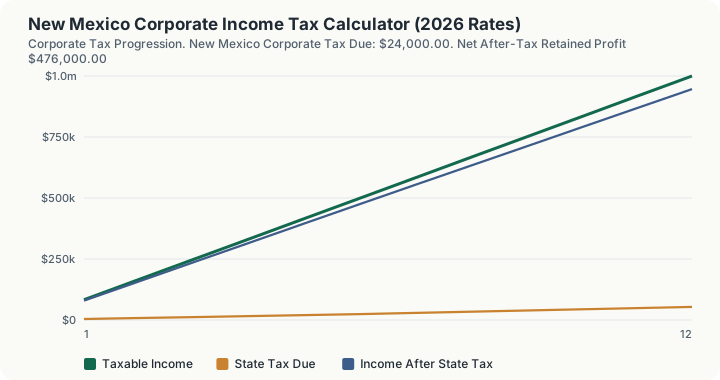
Quick Answer: On $500,000 of pre-apportioned taxable income, New Mexico's graduated corporate income tax brackets (reaching 4.80% at this income level) produce $24,000.00 in state tax due and $476,000.00 in net after-tax profit.
The Whole Schedule Is One Line at $500,000
New Mexico's corporate income tax has exactly two bands: 4.80% on the first $500,000 of apportioned income and 5.90% on everything above. That single threshold is the only structure in the schedule, and this calculator's baseline sits precisely on it.
Sitting on the line rather than above it is why the baseline's effective rate and marginal rate both read 4.80% and the tax comes to $24,000.00. One dollar of additional income changes the marginal rate output but almost nothing else, which makes New Mexico the cleanest illustration in this family of how little a bracket edge actually costs at the moment of crossing.
The tier schedule crosses the line in the middle of the table, and it is visible in the numbers. Rows 1 through 6 climb in even steps of $4,000.00 of tax, from $4,000.00 at $83,333.33 of income to $24,000.00 at $500,000. From row 7 the step widens to $4,916.67, because every dollar in those rows is being taxed at 5.90% instead of 4.80%. Row 12 lands at $1,000,000 of income and $53,500.00 of tax.
How This Is Calculated
The calculator walks your entered income through the two-band array, sums the tax, subtracts your entered credits, and floors the result at zero.
where $c_i$ are the bracket ceilings ($500{,}000$, then unlimited) and $r_i$ the corresponding rates ($4.80\%$, $5.90\%$).
- Read the apportioned taxable income you entered. It is treated as already apportioned to New Mexico and already net of state modifications and NOL carryforwards.
- Tax the portion up to $500,000 at 4.80%.
- Tax any portion above $500,000 at 5.90%.
- Record the top band reached as the marginal rate output.
- Sum the two amounts, subtract entered credits, and floor at zero.
- Divide net tax by income for the effective rate, which falls between 4.80% and 5.90% for any income above the threshold.
- Build the twelve-row tier schedule, re-running the walk on your income times the row number over six.
Worked Example
Using this calculator's baseline scenario: a corporation with $500,000 in taxable income apportioned to New Mexico.
- Start with apportioned taxable income. $500,000 before state tax.
- Fill the first band. The whole $500,000 fits inside the 4.80% band, so no part of it reaches 5.90%.
- Marginal rate reached: 4.80%, identical to the effective rate at this exact income.
- New Mexico corporate tax due: $24,000.00.
- Net retained profit. $500,000 - $24,000.00 = $476,000.00, before any separate federal liability.
The $500,000 Line, Priced
This is the question a New Mexico filer near the threshold actually asks, and the answer is much smaller than the rate gap suggests.
At $499,000 of apportioned income. The tax is $23,952.00, a 4.80% effective rate with a 4.80% marginal rate.
At $501,000, two thousand dollars later. The tax is $24,059.00. The marginal rate output flips to 5.90%, but the effective rate still reads 4.80%.
What the step actually costs. $107.00 of extra tax on $2,000 of extra income. Had that $2,000 stayed entirely inside the lower band it would have cost $96.00. The threshold itself is therefore worth $11.00, not the $22,000 that misreading 5.90% as a whole-base rate would imply. Crossing into New Mexico's top corporate bracket is close to a non-event; only the dollars above the line are repriced.
Each additional $1,000 of income costs $48.00 below $500,000 and $59.00 above it. That $11.00 difference per thousand is the entire economic content of New Mexico's bracket structure.
How far the effective rate can climb. At $600,000 the tax is $29,900.00, an effective 4.98%. At $1,000,000 it is $53,500.00, an effective 5.35%. The effective rate approaches 5.90% only asymptotically, so a filer well into the second band still pays materially less than the top rate on average.
The reverse question: how much income can be apportioned to New Mexico before the tax reaches $10,000? At $208,333 the tax is $9,999.98 and at $208,334 it is $10,000.03. That point sits comfortably inside the 4.80% band, so nothing statutory is happening there.
The credit floor. Credits are subtracted after the bracket walk and floored at zero. At $23,999 of entered credits the tax is $1.00; at $24,000 it is $0.00; at $24,001 it is still $0.00, with the surplus dollar discarded rather than carried forward.
Where the schedule changes slope, in one line. The tier table steps by $4,000.00 of tax per row through row 6 and by $4,916.67 per row from row 7 onward, and that change of step is the $500,000 threshold arriving in the middle of the table. Row 6 prices $500,000 at $24,000.00 and row 7 prices $583,333.33 at $28,916.67. Nothing else in New Mexico's corporate schedule ever changes, so those two step sizes describe the entire rate structure of the state.
One consequence for planning. Because the step is $48.00 per $1,000 below the line and $59.00 above it, deferring $50,000 of income from a year in which it would sit above $500,000 to one in which it would sit below saves $550.00. That is a real number and a small one, and it is worth having it in front of you before restructuring a year end around it.
What This Does Not Account For
- New Mexico's gross receipts tax is not computed. It is imposed on the seller for the privilege of doing business in the state, is measured on receipts rather than profit, and is frequently the larger cost for a service business. Nothing on this page reflects it.
- No minimum tax or franchise fee is applied. The calculator floors liability at $0.00.
- No apportionment is performed. The statutory formula, including the single sales factor election available to qualifying manufacturers and headquarters operations, determines the number you type in.
- No state modifications or NOL carryforwards are computed, including the add-back of federally deducted New Mexico tax and the state's depreciation and foreign dividend adjustments.
- Credits are taken at face value, with no eligibility test, cap, ordering rule or carryforward.
- Federal corporate income tax (21% under IRC § 11) is separate and not included.
- BEAT and GILTI provisions under the federal international regime are not reflected.
- Local municipal corporate earnings taxes are outside the model.
Common Pitfalls
- Reading 5.90% as a whole-base rate. Applying it to $501,000 gives $29,559 against the correct $24,059.00, overstating the tax by roughly $5,500.
- Assuming the threshold is worth avoiding. Crossing it costs $11.00 per $1,000 of income above the line, which is rarely a reason to defer revenue.
- Entering total company income rather than the New Mexico share. Below the threshold each $1,000 of over-entry costs $48.00, above it $59.00.
- Treating the corporate tax as the state's main business levy. For many New Mexico businesses the gross receipts tax, which this calculator does not touch, is the larger number.
Frequently Asked Questions
What are New Mexico's corporate tax brackets?
What does crossing $500,000 of New Mexico income cost?
Why does the effective rate stay at 4.80% just above the threshold?
How much income before New Mexico tax reaches $10,000?
Does this include New Mexico gross receipts tax?
Sources
- New Mexico Taxation and Revenue Department: Corporate Income Tax Statutes and Guidance (2026). tax.newmexico.gov
- Multistate Tax Commission (MTC): Uniform Apportionment and Allocation Guidelines. mtc.gov