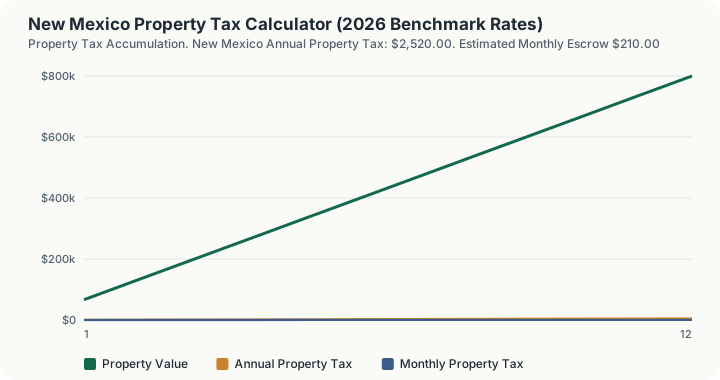
Quick Answer: A $400,000 home in New Mexico carries an estimated $2,520.00 in annual property tax at the state's 0.63% effective rate, or about $210.00 a month.
One Rate, One Multiplication, No Millage
The average effective property tax rate across New Mexico is 0.63%, below the national median and good for #35 nationally. Nationally, the average effective rate runs close to 1.0%, which puts New Mexico noticeably below the national average of roughly 1.0%. That's below the West regional average of about 0.71%.
Like its neighbors elsewhere in the West, New Mexico relies on property tax as the primary funding mechanism for public schools, emergency services, and county infrastructure, with local taxing authorities setting the actual millage each year.
New Mexico counties handle the mechanics of periodic reappraisal and millage-setting locally, so the statewide average above is a useful benchmark but actual bills still hinge on the specific county, school district, and any exemptions or appeals the owner has filed in a given year.
How This Is Calculated
New Mexico assesses property at one third of market value and caps annual increases in that assessed value at 3% for most owners. Values also reset on sale, so the state runs a mild version of an acquisition-value system without ever calling it one.
None of that detail is asked for here. This calculator works one level up, applying New Mexico's average effective property tax rate of 0.63% to the value you enter. That rate is the ratio of property taxes actually paid to home value across the state, so the assessment ratios, caps, and exemptions described above are already baked into it.
What the calculator itself does is shorter than any of that, and it is worth being exact about, because this family of pages has previously described work the engine does not perform. There is no assessed-value conversion in the code, no millage lookup, and no reassessment logic of any kind:
- Read the value you entered in the market value field.
- Subtract the exemption you entered, and floor the result at zero. This is the only adjustment made to the base.
- Multiply by the single stored effective rate of 0.63%. One number, read from the state property tax table, applied once. There is no bracket, no class ratio and no local rate.
- Divide the annual figure by twelve for the escrow output, rounded to the cent.
- Build the twelve-row schedule by multiplying the value you entered by the row number and dividing by six, then applying the same 0.63% to each tier.
Worked Example
Using this calculator's baseline inputs: a $400,000 home in New Mexico, taxed at the state's 0.63% average effective rate (rank #35 of 50 states).
- Start with the assessed value. The home is assessed at its full $400,000.00 market value, with no homestead exemption applied in this baseline scenario.
- Apply the effective rate. $400,000.00 × 0.63% = $2,520.00 in annual property tax, New Mexico's statewide average effective rate.
- Convert to a monthly escrow. Lenders typically collect property tax in twelve equal installments alongside principal and interest: $2,520.00 ÷ 12 = $210.00 per month.
- Check the monthly and the per-thousand figures. The escrow output is $210.00 a month, and each additional $1,000 of market value adds $6.30 a year to the bill.
At 0.63%, New Mexico lands roughly in the middle nationally, ranking #35 of 50 states. That is a moderate but still material carrying cost for homeowners.
Where the New Mexico Number Moves and Where It Does Not
The rate never changes, so the sweep is a straight line and every question about it has an arithmetic answer.
Each additional $1,000 of market value costs $6.30 a year. Raising the entry from $400,000 to $401,000 moves the annual tax from $2,520.00 to $2,526.30, and the same step applies at $100,000 or at $5,000,000. Per $10,000 of value the figure is $63.00.
The schedule row by row. Row 1 prices a $66,666.67 tier at $420.00 a year. Row 6 is your own entry, $400,000 at $2,520.00. Row 12 is $800,000 at $5,040.00, exactly twelve times row 1. The third column is the monthly figure for that row rather than a cumulative total, so nothing in this table accumulates.
The exemption walk. With no exemption the tax is $2,520.00 a year and $210.00 a month. Enter a $25,000 exemption and it becomes $2,362.50 and $196.88, a saving of $157.50 a year. Enter the field's $200,000 maximum against the $400,000 default and the tax falls to $1,260.00. The relationship is exactly linear, because the exemption comes off the base before the single rate is applied: every $1,000 of exemption is worth the same $6.30 that $1,000 of value costs.
How the exemption moves the whole column. The twelve-row schedule nets the exemption off each row's value before applying the 0.63% rate, exactly as the headline does. Enter $400,000 with a $25,000 exemption and the headline reads $2,362.50 against the $2,520.00 the page returns with the field at zero, a saving of $157.50 a year, and row 6 of the schedule reads $2,362.50 as well. Row 1 moves from $420.00 to $262.50 under the same entry. The two outputs answer the same question at the same exemption level, so the table can be read straight down against the result above it.
The reverse question: how much house before the annual bill reaches $5,000? At $793,650 of market value the tax reaches $5,000.00, or $416.67 a month. Nothing statutory happens at that point; it is simply where 0.63% of the value crosses the round number, and the escrow line crosses $416.67.
Right method against wrong method, priced. The input wants market value, because the stored 0.63% is an effective rate: taxes actually paid divided by home value across the state. If you instead enter the assessed or taxable figure printed on your notice, and that figure is a fraction of market value, the result is understated in the same proportion. Entering $100,000 where the market value is $400,000 returns $630.00 instead of $2,520.00, understating the annual bill by the difference. This is the single most common way to get a wrong answer out of this page, and no validation catches it because $100,000 is a perfectly plausible entry.
What This Does Not Account For
- The engine applies one statewide effective rate and nothing else. There is no county or municipal millage lookup, no assessment ratio, no classification, no cap or abatement logic, and no reassessment modelling anywhere in the code path. A single stored rate of 0.63% multiplies the value you enter.
- The exemption field is a flat dollar reduction of the base. It does not know which exemption you mean, tests no eligibility, and applies no per-programme cap beyond the field's own $200,000 maximum.
- The exemption field is a flat dollar subtraction with no eligibility test. Whatever you type is removed from the base before the 0.63% rate is applied, and the engine treats a general homestead, a senior freeze and a disabled-veteran exemption as the same number. A $25,000 entry returns $2,362.50 on a $400,000 home, $50,000 returns $2,205.00 and $100,000 returns $1,890.00; no step of that sweep asks whether the amount is one you actually qualify for, and no per-programme cap is enforced beyond the field's own maximum.
- Specific hyper-local county and municipal millage district variations within New Mexico.
- Public Improvement District (PID) assessments. Master-planned developments in New Mexico, such as Mesa del Sol in Albuquerque, can sit inside a PID that levies property taxes or special assessments to repay bonds for roads, water, and other infrastructure, layered on top of the base county and school millage.
- Commercial vs residential assessment classification differentials.
- Property tax appeal reductions or localized board of equalization adjustments.
Common Pitfalls
- Confusing Market Fair Value with Assessed Basis: Some jurisdictions assess property at fractional ratios rather than 100% of market value.
- Failing to File Homestead Paperwork: Homestead exemptions are rarely automatic; homeowners must file timely paperwork with the county appraisal district.
- Underestimating Post-Sale Supplemental Assessments: Purchasing a newly constructed or reassessed property often triggers catch-up supplemental tax bills.
- Ignoring Property Tax Appeal Windows: Missing the annual 30-to-60 day statutory protest window forfeits the right to challenge over-assessed property values for that tax year.
Frequently Asked Questions
How high are property taxes in New Mexico?
When are property taxes due in New Mexico?
How can I lower my property taxes in New Mexico?
Does purchasing a home trigger a property tax reassessment?
Sources
- U.S. Census Bureau: American Community Survey (ACS) Real Estate Assessment Benchmark Data. census.gov/programs-surveys/acs
- New Mexico Taxation and Revenue Department: Property Tax Assessment Guidance. tax.newmexico.gov