Quick Answer: Exercising non-qualified stock options creates ordinary income equal to (fair market value minus strike price) times shares, taxed immediately as wages with federal income tax and FICA, while any further gain to your eventual sale price is a separate capital gain.
Overview
Non-qualified stock options, usually shortened to NSOs or NQSOs, are the most common type of employee stock option outside of the incentive stock options (ISOs) offered by some startups. The tax treatment of an NSO is simpler than an ISO in one sense: there is no alternative minimum tax trap to worry about. It is more expensive in another sense: the spread you capture at exercise is taxed as ordinary compensation the moment you exercise, whether or not you sell a single share.
This calculator walks through both taxable events an NSO holder faces. The first event is exercise, when you pay the strike price to buy shares at a fixed price set on your grant date. If the stock is now worth more than that strike price, the difference, called the bargain element or the spread, is treated exactly like a cash bonus. Your employer reports it on your W-2, withholds federal income tax and FICA from it, and you owe ordinary income tax on the full amount that year, regardless of whether you hold or sell the shares. The second event is the eventual sale of the shares. From the moment you exercise, your cost basis resets to the fair market value on the exercise date, and any additional movement in price between exercise and sale is a capital gain or loss, taxed under the normal long-term or short-term capital gains rules depending on how long you hold the shares after exercising.
A common point of confusion is thinking the whole gain from strike price to sale price is one number taxed one way. It is not. The IRS splits it into two separate pieces with two separate tax treatments and, in the case of the first piece, two separate types of tax (income tax and payroll tax).
How This Is Calculated
The calculator runs the math in four steps, using the platform's shared payroll and bracket engines rather than any bespoke formula.
- Bargain element. Shares exercised multiplied by (fair market value at exercise minus strike price). If FMV is below strike, exercising would create a loss with no tax benefit, so the calculator floors this at zero, since no one exercises underwater options for tax purposes.
- Ordinary income tax at exercise. The bargain element is stacked on top of your other W-2 wages for the year using the 2026 federal brackets, and the calculator computes the marginal tax attributable specifically to the bargain element, meaning the tax on (other wages + bargain element) minus the tax on other wages alone. This correctly reflects that the bargain element lands on top of your existing income, not at the bottom of the bracket ladder.
- FICA at exercise. The bargain element is W-2 wages, so it is subject to the same 6.2% Social Security tax (up to the annual wage base) and 1.45% Medicare tax as your salary, plus the 0.9% Additional Medicare Tax once your combined wages cross the filing-status threshold. The calculator offsets the Social Security wage base using the "other W-2 wages" you already entered, so high earners who have already crossed the cap correctly see $0 of additional Social Security tax on the bargain element.
- Capital gain at sale. Shares times (sale price minus exercise-date FMV). If you have held the shares more than 12 months since exercise, this is a long-term capital gain, stacked on your ordinary income using the 2026 long-term capital gains brackets (0%, 15%, 20%). If held 12 months or less, it is a short-term gain, taxed at your ordinary marginal rate with no FICA, since capital gains are never subject to payroll tax regardless of holding period.
All bracket lookups pull live from the platform's 2026 federal tax table, sourced from IRS Revenue Procedure 2025-32, and all FICA figures pull from the 2026 Social Security Administration fact sheet, so the numbers stay current as the IRS publishes new inflation adjustments each year.
Worked Example
Assume you exercise 1,000 NSOs with a $10 strike price when the stock's fair market value is $50 per share, and you already have $150,000 in other W-2 wages this year as a single filer. You hold the shares for 18 months and then sell at $70 per share.
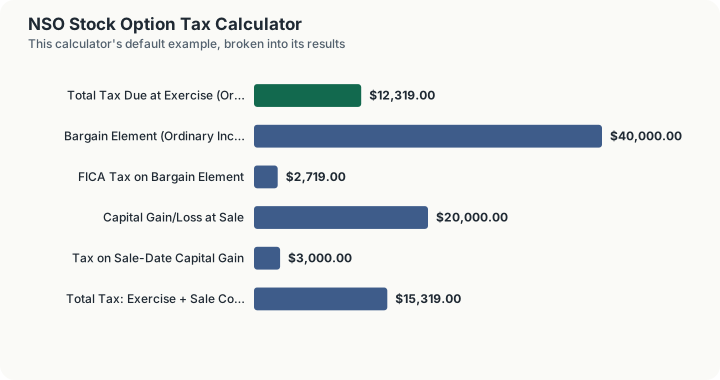
Step 1: Bargain element. (50 − 10) × 1,000 = $40,000 of ordinary income at exercise.
Step 2: Ordinary tax. After the $16,100 standard deduction, your $150,000 in wages leaves $133,900 of taxable income before the exercise. Stacking the $40,000 bargain element on top moves taxable income to $173,900, and the entire $40,000 falls inside the 24% bracket, so incremental tax is 40,000 × 24% = $9,600.
Step 3: FICA. With $150,000 in prior wages, only $34,500 of Social Security wage base capacity remains before the $184,500 cap, so Social Security tax is 34,500 × 6.2% = $2,139. Medicare tax is 40,000 × 1.45% = $580, uncapped. Combined wages of $190,000 stay under the $200,000 Additional Medicare threshold, so that tax is $0. Total FICA: $2,719.
Total tax due at exercise: $9,600 + $2,719 = $12,319. This is due in the tax year you exercise, not the year you eventually sell.
Step 4: Capital gain at sale. (70 − 50) × 1,000 = $20,000, long-term since you held 18 months. Stacked on top of $190,000 of income, the entire gain lands in the 15% long-term bracket: 20,000 × 15% = $3,000.
Combined lifetime tax across both events: $12,319 + $3,000 = $15,319.
What This Does Not Account For
This calculator prices the two core federal taxable events precisely, but a real NSO exercise decision involves more variables than any calculator can fully capture. It does not model state income tax, which many states tax at their own ordinary rates on both the bargain element and any capital gain, and which can add several more points to your effective rate depending on where you live and where you worked when the options vested. It does not model the alternative minimum tax, which generally does not apply to NSOs the way it does to ISOs, but can still be triggered by other items on your return in the same year. It does not account for employer withholding elections; many employers withhold at a flat 22% supplemental rate rather than your true marginal rate, which can leave you owing more at filing time even though tax was technically withheld at exercise. It does not model wash sales, tax-loss harvesting, or the timing flexibility available if you can choose when to exercise or sell across calendar years to manage which tax bracket the income lands in. Finally, it assumes the bargain element and other wages are your only income; investment income, self-employment income, or itemized deductions elsewhere on your return will shift your true marginal rate.
Common Pitfalls
- Forgetting exercise itself is a taxable event. Many people assume no tax is owed until they sell. With NSOs, tax on the bargain element is due in the exercise year even if you never sell a share, which can create a cash flow problem if you exercise and hold.
- Confusing the strike price with the cost basis for capital gains purposes. After exercise, your basis for capital gains purposes is the exercise-date fair market value, not the strike price, because the spread between strike and FMV was already taxed as ordinary income.
- Assuming employer withholding covers the full tax bill. Flat-rate supplemental withholding, commonly 22%, frequently under-withholds for anyone in a 24% or higher bracket, leaving a balance due at filing.
- Exercising without a plan to pay the tax. Since NSOs create immediate ordinary income and FICA liability, exercising a large batch without cash on hand to cover the resulting tax bill, or without selling enough shares to cover it, is one of the most common and costly NSO mistakes.
- Ignoring state tax and multi-state complications. If you worked in more than one state between grant and exercise, part of the bargain element may be taxable in more than one jurisdiction.
Frequently Asked Questions
Do I owe tax when I exercise NSOs even if I don't sell any shares?
How is an NSO different from an ISO for tax purposes?
Why does my FICA tax on the bargain element sometimes show as $0 for Social Security?
What happens if I sell my shares for less than the exercise-date fair market value?
Does the 12-month holding period start at grant or at exercise?
Sources
- Internal Revenue Service, Revenue Procedure 2025-32 (2026 inflation-adjusted federal income tax brackets, standard deductions, and long-term capital gains brackets), irs.gov/pub/irs-drop/rp-25-32.pdf
- Social Security Administration, 2026 COLA Fact Sheet (Social Security wage base and FICA rates), ssa.gov/news/press/factsheets/colafacts2026.pdf
- Internal Revenue Service, Topic No. 427, Stock Options, irs.gov/taxtopics/tc427
- Internal Revenue Code Section 83 and Treasury Regulation 1.83-7 (taxation of nonqualified stock options) law.cornell.edu/uscode/text/26/83