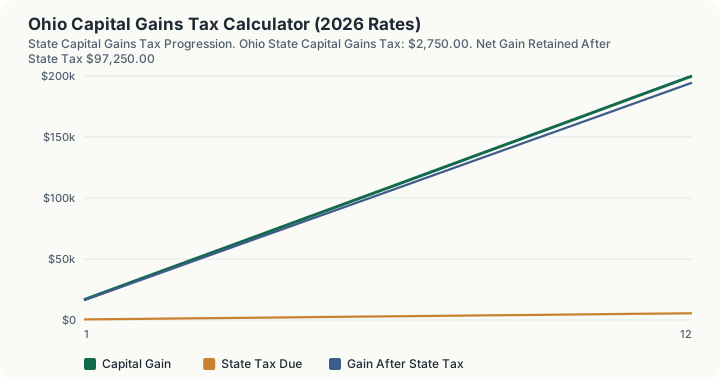
Quick Answer: On a $100,000 capital gain layered on $75,000 of other income, Ohio's 2.75% state tax adds $2,750.00 to your bill, leaving $97,250.00 after state tax.
One Rate, One Zero Band, And A $332 Step
Ohio taxes capital gains as ordinary income under a two-band schedule: the first $26,050 of taxable income is untaxed, and every dollar above that is taxed at a single 2.75% rate. Ohio's schedule also carries a fixed $332.00 charged at the moment taxable income crosses $26,050, on top of the 2.75%. Because the band below that threshold is taxed at 0%, this figure is not accumulated tax carried up from a lower band: it is a genuine step in the schedule, a legacy of Ohio's former nonrefundable credit, and it is set by Ohio Rev. Code 5747.02.
Capital gains get evaluated alongside other taxable earnings. When gains are recognized on top of baseline salary or business income that has already absorbed the $26,050 zero-rate band, the whole gain is taxed at 2.75%. Filers with little other income see a lower effective rate, because part of the gain falls inside the untaxed band.
Understanding state-level capital gains taxation is essential for high-net-worth individuals, portfolio managers, corporate executives, and real estate investors. State income taxes significantly affect net internal rates of return (IRR) on capital dispositions, 1031 exchange planning, installment sale structuring, and equity compensation exercises (ISOs, NSOs, and RSUs).
In institutional wealth management and private equity underwriting, capital gains calculations must account for both statutory tax rates and multi-jurisdictional residency rules. Whether disposing of publicly traded securities, privately held business interests, real property, or digital assets, evaluating state-level tax exposure is a critical component of pre-liquidity tax modeling and post-sale wealth preservation.
Proper capital asset planning in Ohio requires tracking taxable events across federal and state reporting cycles. Because timing and holding structure dictate net after-tax proceeds, investors must rigorously analyze the interaction between federal adjusted gross income (AGI) baselines and state modifications before closing substantial transactions.
How This Is Calculated
Ohio has compressed its schedule to a zero band and one rate: nothing on the first $26,050 of taxable income, then a fixed $332.00 plus 2.75% of everything above it. That zero band is unusually large, so a small gain earned by someone with little other income can genuinely escape Ohio tax, while a gain stacked on a normal salary meets the flat 2.75%.
The $332.00 is charged only once, when taxable income first crosses $26,050. If your other income has already carried you past that threshold, the step has already been paid and none of it is attributed to the gain, so the gain meets the 2.75% rate alone. If the gain is what carries you across, the calculator charges the step against the gain.
The gain is stacked on top of your other income and walked through the bands from there.
Step by step, with your numbers:
- Start with the net gain. Capital losses and loss carryforwards are netted against the gain before anything else happens.
- Stack the gain on your other income. Ordinary income fills the lower brackets first and the gain sits on top of it, so the gain is taxed at whatever rates are still open above your salary. The same gain costs a high earner more than it costs a low earner. Enter other income as a taxable-income figure: the calculator does not subtract a standard deduction or personal exemption for you.
- Walk the brackets. The slice of the gain that falls in each band is multiplied by that band's rate, and the pieces are added together.
- Add the $332.00 step, if the gain triggers it. If your other income was at or below $26,050 and the gain carries you above it, Ohio's fixed $332.00 is added. If your other income already exceeded $26,050, nothing is added here.
- Effective rate. Total Ohio tax divided by the whole realized gain. Where the step applies, the effective rate sits above 2.75%, because the fixed amount is spread across the gain.
- Net proceeds. Subtract the state tax from the gain to get what you keep before federal tax.
Worked Example
Consider an investor in Ohio who realizes $100,000 in capital gains on top of $75,000 in baseline ordinary income for the year.
- Stack the income. Ohio taxes capital gains as ordinary income. Income fills the zero-rate band first, so the $75,000 of baseline income already covers it and the $100,000 gain stacks on top.
- Apply the rate. The $75,000 of other income has already used up Ohio's $26,050 zero-rate band, so all $100,000 of the gain falls in the 2.75% band. That same fact means the $332.00 step has already been incurred by the other income, so none of it is charged against the gain here.
- Total state tax due. $100,000 × 2.75% = $2,750.00 in Ohio state tax.
- Effective rate. Dividing that liability by the $100,000 gain gives an effective rate of 2.75%, equal to the marginal rate here because no part of this gain lands in the untaxed band.
- Net proceeds. After paying $2,750.00 in state tax, the investor keeps $97,250.00 of the $100,000 gain, before any federal tax applies.
Who Pays Ohio's $332 Step, The Gain Or The Salary
Ohio's schedule contains a fixed $332.00 that is charged once, when taxable income first crosses $26,050. Whether the gain or the other income pays it is decided by a single comparison in the engine, and the sweep across the other-income field shows the switch flipping.
With $26,000 of other income. The other income sits just below the threshold, so the $100,000 gain is what carries taxable income across it. The engine attributes the whole $332.00 step to the gain. Ohio's tax is $3,080.63, an effective rate of 3.08% on the gain.
With $26,100 of other income, one hundred dollars more. The threshold has already been crossed before the gain arrives, so the step has been incurred by the salary and none of it belongs to the gain. Ohio's tax on the identical $100,000 gain falls to $2,750.00, an effective rate of 2.75%.
One hundred dollars of extra salary therefore reduces the tax attributed to the gain by $330.63. That is not a rounding artefact; it is the engine deciding, correctly, that a step already paid cannot be charged twice.
With no other income at all. The same $100,000 gain costs $2,365.63, because the first $26,050 of it falls in Ohio's zero band and only the $73,950 above it meets 2.75%, before the $332.00 step is added back.
The marginal cost of the next unit. At the baseline, raising the gain from $100,000 to $101,000 moves the tax from $2,750.00 to $2,777.50. Above the threshold every additional $1,000 of gain costs exactly $27.50, and the twelve-row schedule confirms it: each row adds $16,666.67 of gain and $458.33 of tax, unbroken from row one to row twelve.
The reverse question: how much gain escapes Ohio entirely? With no other income, $26,050 of gain, and not a dollar more. At $26,050 the tax is nothing; the very next dollar triggers the $332.00 step plus 2.75%, which is a marginal cost of $332.03 on a single dollar of gain.
What the engine does not model. It applies no Ohio personal exemption credit and no standard deduction to the other-income figure, so a filer whose real taxable income sits below $26,050 after deductions may be charged the step here when Ohio would not charge it. Ohio's municipal income taxes, which many cities apply to some forms of investment income, are computed nowhere on this page.
What This Does Not Account For
While this calculator provides penny-exact state statutory modeling, additional federal and transactional complexities warrant supplementary review: - Federal Capital Gains Taxes: Federal long-term brackets (0%, 15%, 20%) and short-term ordinary rates up to 37% under IRC § 1. - Net Investment Income Tax (NIIT): The 3.8% surtax on net investment income under IRC § 1411 for single filers over $200,000 (married joint over $250,000). - Alternative Minimum Tax (AMT): Federal AMT calculations under IRC § 55 impacting incentive stock option (ISO) exercise spread. - Section 1031 Like-Kind Exchanges: Tax deferral mechanisms for real property held for productive use in trade, business, or investment. - Qualified Small Business Stock (QSBS): Federal Section 1202 gain exclusions where state conformity varies significantly.
Common Pitfalls
- Assuming Federal Rate Parity: Most states do not offer preferential long-term capital gains rates; gains are taxed at standard ordinary income rates.
- Failing to Track Holding Periods: Short-term gains (assets held ≤1 year) generate higher federal tax liabilities even if state rates treat both holding periods identically.
- Underestimating Multi-State Apportionment: Selling real estate or business assets located in other jurisdictions triggers multi-state non-resident return filing obligations.
- Neglecting Underpayment Penalties: Substantial one-time liquidity events require prompt estimated tax payments within the quarter of sale to avoid statutory penalties.
- Mismatched Cost Basis Records: Failure to document reinvested dividends, stock splits, or structural return-of-capital distributions leads to inflated taxable gain calculations.
Frequently Asked Questions
Does Ohio have a state capital gains tax?
How are short-term and long-term capital gains taxed in Ohio?
Are retirement account distributions subject to capital gains tax in Ohio?
Can capital losses offset capital gains in Ohio?
When are estimated state tax payments required on capital gains?
Does filing status change the Ohio tax on a capital gain?
Sources
- Internal Revenue Service (IRS): Publication 544 (Sales and Other Dispositions of Assets) and Publication 550 (Investment Income and Expenses). irs.gov/publications/p544
Also consulted: Ohio Department of Taxation: 2026 Statutory Individual Income Tax Rate Schedules.