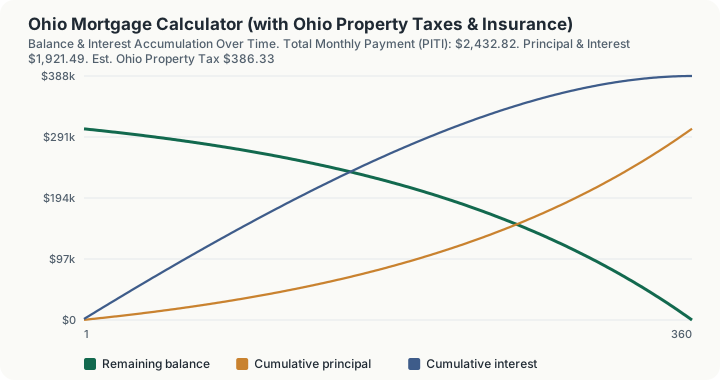
Quick Answer: A $380,000 Ohio home with 20% down at 6.5% costs about $2,432.82 a month once principal, interest, an estimated 1.22% property tax rate, and $125 of insurance are added together.
Overview
Ohio's property tax system runs on a mix of voted local levies and inside millage set without voter approval, which is a big part of why the state's effective rates sit meaningfully above the national median even though Ohio home prices are generally moderate. This calculator models a standard 30-year fixed-rate mortgage using the same amortization engine as every lending calculator on this platform, then layers on a property tax escrow built from a 1.22% statewide effective rate and a flat $125 monthly insurance placeholder to arrive at a total PITI (principal, interest, taxes, insurance) figure.
Ohio counties reappraise property values on a state-mandated six-year cycle, with a triennial update in between full reappraisals. That means a homeowner's assessed value, and therefore tax bill, can shift meaningfully even without any change to the local millage rate itself, simply because the county auditor's updated market value pushes the taxable base higher. Rates also vary widely by school district, since Ohio funds a large share of K-12 education through local property levies that voters must periodically renew or replace. Franklin, Cuyahoga, and Hamilton county suburbs with strong school districts frequently carry effective rates above 1.8%, while some rural counties sit closer to 0.8%. The 1.22% figure used here is a reasonable statewide starting point, not a substitute for the county auditor's actual current rate.
How This Is Calculated
The calculator performs a standard fixed-rate amortization, then adds two escrow-style estimates on top of the raw debt service number.
- Down payment and loan principal. Home price is multiplied by the down payment percentage to determine the cash due at closing, and the remainder becomes the financed loan amount. At the default inputs, $380,000 minus 20% down ($76,000) leaves a $304,000 loan.
- Monthly interest rate. The annual mortgage APR is divided by 12 to produce the periodic rate applied across a fixed 360-month, 30-year amortization schedule.
- Principal and interest (P&I). The standard amortizing payment formula, PMT = P × [r(1+r)^n] / [(1+r)^n − 1], runs against the loan principal, monthly rate, and 360 periods using the site's Decimal.js-based amortization primitive, which eliminates the floating-point rounding drift found in typical spreadsheet mortgage formulas.
- Property tax escrow. Home price is multiplied by the 1.22% effective rate and divided by 12 to produce a monthly property tax line item.
- Insurance escrow. A flat $125 monthly homeowners insurance estimate is added as a national baseline placeholder.
- Total monthly payment (PITI). Principal and interest, property tax, and insurance sum into the headline monthly payment.
Worked Example
Using the calculator's default inputs of a $380,000 home price, 20% down payment, and a 6.5% fixed 30-year rate:
- Down payment: $380,000 × 20% = $76,000
- Loan principal: $380,000 − $76,000 = $304,000
- Monthly interest rate: 6.5% ÷ 12 = 0.5416667%
- Monthly principal and interest: $1,921.49
- Monthly estimated Ohio property tax (on the full home price): $380,000 × 1.22% ÷ 12 = $386.33
- Monthly insurance estimate: $125.00
- Total monthly payment (PITI): $1,921.49 + $386.33 + $125.00 = $2,432.82
Over the full 360-month term, this loan accumulates roughly $387,733 in total interest on the $304,000 borrowed, meaning total principal and interest payments over 30 years approach $691,735. Because Ohio's effective property tax rate is well above states like North Carolina or North Dakota, the tax escrow line item here makes up a noticeably larger share of the total payment than it would for an identical loan in a lower-tax state, which is worth keeping in mind when comparing Ohio affordability against other Midwestern states.
What This Does Not Account For
- Voted versus inside millage. Ohio's tax bills combine unvoted "inside" millage with voter-approved levies for schools, libraries, and other local services. This calculator collapses all of that into a single blended percentage and cannot reflect a specific district's actual levy stack.
- Conveyance fee. Ohio counties charge a real property conveyance fee at closing, generally around $1 to $4 per $1,000 of sale price depending on the county, plus a small per-parcel transfer fee. This is a closing cost, not a recurring monthly expense, so it is excluded here.
- Homestead exemption. Ohio's Homestead Exemption reduces the taxable value of a primary residence for qualifying senior citizens, disabled homeowners, and some disabled veterans; this calculator does not net out any exemption.
- CAUV valuation for agricultural parcels. Properties enrolled in the Current Agricultural Use Value program are assessed very differently than standard residential parcels, which this calculator does not model.
- Private mortgage insurance (PMI). The default 20% down payment avoids PMI; buyers financing with less than 20% down on a conventional loan should expect an additional PMI premium not reflected here.
- Reappraisal timing. Ohio's six-year reappraisal and triennial update cycle can shift a home's assessed value mid-ownership in ways this static calculator cannot forecast.
Common Pitfalls
- Assuming 1.22% applies evenly across Ohio. Effective rates vary from close to 0.8% in some rural counties to well over 1.8% in high-service suburban school districts around Columbus, Cleveland, and Cincinnati, so the statewide default should be replaced with the county auditor's actual rate whenever precision matters.
- Forgetting that levies expire and get renewed. Many Ohio school and library levies are time-limited and go back to voters periodically; a homeowner's tax bill can change even without any reassessment if a levy is renewed at a higher rate or a new one passes.
- Missing the conveyance fee at closing. Buyers who budget only for lender-related closing costs sometimes overlook the county conveyance fee, which is a separate line item due at the closing table.
- Overlooking the reappraisal cycle. A home purchased shortly before a county-wide reappraisal can see its assessed value, and therefore its tax bill, jump substantially in the following tax year even with no levy changes.
- Conflating gross and effective rates. Ohio's nominal mill rates look large on paper because of statutory rollback and reduction factors that bring the effective rate down; comparing a raw millage number to another state's simple percentage can produce a misleading conclusion.
Frequently Asked Questions
Why is Ohio's property tax rate shown as 1.22% here?
How often does Ohio reassess property values?
Does this calculator include Ohio's conveyance fee?
What down payment avoids PMI in Ohio?
Is $125 a realistic insurance estimate for Ohio?
Why does the tax escrow make up a larger share of the Ohio payment than in some other states?
Sources
- Consumer Financial Protection Bureau, Regulation Z (Truth in Lending Act) and Loan Estimate/Closing Disclosure standards. ecfr.gov/current/title-12/chapter-X/part-1026
Also consulted: Ohio Department of Taxation, Tax Analysis Division, county effective property tax rate and rollback data; Ohio Revised Code, Chapter 5715, county reappraisal and triennial update requirements; Ohio Housing Finance Agency, first-time homebuyer program guidelines.