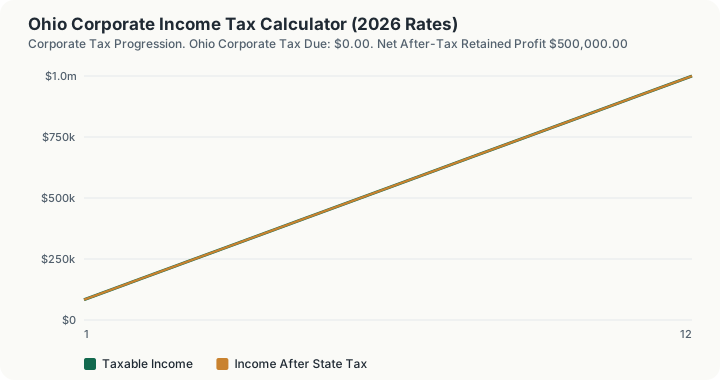
Quick Answer: On $500,000 of pre-apportioned taxable income, Ohio imposes no general state-level corporate income tax, so state tax due is $0.00 and net after-tax profit equals the full $500,000 (before any separate federal tax liability).
A State That Taxes Receipts Instead Of Profit
Ohio does not levy a net corporate income tax, joining Nevada, South Dakota, Texas, Washington, and Wyoming as one of six states in this dataset with a 0.00% corporate income tax rate. Unlike North Carolina's low-but-real 2.00% flat rate, Ohio collects nothing from corporations under a traditional net-income framework.
In place of an income tax, Ohio imposes its Commercial Activity Tax (CAT), a gross-receipts-style levy measured against total revenue rather than net profit, referenced elsewhere on this page as a tax this calculator does not model. A corporation comparing Ohio to a low-flat-rate state like North Carolina needs to weigh the CAT's gross-receipts base separately, since a high-revenue, low-margin business can face a meaningfully different burden under a receipts tax than under a net-income tax.
Because Ohio's corporate income tax rate is 0.00%, the calculator's $500,000 example produces no net-income tax liability at all, compared with $32,500.00 for the identical income in a flat 6.50%-rate state like Tennessee. Ohio's Commercial Activity Tax, assessed on gross receipts rather than net income, sits entirely outside that comparison.
How This Is Calculated
Ohio abolished its corporate franchise tax on income and replaced it with the Commercial Activity Tax, a tax on gross receipts. That is a different tax on a different base: the CAT is charged on Ohio-sourced revenue regardless of whether the business made a profit, applies above an exclusion threshold that has been raised substantially in recent years, and cannot be reduced by deductions, cost of goods sold, or net operating losses. There is no Ohio corporate income tax rate to apply.
The corporate income tax result is fixed at zero at every income level. Ohio's actual business tax runs on a receipts base instead:
- Corporate Income Tax Determination: Ohio levies no corporate income tax, so no federal-to-state income base is computed and no income tax return is filed.
- Ohio Gross Receipts Measurement: Taxable gross receipts sitused to Ohio are totalled. Receipts are sourced to where the benefit is received, which for services means the customer's Ohio location.
- Exclusion Threshold Test: Annual Ohio taxable gross receipts are measured against the statutory exclusion amount. Businesses below it owe no CAT and, above a lower registration floor, may still have a filing obligation.
- CAT Rate Application: The statutory CAT rate is applied to receipts above the exclusion. Because the base is revenue, a loss-making Ohio business can owe CAT while a profitable one with few Ohio receipts owes little.
- Municipal Net Profits Tax: Ohio cities levy their own net profits taxes on business income earned within their limits, filed separately from the CAT and not included here.
- Federal Liability Verification: With no state income tax, the federal 21% corporate rate is the only income tax applied to these profits.
Worked Example
Using this calculator's baseline scenario: a corporation with $500,000 in taxable income apportioned to Ohio.
- Start with apportioned taxable income. The corporation has $500,000 of taxable business income apportioned to Ohio.
- Apply Ohio's statutory corporate income tax rate. Ohio does not levy a general corporate income tax on this income, so the applicable state rate is 0.00%: $500,000 × 0.00% = $0.00.
- Ohio state corporate income tax due: $0.00.
- Net retained profit. With no state income tax liability, the corporation retains the full $500,000.00 apportioned to Ohio.
This calculator computes only the Ohio state corporate income tax shown above; it does not compute, model, or include federal corporate income tax in this result. Separately from this calculator's output, the corporation's federal taxable income would remain subject to the flat 21% federal corporate income tax rate under IRC § 11, assessed independently by the IRS regardless of Ohio's lack of a state-level corporate income tax.
What This Calculator Returns For Ohio, And Why It Is Always Zero
Ohio abolished its corporate franchise tax on net income and replaced it with the Commercial Activity Tax, a levy on gross receipts. The state's entry in this engine's table is flagged as a zero-tax jurisdiction, and the sweep confirms what that means at every scale.
At $500,000 of apportioned income. The tax is $0.00 and net retained profit is the full $500,000.00.
At $5,000,000. The tax is $0.00 and retained profit is $5,000,000.00.
At $50,000,000. Still $0.00. There is no income level anywhere in this calculator's accepted range, from zero to one billion dollars, at which Ohio's corporate income tax becomes a positive number. The twelve-row schedule reflects this exactly: every row shows the tier income in the second column and $0.00 in the third.
The marginal cost of the next unit is $0.00. Each additional $1,000, or $1,000,000, of Ohio apportioned net income adds nothing to the figure this page computes. That is a true statement about Ohio's corporate income tax and a badly misleading one about an Ohio corporation's actual tax position.
The credit field is inert here. The engine computes net tax as the entered credits subtracted from the computed tax and floored at zero. Because the computed tax is already zero, entering $250,000 of Ohio R&D or job-creation credits changes the displayed answer from $0.00 to $0.00. Those credits are real and they do offset the Commercial Activity Tax, but this page has no CAT figure for them to reduce.
Right method against wrong method, and it is the whole point of the page. A business planner who reads $0.00 and concludes Ohio costs nothing has used the wrong base entirely. The Commercial Activity Tax is assessed on gross receipts sourced to Ohio, not on net profit, and the two bases diverge most for exactly the businesses that most want a low tax: a high-revenue, thin-margin distributor pays CAT on the whole revenue line while its net income, the only figure this calculator accepts, may be near zero. Nothing on this page computes receipts, applies the CAT exclusion amount, or produces a CAT liability.
What else the zero conceals. Public Law 86-272, which shields out-of-state sellers from net income taxation, offers no protection against a gross receipts tax and is therefore largely irrelevant to Ohio exposure. Ohio's municipal net profits taxes, levied by hundreds of cities on business income earned within their limits, are also computed nowhere here. The $0.00 above is the Ohio corporate income tax, and it is accurate, but it is one of at least three Ohio business levies and the smallest of them by a wide margin.
What This Does Not Account For
- Federal corporate income tax (21% under IRC § 11).
- Specialized gross receipts taxes (e.g. Ohio CAT, Washington B&O, Texas Franchise Tax) where applicable.
- Minimum entity franchise tax fees or annual report filing charges.
- Base Erosion and Anti-Abuse Tax (BEAT) or Global Intangible Low-Taxed Income (GILTI) provisions.
- Local municipal corporate earnings taxes (e.g. NYC General Corporation Tax).
Common Pitfalls
- Assuming 0.00% Means Zero State Tax: Treating Ohio's 0.00% corporate income tax rate as the whole picture, when the Commercial Activity Tax still applies to gross receipts regardless of net profit.
- Improper Apportionment Sourcing: Applying market-based sourcing vs cost-of-performance rules incorrectly for service revenue tied to Ohio.
- Ignoring Unitary Group Combined Reporting: Failing to account for mandatory combined return requirements across related entities in states where a corporation does owe net income tax.
- Neglecting State NOL Carryforward Caps: Overlooking annual percentage limitations on net operating loss deductions in the other states where an Ohio-based company actually owes income tax, since Ohio's own CAT doesn't use an NOL mechanism the same way.
Frequently Asked Questions
Does Ohio have a corporate income tax?
When are Ohio corporate tax returns due?
Does Ohio tax S-corporations and LLCs?
How is multi-state corporate income apportioned to Ohio?
Sources
- Multistate Tax Commission (MTC): Uniform Apportionment and Allocation Guidelines. mtc.gov
Also consulted: Ohio Department of Taxation: Corporate Tax Statutes and Guidance (2026).