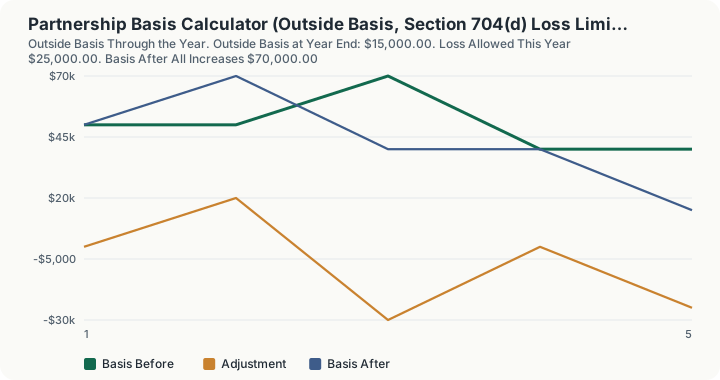
Quick Answer: A partner starting with $50,000 of outside basis, picking up $20,000 more of liability share, taking $30,000 of cash distributions and absorbing a $25,000 loss ends the year with $15,000 of outside basis. The whole $25,000 loss is allowed, nothing is suspended under section 704(d), and no section 731(a)(1) gain arises because the distributions stayed inside basis.
What does this calculator do?
A partner's outside basis is their adjusted basis in the partnership interest itself, as opposed to the partnership's inside basis in its own assets. It is the single number that decides three separate questions every year: how much partnership loss the partner may actually deduct, whether a cash distribution is a tax-free return of capital or a taxable gain, and how much gain or loss arises when the interest is eventually sold.
Outside basis is not the capital account on the K-1. The two diverge the moment partnership liabilities enter the picture, because section 752(a) treats an increase in a partner's share of partnership debt as a contribution of money, and section 752(b) treats a decrease as a distribution of money. A partner who wrote no cheque at all this year can gain basis simply because the partnership borrowed. A partner who received no money at all can be taxed because the partnership repaid a loan. Capital accounts do not behave that way, which is why relying on them is one of the most common ways to get this wrong.
This calculator runs one year of the basis waterfall in the order the statute requires, and reports what the loss limitation of section 704(d) does to the year's loss.
How is this calculated?
The engine runs a strict five-step waterfall. Everything is floored at zero: basis can never go negative.
Closing basis = max(0, [ max(0, (B₀ + I) − D)] − N_claimed − L_allowed)
where B₀ is opening basis, $I$ the total section 705(a)(1) increases, $D$ the total distributions including deemed distributions, $N$ the nondeductible non-capital expenditures and $L$ the loss.
Step 1: Start from the opening outside basis. The basis carried in from last year, floored at zero: $50,000
Step 2: Add every section 705(a)(1) increase. Contributions under section 722, the distributive share of taxable income, tax-exempt income under section 705(a)(1)(B), and the section 752(a) liability increase are summed: $0 + $0 + $0 + $20,000 = $20,000 of total increases
Step 3: Carry that to the basis before any decrease. $50,000 + $20,000 = $70,000
Step 4: Subtract distributions, including the section 752(b) deemed distribution. Cash distributions plus any decrease in the liability share are added together first: $30,000 + $0 = $30,000 of total deemed distributions
Step 5: Test for section 731(a)(1) gain. Gain arises only to the extent distributions exceed basis: (0, \30{,}000 - \$70{,}000) = $$0 of gain
Step 6: Reduce basis by the distributions, floored at zero. (0, \70{,}000 - \$30{,}000) = $$40,000 available to absorb loss
Step 7: Total the demand on that remaining basis. Nondeductible non-capital expenditures plus the loss available (the current-year share plus any suspended loss carried in): $0 + ($25,000 + $0) = $25,000 of demand
Step 8: Compare demand against basis available. $25,000 demand is less than or equal to $40,000 available, so both the expenditures and the whole loss are absorbed in full. Loss allowed: $25,000. Loss suspended: $0.
Step 9: Compute the closing basis. $40,000 − $0 − $25,000 = $15,000
If demand had exceeded the basis available, Treas. Reg. 1.704-1(d)(2) decides the order: the nondeductible expenditure comes off basis first, and the loss is allowed only against whatever is left. The unabsorbed loss is suspended indefinitely under section 704(d).
Worked Example
Take a partner in a leveraged real estate LLC. Opening basis $50,000. The partnership refinances, and the partner's allocated share of the new nonrecourse debt rises by $20,000. The partnership distributes $30,000 of refinancing proceeds to the partner in cash. The K-1 reports a $25,000 loss.
Step 1: Opening basis. $50,000
Step 2: Section 752(a) deemed contribution. The $20,000 rise in the liability share is treated as a cash contribution even though no cash moved: $50,000 + $20,000 = $70,000
Step 3: Distributions. $30,000 of cash, plus $0 of liability relief: $30,000
Step 4: Gain test under section 731(a)(1). $30,000 distributed is less than $70,000 of basis, so: $0 of gain: the distribution is a tax-free return of capital
Step 5: Basis after distributions. $70,000 − $30,000 = $40,000
Step 6: Loss limitation under section 704(d). $25,000 of loss against $40,000 of basis: (\25{,}000,\ \$40{,}000) = $$25,000 allowed, $0 suspended
Step 7: Closing basis. $40,000 − $25,000 = $15,000
Now change one input. Suppose the partnership had instead paid down $75,000 of debt and the partner's liability share fell by that amount. Section 752(b) makes that a deemed cash distribution of $75,000 against $50,000 of basis, so the partner recognises $25,000 of section 731(a)(1) gain, basis drops to zero, and the entire $25,000 loss is suspended: a tax bill and a lost deduction in the same year, from a transaction in which the partner received nothing at all.
What does this calculator not account for?
- The at-risk limitation of section 465 and the passive activity loss limitation of section 469. Both apply after section 704(d). A loss this page reports as allowed can still be suspended by either of them, and nonrecourse debt that gives basis under section 752 frequently gives no at-risk amount at all.
- The character of the suspended loss. Capital and ordinary items are not tracked separately, and section 704(d)(3)'s special ordering for charitable contributions and foreign taxes is not applied.
- Distributions of property rather than money. Property distributions carry over basis under section 732 instead of triggering section 731(a)(1) gain, and are outside this model.
- Whether the liability allocation itself is correct. The split of recourse and nonrecourse debt under Treas. Reg. 1.752-1 through 1.752-3 is assumed; you enter the result, not the reasoning.
What mistakes do people make with this?
- Using the capital account instead of outside basis. They are different numbers computed under different rules. A tax capital account of zero does not mean outside basis is zero, and vice versa.
- Deducting a loss the basis cannot support. Section 704(d) allows loss only to the extent of basis at year end. The excess is not lost, but it is not this year's deduction either.
- Forgetting that distributions come out of basis before losses do. The ordering is not optional. A large distribution can consume the basis a loss needed, converting a deductible loss into a suspended one.
- Assuming debt paydown is tax-neutral. A decrease in the liability share is a deemed distribution. Partnerships that deleverage routinely generate phantom gain for partners whose basis was already thin.
- Ignoring tax-exempt income. Section 705(a)(1)(B) adds it to basis even though it is never taxed, which is precisely why it is easy to leave out.
- Treating a suspended loss as expired. The section 704(d) carryforward is indefinite and follows the partner. It is released the moment basis reappears, whether from income, a contribution or a new liability share.
Frequently Asked Questions
What is the difference between outside basis and my capital account?
Can my outside basis go below zero?
How does a partnership loan increase my basis if I did not put in any money?
How long can a suspended section 704(d) loss be carried forward?
If I have suspended losses, what releases them?
Does this calculator tell me whether I can actually deduct the loss on my return?
Sources
- 26 U.S.C. 705(a): basis increased by the distributive share of income and tax-exempt income, decreased but not below zero by distributions, losses and nondeductible non-capital expenditures. law.cornell.edu/uscode/text/26/705
- 26 U.S.C. 722: basis of a contributing partner's interest. law.cornell.edu/uscode/text/26/722
- 26 U.S.C. 752(a) and 752(b): an increase in the share of partnership liabilities is a deemed contribution of money; a decrease is a deemed distribution of money. law.cornell.edu/uscode/text/26/752
- 26 U.S.C. 731(a)(1): gain recognised to the extent money distributed exceeds the adjusted basis of the interest. law.cornell.edu/uscode/text/26/731
- 26 U.S.C. 704(d): loss allowed only to the extent of adjusted basis at year end, with the excess allowed in a later year to the extent basis is restored. law.cornell.edu/uscode/text/26/704
- Treas. Reg. 1.704-1(d)(2): basis is reduced by distributions and nondeductible expenditures before the loss limitation is applied. ecfr.gov/current/title-26/section-1.704-1
All statutory text verified 2026-08-30. No dollar figures appear in any of these sections; the entire computation is driven by the partner's own K-1.