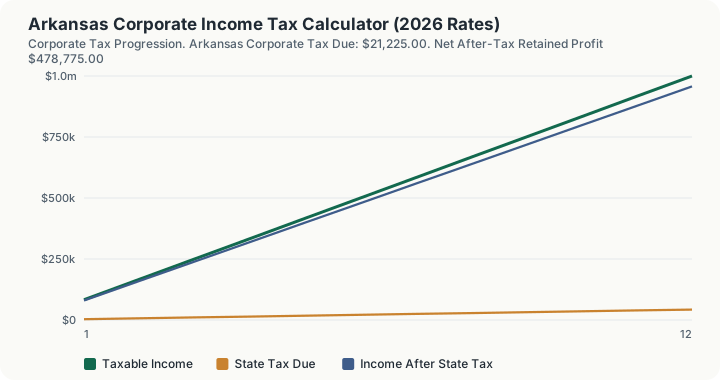
Quick Answer: On $500,000 of pre-apportioned taxable income, Arkansas's graduated corporate income tax brackets (reaching 4.30% at this income level) produce $21,225.00 in state tax due and $478,775.00 in net after-tax profit.
A Graduated Schedule That Runs Out at $25,000
Five brackets and a top marginal rate of 4.30% define Arkansas's corporate income tax schedule, the lowest ceiling among the ten states in this dataset that use graduated rather than flat corporate rates. The brackets move in small increments: 1% on the first $3,000 of apportioned income, rising through 2%, 3%, and 4% before reaching the 4.30% rate that applies above $25,000.
Because the top bracket kicks in at a relatively low $25,000 threshold, most corporations with any meaningful Arkansas-sourced income face the 4.30% marginal rate on the bulk of their earnings, since the early, lower brackets shelter only a small slice of income. That combination of a low ceiling and a low threshold makes Arkansas's effective rate converge toward its top rate faster than in states like Oregon or New Jersey, where the top bracket only applies well above $500,000.
At the calculator's $500,000 baseline, Arkansas's bracket structure produces a 4.25% effective rate against a 4.30% marginal rate, a narrow gap that reflects how quickly the schedule's low thresholds push most income into the top bracket. Larger filers see that gap shrink further, converging toward 4.30% as income climbs.
How This Is Calculated
Arkansas still runs a graduated corporate schedule, but it is a vestigial one: five brackets compress into the first $25,000 of income, above which everything is taxed at 4.30%. For any filer of size the schedule is functionally flat, and the low brackets are worth a few hundred dollars, not a planning strategy. At $500,000 the calculator returns $21,225.00, an effective rate of 4.25% against a 4.30% top rate.
where $c_i$ are the bracket ceilings ($3{,}000$, $6{,}000$, $11{,}000$, $25{,}000$, then unlimited) and $r_i$ the corresponding rates ($1\%$, $2\%$, $3\%$, $4\%$, $4.30\%$).
The engine runs three steps and no more. Apportionment, modifications and loss carryforwards all have to be settled before the figure reaches this box.
- Take the income figure as entered. There is no single-sales-factor computation inside this calculator, no depreciation modification, no nexus test and no NOL carryforward. Whatever you type is treated as final Arkansas taxable income.
- Walk the five brackets. Each slice is multiplied by its own rate and the pieces are added: 1% on the first $3,000, 2% to $6,000, 3% to $11,000, 4% to $25,000, and 4.30% on everything above. At $500,000 the pieces total $21,225.00.
- Subtract credits, floor at zero, and report. $10,000 of credits against the baseline returns $11,225.00 and moves the effective rate from 4.25% to 2.25%, while the marginal rate, computed before credits, still reads 4.30%. Net retained profit is $478,775.00 at the baseline.
Arkansas's separate annual franchise tax, administered by the Secretary of State, is not an income tax and forms no part of this result.
Worked Example
Using this calculator's baseline scenario: a corporation with $500,000 in taxable income apportioned to Arkansas.
- Start with apportioned taxable income. The corporation has $500,000 of taxable income apportioned to Arkansas before state tax is applied.
- Work through Arkansas's bracket schedule. Arkansas taxes corporate income progressively: each slice of income is taxed only at the rate for its own bracket rather than the entire amount being taxed at the top rate, so lower brackets are filled first and the marginal rate rises step by step as income climbs.
- Marginal rate reached at this income level. At $500,000 of taxable income, the highest bracket reached is 4.30%.
- Sum the marginal brackets. Adding together the tax owed within every bracket the $500,000 passes through produces a total Arkansas state tax liability of $21,225.00.
- Net retained profit. $500,000 − $21,225.00 = $478,775.00 retained after state tax, before any separate federal tax liability.
Because the calculation sums each bracket's marginal tax rather than applying one flat rate to the whole amount, the resulting effective rate (4.25%) is always lower than the top marginal bracket actually touched.
Four Edges Inside the First $25,000
Every bracket Arkansas has is spent before a corporation reaches $25,000 of apportioned income, and the calculator prices each edge to the cent. Each figure below is a separate run.
At $2,999, the top of the 1% band. Arkansas tax = $29.99, effective rate 1.00%, marginal rate 1.00%.
At $3,001, two dollars later. Arkansas tax = $30.02, and the marginal rate flips to 2.00%. Three cents bought the step.
At $6,000. Arkansas tax = $90.00, an effective rate of 1.50% against a 2.00% marginal rate. At $11,000 the tax is $240.00, effective 2.18%, marginal 3.00%.
At $24,999, the last dollar below the top rate. Arkansas tax = $799.96, effective 3.20%, marginal 4.00%.
At $25,001. Arkansas tax = $800.04, and the marginal rate reaches 4.30%. That is the final step in the schedule. Above it there is no edge at any income: $26,000 returns $843.00, $49,000 returns $1,832.00, $99,000 returns $3,982.00, and the marginal rate reads 4.30% at every one of them.
What the Graduated Schedule Is Actually Worth
Very little, and the sweep says how little. Each additional $1,000 of Arkansas taxable income above $25,000 costs $43.00: $499,000 returns $21,182.00 and $500,000 returns $21,225.00. The four cheap bands below $25,000 never grow, so their benefit is a fixed amount that a larger filer dilutes away.
Watch the effective rate converge on the top rate as that happens. At $250,000 of income the tax is $10,475.00, an effective rate of 4.19%. At $500,000 it is $21,225.00, or 4.25%. At $1,000,000 it is $42,725.00, or 4.27%. At $5,000,000 it is $214,725.00, or 4.29%. The gap between effective and marginal shrinks from eleven basis points to one, which is why the graduated schedule is worth reading as a rounding detail rather than a planning lever for any filer of size.
The reverse question has a precise answer: $25,000. That is the most Arkansas income a corporation can report before the next dollar is taxed at 4.30%, and the tax on exactly that amount is $800.00.
The Credits Field, and the Cliff at the Bottom of It
Credits come off the bracket total and the answer is floored at zero. On the $500,000 baseline, $10,000 of credits returns $11,225.00. $50,000 of credits returns $0.00, and so does $1,000,000 of credits.
The engine treats credits as non-refundable with no carryforward, so $950,000 of credit value evaporates between those two runs with nothing reported about it. The twelve-row schedule, meanwhile, is computed from the brackets alone and never sees the credit input at all, so a credited run shows $11,225.00 in the headline while the table's sixth row still reads $21,225.00.
What This Does Not Account For
- Federal corporate income tax (21% under IRC § 11).
- Specialized gross receipts taxes (e.g. Ohio CAT, Washington B&O, Texas Franchise Tax) where applicable.
- Minimum entity franchise tax fees or annual report filing charges.
- Base Erosion and Anti-Abuse Tax (BEAT) or Global Intangible Low-Taxed Income (GILTI) provisions.
- Local municipal corporate earnings taxes (e.g. NYC General Corporation Tax).
- Arkansas's annual franchise tax, administered by the Secretary of State and assessed independently of income.
- Everything that produces the base. No single-sales-factor apportionment, no nexus or P.L. 86-272 test, no depreciation or other state modification and no NOL carryforward are computed here.
- Credit carryforward and refundability. $50,000 and $1,000,000 of credits both return $0.00 on the $500,000 baseline.
Common Pitfalls
- Applying the Top Bracket to the Whole Amount: Treating Arkansas's 4.30% top rate as a flat rate rather than stepping through the 1%, 2%, 3%, and 4% brackets that apply below $25,000 of apportioned income.
- Improper Apportionment Sourcing: Applying market-based sourcing vs cost-of-performance rules incorrectly for service revenue, which shifts income between Arkansas's five brackets.
- Ignoring Unitary Group Combined Reporting: Failing to account for Arkansas's mandatory combined return requirements across related entities.
- Neglecting State NOL Carryforward Caps: Overlooking Arkansas's annual percentage limitations on net operating loss deductions, which matter less here given how quickly the schedule's low thresholds push income into the 4.30% top bracket.
Frequently Asked Questions
Does Arkansas have a corporate income tax?
When are Arkansas corporate tax returns due?
Does Arkansas tax S-corporations and LLCs?
How is multi-state corporate income apportioned to Arkansas?
Sources
- Arkansas Department of Finance and Administration: Corporate Tax Statutes and Guidance (2026). dfa.arkansas.gov
- Multistate Tax Commission (MTC): Uniform Apportionment and Allocation Guidelines. mtc.gov