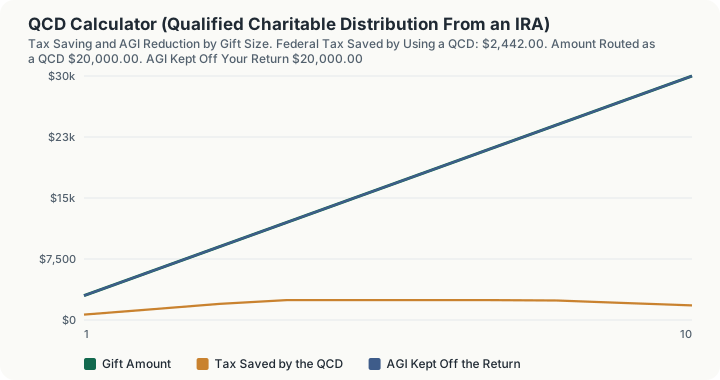
Quick Answer: A 73-year-old giving $20,000 from a $30,000 IRA distribution saves $2,442.00 of federal income tax by routing it as a Qualified Charitable Distribution rather than taking the whole distribution into income and donating cash. The QCD route pays $6,570.00 on $70,000 of AGI; the cash-gift route pays $9,012.00 on $90,000. The QCD also satisfies $20,000 of the $25,000 RMD, leaving $5,000 still to take.
What does this calculator do?
A Qualified Charitable Distribution under IRC section 408(d)(8) is money transferred directly from a traditional IRA to a qualifying charity by the custodian. It never touches your bank account and it never enters your adjusted gross income.
That last point is the whole thing, and it is why a QCD is not simply "a tax-efficient way to donate."
A cash gift is a deduction. It only helps to the extent your total itemised deductions clear the standard deduction, and even when it does help, it does nothing at all to AGI.
A QCD is an exclusion. The money never enters AGI, so it helps whether you itemise or not, which matters enormously, because most retirees take the standard deduction and get precisely nothing from a charitable gift.
And AGI is not a bookkeeping figure for a retiree. It drives the taxation of Social Security under section 86, it drives Medicare IRMAA surcharges two years later, and it drives the medical expense deduction floor. Keeping $20,000 out of AGI is worth more than the federal tax number on this page shows, because none of those second-order effects are modelled here.
How is this calculated?
The engine computes two complete returns on identical facts and differences the tax.
AGI_QCD = other income + (IRA distribution − QCD amount)
AGI_cash = other income + IRA distribution
Deduction taken = max(standard deduction, itemised total)
Saving = T(AGI_cash) − T(AGI_QCD)
Step by step:
Step 1: Test eligibility. A QCD requires age 70½ or older on the day of the distribution. Below that, no QCD is available and both paths collapse to the cash gift.
Step 2: Size the QCD. It is the smallest of three things: the amount you want to give, the distribution it comes out of, and the 2026 annual exclusion limit of $111,000 per individual.
Step 3: Identify any donation the QCD could not absorb. Whatever the QCD cannot cover remains an ordinary cash gift, itemisable on the QCD path too.
Step 4: Build the QCD path's AGI. Other income plus the part of the distribution that was not routed as a QCD.
Step 5: Choose the QCD path's deduction. The larger of the standard deduction and the itemised total (other itemised deductions plus any un-absorbed gift). The excluded QCD amount is deliberately not deductible; you cannot exclude and deduct the same dollar.
Step 6: Compute the QCD path's federal tax on the 2026 ordinary schedule.
Step 7: Build the cash-gift path's AGI. Other income plus the entire distribution.
Step 8: Choose the cash-gift path's deduction. Other itemised deductions plus the whole donation, against the standard deduction.
Step 9: Compute the cash-gift path's federal tax.
Step 10: Difference the two, and report the AGI kept off the return.
Step 11: Apply the QCD against the RMD. A QCD counts toward the required minimum distribution dollar for dollar, capped at the RMD itself.
Worked Example
Using the defaults: age 73, $30,000 IRA distribution, $20,000 gift, $60,000 of other income, $5,000 of other itemised deductions, $25,000 RMD, single filer. The 2026 single standard deduction is $16,100.
Step 1: Confirm eligibility. Age 73 is at or above 70½, so a QCD is available.
Step 2: Size the QCD. min($20,000 gift, $30,000 distribution, $111,000 limit) = $20,000.00
Step 3: Find the donation the QCD could not absorb. $20,000 − $20,000 = $0.00
Step 4: Build the QCD path's AGI. $60,000 + ($30,000 − $20,000) = $70,000.00
Step 5: Choose the QCD path's deduction. Itemised total is $5,000, below the $16,100 standard deduction, so the standard deduction is taken. $70,000 − $16,100 = $53,900.00 of taxable income
Step 6: Compute the QCD path's federal tax. 10% × $12,400 = $1,240.00; 12% × $38,000 = $4,560.00; 22% × $3,500 = $770.00. $1,240.00 + $4,560.00 + $770.00 = $6,570.00
Step 7: Build the cash-gift path's AGI. $60,000 + $30,000 = $90,000.00
Step 8: Choose the cash-gift path's deduction. $5,000 + $20,000 = $25,000 of itemised deductions, which beats $16,100, so this path itemises. $90,000 − $25,000 = $65,000.00 of taxable income
Step 9: Compute the cash-gift path's federal tax. 10% × $12,400 = $1,240.00; 12% × $38,000 = $4,560.00; 22% × $14,600 = $3,212.00. $1,240.00 + $4,560.00 + $3,212.00 = $9,012.00
Step 10: Difference the two. $9,012.00 − $6,570.00 = $2,442.00 saved by the QCD
Step 11: Read the AGI difference. $90,000 − $70,000 = $20,000.00 of AGI kept off the return, on top of the tax saving.
Step 12: Apply the QCD to the RMD. min($20,000, $25,000) = $20,000.00 of the RMD satisfied, leaving $5,000.00 still to take.
Note what happened here. This taxpayer does itemise on the cash-gift route, so the gift is not wasted. The QCD still wins by $2,442, purely because an exclusion beats a deduction of the same size when the deduction merely displaces a standard deduction you were entitled to anyway.
What does this calculator not account for?
- State income tax. Many states start from federal AGI, which makes the exclusion worth more than shown. Others do not conform. None of it is modelled.
- The taxation of Social Security under section 86. A $20,000 lower AGI can pull benefits back out of taxable income, and that effect is not included in the $2,442.
- Medicare IRMAA. The 2026 income here sets the 2028 Part B and Part D premiums. Staying under a threshold can be worth thousands a year per beneficiary, and none of that is computed on this page.
- The AGI-percentage ceilings on charitable deductions (the 60%, 50% and 30% limits and their carryforwards). The cash-gift path deducts the full gift.
- The medical expense deduction floor, which is a percentage of AGI and therefore moves with it.
- Whether the recipient is a qualifying charity. Donor-advised funds and most private foundations are excluded from QCD treatment. The calculator assumes a qualifying recipient.
- Ongoing SEP and SIMPLE IRAs, which cannot be the source of a QCD.
- Basis in the IRA. QCDs come first out of the otherwise-taxable portion, and the calculator assumes the whole IRA is pre-tax.
- The reduction of the QCD limit for taxpayers who made deductible IRA contributions after age 70½.
What mistakes do people make with this?
- Taking the money first. A QCD must go directly from the custodian to the charity. Withdraw it into your own account and write a cheque, and it is an ordinary distribution plus an ordinary gift, however quickly you do it.
- Confusing 70½ with the RMD age. QCD eligibility starts at 70½. RMDs start later. There are several years in which a QCD is available and no RMD is due, and those are useful years.
- Missing the RMD ordering rule. The first dollars distributed in a year count toward the RMD. If you want a QCD to satisfy it, do the QCD before taking any other distribution.
- Sending it to a donor-advised fund. DAFs do not qualify. Neither do most private foundations or supporting organisations.
- Assuming a cash gift is equivalent because you itemise. On these defaults the taxpayer itemises and the QCD still wins by $2,442.
- Forgetting to tell your tax preparer. The Form 1099-R shows the full distribution. Nothing on it identifies the QCD; you report the taxable amount as reduced and write "QCD" on the return.
- Exceeding the annual limit. Anything above $111,000 for 2026 falls back to being an ordinary distribution plus an itemisable gift.
Frequently Asked Questions
How much can I give as a QCD in 2026?
Does a QCD count toward my RMD?
I take the standard deduction. Is a QCD still worth it?
Can I do a QCD from my 401(k)?
What age do I have to be?
Is the QCD deductible as well?
Sources
- IRS Notice 2025-67, irs.gov/pub/irs-drop/n-25-67.pdf: "The aggregate amount of qualified charitable distributions that are not includible in gross income under section 408(d)(8)(A) is increased from $108,000 to $111,000," and the split-interest entity election "is increased from $54,000 to $55,000." Fetched and read 2026-08-30.
- IRS, "Retirement plans FAQs regarding IRA distributions (withdrawals)": "a qualified charitable distribution is an otherwise taxable distribution from an IRA (other than an ongoing SEP or SIMPLE IRA) owned by an individual who is age 70½ or over." Fetched 2026-08-30. irs.gov/retirement-plans/retirement-plans-faqs-regarding-iras-distributions-withdrawals
- IRC section 408(d)(8): the statutory exclusion, the annual limit, and the split-interest entity election. law.cornell.edu/uscode/text/26/408
- IRS Revenue Procedure 2025-32, irs.gov/pub/irs-drop/rp-25-32.pdf: the 2026 ordinary brackets and the $16,100 single standard deduction, held in
engine/tables/2026/federal-tax.json.
Also consulted: IRS, "Seniors can reduce their tax burden by donating to charity through their IRA", "A QCD will count toward a required minimum distribution," reported with a taxable amount of zero. Fetched 2026-08-30.