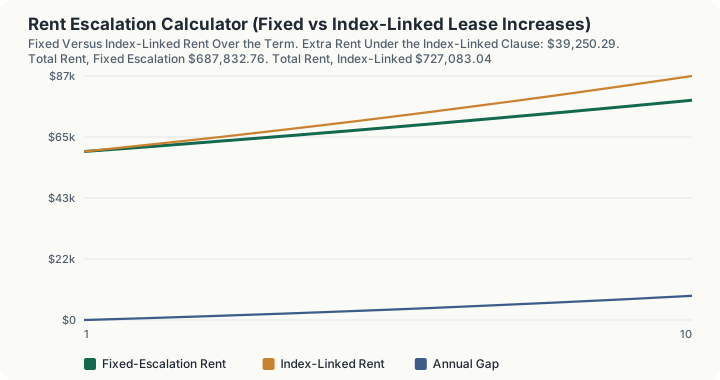
Quick Answer: A ten-year lease at $60,000 base rent costs $39,250.29 more under an index clause running at 4.2% than under a 3% fixed escalator. Total rent is $687,832.76 fixed against $727,083.04 indexed, the final-year gap alone is $8,601.79, and discounted at 6% the whole divergence is worth $25,557.31 in present value. At a 4.2% index the 5% cap never binds, so the equivalent fixed escalation is exactly 4.20%.
What does this calculator do?
Commercial leases, and increasingly long residential ones, escalate in one of two ways. A fixed clause raises rent by a stated percentage every year, known on the day you sign. An index-linked clause raises it by the movement in a published index, usually a consumer price index, and usually inside a collar: a cap protecting the tenant from a spike and a floor protecting the landlord from deflation.
Both compound, and that is the entire story. A 1.2 percentage point difference in the annual escalator is not a 1.2% difference in rent. Every year's increase applies to a base that already contains all the previous increases, so the gap widens geometrically and most of it lands in the back half of the term.
The collar is what makes the comparison non-obvious. A capped index clause is not "inflation". It is inflation truncated, and in a high-inflation year the cap, not the index, is the term you are actually signing. This calculator evaluates both streams year by year, applies the collar, and reports the single fixed rate you should be indifferent between, which is the only number that makes two structurally different clauses directly comparable.
How is this calculated?
Year one is the base rent in both clauses; escalation first applies in year two. Writing R₀ for the base rent, $f$ for the fixed escalator, and i^∗ for the collared index rate:
Rₙ^(fixed) = R₀(1 + f)^(n − 1); Rₙ^(index) = R₀(1 + i^∗)^(n − 1)
i^∗ = min(cap, max(floor, i))
PV = ∑(n = 1 to N) Rₙ/((1 + d)ⁿ)
Step 1: Apply the collar to the index assumption. The floor is 0% and the assumption is 4.2%, so the floor does not bind. The cap is 5% and 4.2% is below it, so the cap does not bind either: the applied rate is 4.20%
Step 2: Year one rent under both clauses is the base rent. Fixed $60,000.00, indexed $60,000.00, gap $0.00
Step 3: Year two: apply each escalator once. $60,000 x 1.03 = $61,800.00 fixed; $60,000 x 1.042 = $62,520.00 indexed; gap $720.00
Step 4: Year three: apply each escalator twice. $60,000 x 1.03^2 = $63,654.00; $60,000 x 1.042^2 = $65,145.84; gap $1,491.84
Step 5: Year ten: apply each escalator nine times. $60,000 x 1.03^9 = $78,286.39; $60,000 x 1.042^9 = $86,888.18
Step 6: The final-year gap. $86,888.18 - $78,286.39 = $8,601.79
Step 7: Sum all ten years of the fixed stream. Total fixed rent = $687,832.76
Step 8: Sum all ten years of the indexed stream. Total indexed rent = $727,083.04
Step 9: The total difference over the term. $727,083.04 - $687,832.76 = $39,250.29
Step 10: Discount each year's rent at 6% and sum. Present value fixed = $499,128.23; present value indexed = $524,685.54
Step 11: The present value of the divergence. $524,685.54 - $499,128.23 = $25,557.31
Step 12: Express the growth of each stream as a multiple of the starting rent. 1.03^9 = 1.3048x fixed; 1.042^9 = 1.4481x indexed
Step 13: Solve for the fixed escalation whose total matches the indexed total. The engine bisects on the rate until the undiscounted total equals $727,083.04, giving 4.20%
Step 11 is worth pausing on. The nominal gap is $39,250.29 but its present value is $25,557.31, about 65% of it. That is because the divergence is concentrated in the late years, exactly where the discount factor bites hardest. A tenant comparing two clauses on nominal totals systematically overstates how much the difference matters; a landlord doing the same systematically overstates what the index clause is worth.
Worked Example
Now assume inflation runs hot and the index moves at 7% a year rather than 4.2%. Every other input is unchanged, and the 5% cap is now the binding term.
Step 1: Apply the collar. The raw index is 7%, the cap is 5%, so the applied rate is 5.00% and the cap binds in every escalation year
Step 2: Year ten rent under the capped index clause. $60,000 x 1.05^9 = $93,079.69
Step 3: Year ten rent under the fixed clause, unchanged. $60,000 x 1.03^9 = $78,286.39
Step 4: The final-year gap. $93,079.69 - $78,286.39 = $14,793.30
Step 5: The escalation the tenant actually signed up to. Not 7%, and not 4.2%, but 5.00%: the cap, in every single year
Step 5 is the whole point of modelling the collar. In a high-inflation environment the negotiation over the index is close to irrelevant and the negotiation over the cap is everything, because the cap is the number that will actually be applied. The mirror image holds at the bottom: run the index at negative 1% and the 0% floor holds rent flat rather than letting it fall, which is the landlord's protection and is invisible if you model the index alone.
Carrying the Capped Clause Across the Term
Still at the 7% index, where the 5% cap binds every year:
Step 6: Year one, both clauses. Fixed $60,000.00, capped index $60,000.00, gap $0.00. Escalation first applies in year two.
Step 7: Year two. Fixed $60,000 x 1.03 = $61,800.00. Capped index $60,000 x 1.05 = $63,000.00. Gap $1,200.00.
Step 8: Cumulative rent after two years. Fixed $121,800.00, capped index $123,000.00, cumulative gap $1,200.00.
Step 9: Cumulative rent across the full ten years. Fixed $687,832.76, capped index $754,673.55, total difference $66,840.79, of which $14,793.30 falls in year ten alone.
The first year of divergence costs $1,200 and the last costs $14,793.30, so more than a fifth of the ten-year gap arrives in the final year. Compare that with the 4.2% case elsewhere on this page, where the same term diverges by $39,250.29: raising the index assumption by 2.8 points added only $27,590.50 of rent, because the cap absorbed the rest. The cap is doing more work than the index in this scenario, and it is the term to negotiate.
What does this calculator not account for?
- It applies one constant index assumption to every year. Real indices move differently each year, and a cap that binds in year three may not bind in year seven. This models a single collared rate applied throughout, which is exact when the assumption holds and approximate otherwise.
- It does not model a cumulative or "catch-up" cap, where an increase suppressed by the cap in one year can be recovered in a later year when the index falls below it. Those clauses cost a tenant more than the simple cap modelled here.
- It does not model stepped or stepped-plus-index structures, market rent reviews, ratchet clauses, or reviews that occur other than annually.
- It ignores operating expenses entirely. Base rent is only part of a lease. Net leases pass through taxes, insurance and common area costs, and those escalate on their own terms.
- It does not model rent-free periods, fit-out contributions, or other inducements, all of which change the economics of a lease more than a modest difference in escalator.
- It assumes rent is paid annually at year end for the present value calculation. Monthly payment in advance produces a slightly higher present value for both streams, and only a negligible change in the difference between them.
- It contains no tax treatment. Rent is deductible to most business tenants, so the after-tax cost of the divergence is smaller than the pre-tax figures shown.
What mistakes do people make with this?
- Comparing escalators as if they were simple. A 3% clause and a 4.2% clause differ by 1.2 points in year one and by $8,601.79 in year ten. The compounding is the cost.
- Treating an index clause as "just inflation". With a cap, it is inflation or the cap, whichever is lower. With a floor, it is inflation or the floor, whichever is higher. It is only inflation in the range between the two.
- Negotiating the index and ignoring the cap. In an inflationary decade the cap is the operative term, and a tenant who wins a favourable index definition while conceding a high cap has won nothing.
- Setting a floor equal to the fixed rate and calling it a compromise. A floor at 3% against a fixed clause at 3% means the tenant can never do better than the fixed clause and can do considerably worse. That is not a collar, it is a one-way option in the landlord's favour.
- Comparing nominal totals across leases of different lengths. A twelve-year lease will always total more than a ten-year one. Compare present values, or compare the equivalent fixed rate the calculator reports.
- Forgetting which direction the sign runs. The headline figure here is the indexed total less the fixed total. When the index runs below the fixed rate (1.5% against 3%, for instance) the sign reverses and the fixed clause becomes the expensive one.
Frequently Asked Questions
Is a fixed escalation or a CPI escalation better for a tenant?
What does the cap actually protect me from?
Why is the present value of the gap so much smaller than the nominal gap?
Should the escalation apply in year one?
What discount rate should I use?
Sources
- U.S. Bureau of Labor Statistics, Consumer Price Index. bls.gov/cpi
This calculator uses no statutory or tabulated data. It is pure lease mathematics, implemented in engine/primitives/rent-escalation.ts: compound escalation of both streams from the base rent, a collar applied by clamping the index assumption between the floor and the cap, discounted cash flow at the stated rate, and a bisection search for the equivalent fixed escalation rate.
Also consulted: The index assumption, the cap, the floor and the discount rate are all user inputs, because none of them has a national or universal value. Your index assumption should come from the published series your lease actually names, and the cap and floor from the executed lease document; Method reference: standard annuity and discounted cash flow relationships as set out in PRIMITIVES.md, section 1 (time value of money), with the sign convention documented there.