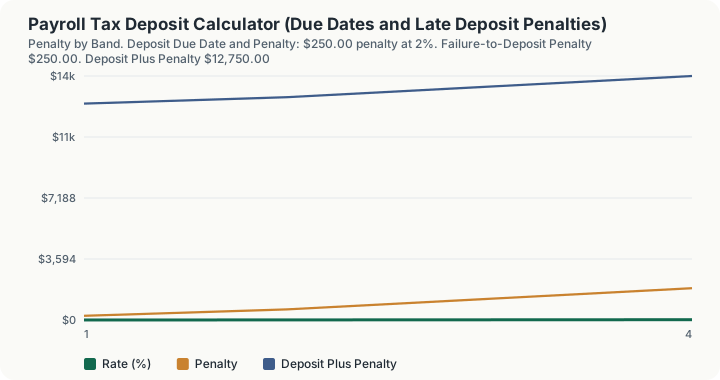
Quick Answer: A $12,500 deposit made 3 calendar days late draws a $250.00 penalty at 2%. The employer, with $74,500 of tax in the lookback period, is a semiweekly schedule depositor, so the Wednesday 16 September 2026 payday was due 2026-09-23, and that flat 2% for three days annualises to roughly 243.3% a year. Interest under IRC section 6601 runs on top and is not included.
What does this calculator do?
Federal employment taxes are not paid when the return is filed. They are deposited on a schedule that runs independently of Form 941, and the penalty for missing that schedule is charged on the deposit, not on the quarter. This calculator answers the two questions that matter: when is the deposit due, and what does being late cost.
Two rules drive the due date. First, your depositor status is fixed for the whole calendar year by the tax you reported in the lookback period: the four quarters running from 1 July of the second preceding year to 30 June of the prior year. $50,000 or less makes you a monthly schedule depositor; more than $50,000 makes you semiweekly. Second, the $100,000 next-business-day rule overrides both: accumulate $100,000 of liability on any day in a deposit period and that deposit is due the next business day, however small your lookback figure.
The penalty side is a four-band structure under IRC section 6656, and the single most misread feature of it is that the bands do not stack. Exactly one rate applies. Being twenty days late is a 10% penalty, not 2% plus 5% plus 10%.
How is this calculated?
Penalty = Deposit amount × r; r ∈ {2%, 5%, 10%, 15%}
Step 1: Total the lookback period. The tax reported across the four lookback quarters: $74,500
Step 2: Compare that against the $50,000 threshold. $74,500 is greater than $50,000, so: Semiweekly schedule depositor Headroom below the threshold: $50,000 − $74,500 = −$24,500 (a negative figure means you are over it)
Step 3: Test the $100,000 one-day rule. Largest single-day accumulation entered is $0, which is below $100,000, so: The next-business-day rule does not apply
Step 4: Find the payday's weekday. 16 September 2026 is a Wednesday
Step 5: Apply the semiweekly window. A Wednesday, Thursday or Friday payday is deposited by the following Wednesday: 16 September + 7 days = 2026-09-23 A due date landing on a Saturday is rolled forward two days and a Sunday by one day. Federal legal holidays are not modelled.
Step 6: Select the penalty band from the calendar days late. 3 days falls in the first band (1 to 5 calendar days): 2%
Step 7: Apply that single rate to the deposit. $12,500 x 2% = $250.00
Step 8: Add the penalty to the deposit. $12,500 + $250.00 = $12,750.00 total due (before section 6601 interest)
Step 9: Express the flat penalty as an annual rate. $2\% \times \dfrac{365}{3} = $ 243.3% a year, as a simple rate
Step 10: Price the next band. Slipping from 3 days to 6 days moves the rate from 2% to 5%: $625.00 − $250.00 = $375.00 of extra penalty for three more days
The calculator also shows the penalty at every band on the same deposit: $250.00 at 2%, $625.00 at 5%, $1,250.00 at 10% and $1,875.00 at 15%.
Worked Example
A restaurant group with $74,500 of lookback-period tax runs a Wednesday payroll on 16 September 2026. The employment tax deposit is $12,500. The bookkeeper is on leave and the deposit is made on 26 September.
Step 1: Depositor status. $74,500 exceeds $50,000, so this is a semiweekly schedule depositor for the entire calendar year. The status does not change mid-year because payroll changed; it is fixed by the lookback figure.
Step 2: Due date. Wednesday payday, so the following Wednesday: 2026-09-23, which is 7 days from payday
Step 3: Days late. 26 September minus 23 September = 3 calendar days Calendar days, not business days. A Friday due date missed until Monday is three days late, not one.
Step 4: Band. 3 days is inside the 1-to-5-day band, so the rate is 2%
Step 5: Penalty. $12,500 x 0.02 = $250.00
Step 6: Total due. $12,500 + $250 = $12,750.00
Step 7: What the delay actually cost. $250 for the use of $12,500 for three days is an annualised 243.3%. Almost any borrowing would have been cheaper than being late.
Now suppose the deposit slipped to 2 October instead, making it 9 days late. The band becomes 5%, the penalty becomes $12,500 x 0.05 = $625.00, and the extra six days of delay cost $375.00. Slipping past day 15 doubles it again to $1,250.00. If an IRS notice then goes unpaid for more than ten days, the rate becomes 15% regardless of how short the original delay was: $1,875.00.
What does this calculator not account for?
- Federal legal holidays are not modelled in the due date. A due date falling on a Saturday is rolled to Monday and a Sunday to Monday, but the IRS also rolls off legal holidays, and no holiday calendar is encoded in this repository. In a holiday week the date returned here can be one to two days earlier than the true deposit deadline. Always check the date against the IRS calendar before relying on it.
- Interest under IRC section 6601 is not computed. It accrues on the unpaid deposit separately from, and in addition to, the penalty shown here. The "deposit plus penalty" figure is not your final bill.
- The lookback period is entered as a single total, not derived. You supply the four quarters' combined tax; the calculator does not reconstruct it from your filing history or check the dates.
- No reasonable-cause abatement, first-time abatement, or deposit reallocation is applied. The IRS applies deposits to periods in a specified order and can abate for reasonable cause; neither is modelled.
- State and local deposit schedules are entirely out of scope. These are federal rules only, and state deposit deadlines frequently differ.
- The trust fund recovery penalty of section 6672 is a separate exposure and is not shown here.
What mistakes do people make with this?
- Assuming the penalty bands stack. They do not. The IRS is explicit that one rate applies. Twenty days late is 10%, not 17%.
- Counting business days instead of calendar days. The bands break at 5 and at 15 calendar days. A weekend inside the delay counts.
- Thinking depositor status follows current payroll. It follows the lookback period. A business that shrank sharply this year can still be a semiweekly depositor for the whole of it.
- Forgetting the $100,000 one-day rule. A single large bonus run can force a next-business-day deposit from an employer who is otherwise a comfortable monthly depositor, and this is the classic way a small business incurs its first failure-to-deposit penalty.
- Treating the penalty as the whole cost. Section 6601 interest runs on top, and the trust fund recovery penalty can reach individuals personally.
- Paying the tax with the return instead of depositing it. Depositing and filing are separate obligations. Paying the whole quarter with Form 941 does not cure missed deposits, and the penalty still applies.
Frequently Asked Questions
Am I a monthly or a semiweekly depositor?
When exactly is a semiweekly deposit due?
Does the 2% penalty become 5% and then 10% as the days pass, adding up?
What triggers the 15% rate?
What is the $100,000 next-day rule?
Can I get the penalty removed?
Sources
- Internal Revenue Service, "Failure to Deposit Penalty," for the 2%, 5%, 10% and 15% bands under IRC section 6656 and the statement that the bands do not stack. irs.gov/payments/failure-to-deposit-penalty
- Internal Revenue Service, Tax Topic 757, "Forms 941 and 944: Deposit Requirements," for the lookback period definition, the $50,000 monthly-versus-semiweekly threshold, the two semiweekly deposit windows, the monthly 15th-of-the-following-month rule, and the $100,000 next-business-day rule. irs.gov/taxtopics/tc757
- 26 U.S.C. 6656: failure to make deposit of taxes. law.cornell.edu/uscode/text/26/6656
- 26 U.S.C. 6601: interest on underpayment, charged separately from the penalty above. law.cornell.edu/uscode/text/26/6601
All figures verified against irs.gov on 2026-08-30.