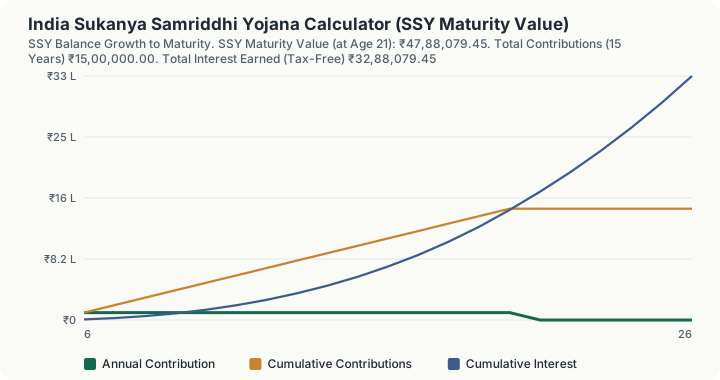
Quick Answer: Opening a Sukanya Samriddhi Yojana (SSY) account for a 5-year-old girl child and contributing ₹1,00,000 every financial year for 15 years, at the current 8.2% p.a. rate, projects to a maturity value of roughly ₹47,88,079 when the account matures 21 years after opening (the girl turning 26) -- with the entire amount, principal and interest, tax-free.
Overview
This calculator is built specifically for India's Sukanya Samriddhi Yojana (SSY), a government savings scheme reserved for a girl child's future, and every figure is shown in Indian Rupees (₹). It is not a generic child-savings calculator for another country. SSY offers the highest interest rate among small savings schemes tied for the top spot alongside SCSS, currently 8.2% per annum, compounded annually, and -- like PPF -- is a full EEE (Exempt-Exempt-Exempt) instrument: contributions qualify for a Section 80C deduction, the interest is tax-exempt, and the maturity proceeds are tax-free.
An account can be opened for a girl child at any time before she turns 10, by a parent or legal guardian. Contributions are required for the first 15 years from account opening (minimum ₹250, maximum ₹1,50,000 per financial year), after which no further deposits are needed -- but the balance keeps earning interest until the account matures, which happens 21 years after opening (not 21 years from the girl's birth), unless she marries after turning 18, in which case the account can be closed early.
How This Is Calculated
SSY follows the same annual compounding convention as PPF: interest is credited annually, but a deposit made early in the financial year (by the 5th of the relevant month) earns interest for that entire year, which this calculator models as a full year's interest on each year's contribution.
The projection runs in two phases. Phase one, years 1-15: each year, the balance grows by (Previous Balance + This Year's Contribution) × (1 + Annual Rate), with the contribution capped at ₹1,50,000/year. Phase two, years 16-21: no further contributions are required or modeled; the balance from year 15 simply keeps compounding at the same annual rate for the remaining years until the account reaches its 21-year maturity.
Because SSY's 15-year contribution window and 21-year maturity are fixed relative to the account's opening date -- not adjustable inputs -- this calculator derives the girl's age at maturity directly from her age when the account is opened (her current age, since this calculator assumes the account is opened today).
Worked Example
A parent opens an SSY account for a daughter who has just turned 5, and sets a standing instruction of ₹1,00,000 each April at the current 8.2% p.a. notified rate. SSY is a two-phase product, so the arithmetic is worth following past the first year.
Step 1 -- The credited deposit. ₹1,00,000 requested against the ₹1,50,000 statutory ceiling, so the full ₹1,00,000 is credited
Step 2 -- The annual growth factor. 1 + (8.2 / 100) = 1.082
Step 3 -- Year 1, the girl aged 6. (₹0 + ₹1,00,000) × 1.082 = ₹1,08,200.00
Step 4 -- Year 2, aged 7. (₹1,08,200.00 + ₹1,00,000) × 1.082 = ₹2,25,272.40
Step 5 -- Cumulative interest after two years. ₹2,25,272.40 - ₹2,00,000 = ₹25,272.40
Year 2 credits ₹17,072.40 of interest against year 1's ₹8,200, which is the whole case for opening the account as early as the rules allow rather than waiting.
Step 6 -- Year 3, aged 8. (₹2,25,272.40 + ₹1,00,000) × 1.082 = ₹3,51,944.74
Step 7 -- The last contribution year, year 15, aged 20. Balance: ₹29,83,992.88 Contributed so far: ₹15,00,000 Interest so far: ₹14,83,992.88
At the end of the contribution phase the interest has almost exactly caught up with the principal. That is the crossover point, and it happens before a single rupee of the second phase is earned.
Step 8 -- Phase two begins, no further deposits. Years 16 to 21 apply the same × 1.082 factor to a balance that no longer receives contributions. By year 18 (aged 23) the balance is ₹37,79,893.52
Step 9 -- Maturity at year 21, the girl aged 26. Balance: ₹47,88,079.45
Step 10 -- Split the maturity value. Total contributed: 15 × ₹1,00,000 = ₹15,00,000 Total interest: ₹47,88,079.45 - ₹15,00,000 = ₹32,88,079.45
The six contribution-free years added ₹18,04,086.57 to the balance without a rupee of new money going in, which is more than the total interest earned across the entire fifteen-year contribution phase. Anyone weighing SSY against a shorter-dated deposit is really deciding whether to keep that tail.
Step 11 -- The same structure at the statutory maximum. ₹1,50,000 a year for 15 years, same 8.2% rate, matures at ₹71,82,119.17
Note that the maturity age in step 9 is driven entirely by the opening age: the 15-year contribution window and 21-year term are fixed by the scheme, so opening at birth instead of at 5 matures the account when the girl is 21, not 26.
What This Does Not Account For
- Partial withdrawal at age 18. SSY rules allow withdrawing a portion of the balance (commonly cited as up to 50% of the immediately preceding financial year's balance) once the girl turns 18 or completes Class 10, for higher education or marriage expenses. This calculator flags an illustrative estimate for this but the exact 50% figure was not independently confirmed against a primary government source in this calculator's research pass -- verify the current rule before relying on it.
- The 2-accounts-per-family limit. Generally, only one SSY account can be opened per girl child, and a family may open accounts for a maximum of two girl children (with an exception for twins/triplets). This eligibility rule is well-established but was not present on the specific primary source page checked for this calculator; confirm current details with your bank or post office.
- Marriage-triggered early closure. If the girl marries after turning 18, the account can be closed before the full 21-year maturity; this calculator only models the full-term scenario.
- Rate changes mid-projection. The entered rate is held constant across the full 21-year projection; SSY's actual rate is reviewed quarterly and can change.
- Irregular/missed contributions. This calculator assumes the same contribution amount every year for the full 15-year window; real-world irregular deposits (subject to the ₹250/year minimum to avoid the account going inactive) would produce a different, path-dependent result.
Common Pitfalls
- Confusing the 15-year contribution window with the 21-year maturity. SSY does not mature when contributions stop -- the account keeps compounding for a further 6 years (in the standard case of a 15-year contribution period against a 21-year maturity) with no new deposits needed.
- Assuming maturity happens at a fixed girl's age. Maturity is 21 years after the account's opening date, not a fixed age like 21; a girl whose account opened at age 3 matures at 24, while one opened at age 9 matures at 30.
- Missing the minimum ₹250/year deposit. Failing to deposit at least ₹250 in a financial year makes the account "discontinued," typically requiring a penalty payment per defaulted year to reactivate.
- Depositing late in the financial year. As with PPF, SSY's interest calculation rewards depositing early in the month/year; a deposit made late in March instead of April can meaningfully reduce that year's effective interest.
- Opening more than the permitted number of accounts. Exceeding the permitted number of SSY accounts per family (subject to the twin/triplet exception) can create compliance issues; check current rules with India Post or your bank before opening a second or third account.
Frequently Asked Questions
What is the SSY maturity value for ₹1,00,000/year at the current interest rate?
Do I have to keep contributing to SSY for all 21 years?
Is Sukanya Samriddhi Yojana maturity amount taxable?
Can I withdraw money from SSY before it matures?
What is the current SSY interest rate?
Sources
- Income Tax Department, Government of India, the official authority for the national tax authority this calculator relates to. incometax.gov.in/iec/foportal
Also consulted: National Savings Institute, nsiindia.gov.in, Sukanya Samriddhi Account scheme page -- interest rate, contribution limits, maturity rules, eligibility, tax treatment; Dept. of Economic Affairs, Ministry of Finance, Office Memorandum F.No.1/4/2019-NS (dated 2026-06-30) -- Q2 FY 2026-27 (1 July - 30 September 2026) small savings interest rate notification, confirming 8.2% unchanged; Income Tax Act, 1961, Section 80C (contribution deduction) and Section 10 (interest exemption) -- SSY's EEE tax treatment.