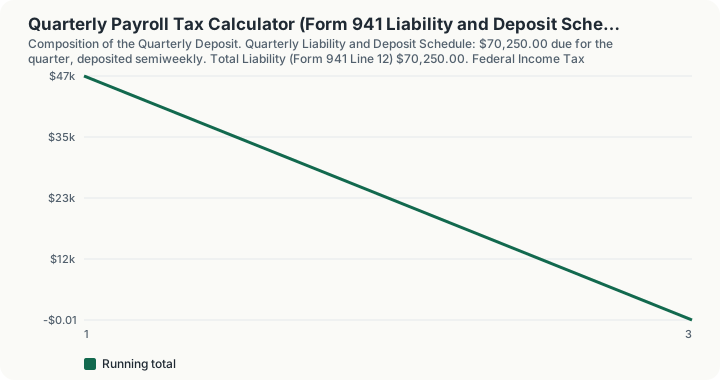
Quick Answer: $250,000 of quarterly wages with $32,000 of federal income tax withheld produces a Form 941 line 12 liability of $70,250.00 for the quarter, deposited semiweekly. Of that, $51,125.00 is money withheld from employees and held in trust and $19,125.00 is the employer's own tax. With $74,500 of lookback-period tax the employer is a semiweekly schedule depositor, so a Wednesday 16 September 2026 payday is due by 2026-09-23.
What does this calculator do?
Form 941 is the quarterly return on which an employer reports federal income tax withheld from wages together with both halves of FICA. The line that matters is line 12, the total liability for the quarter, and it is the figure the whole deposit schedule is built to satisfy.
The single most misread feature of the form is that lines 5a and 5c are stated at the combined employee plus employer rate. Social Security appears at 12.4%, not the 6.2% an employee sees on a pay stub, and Medicare appears at 2.9%, not 1.45%. That is why a quarter's deposits are roughly twice the FICA visible in payroll reports, and why employers who budget from pay stubs consistently under-reserve.
The second thing this page does is separate the liability into two economically different halves. Withheld income tax and the employee's share of FICA are trust fund taxes: the employer never owned that money, and failure to remit it exposes responsible individuals personally under IRC section 6672. The employer's matching FICA is a genuine business expense. The total is a single deposit, but only half of it is a cost.
How is this calculated?
Line 12 = W + (S × 12.4%) + (M × 2.9%) + (A × 0.9%)
where $W$ is federal income tax withheld, $S$ Social Security taxable wages, $M$ Medicare taxable wages and $A$ wages above $200,000 paid to an individual employee. Every rate comes from the 2026 FICA table; none is hard-coded in this calculator.
Step 1: Start with federal income tax withheld (line 3). $32,000.00
Step 2: Apply the combined Social Security rate to line 5a wages. $250,000 x 12.4% = $31,000.00 Medicare taxable wages default to the full quarterly wages, since Medicare has no wage base.
Step 3: Apply the combined Medicare rate to line 5c wages. $250,000 x 2.9% = $7,250.00
Step 4: Apply the Additional Medicare Tax to line 5d wages. $0 x 0.9% = $0.00 This 0.9% is withheld from the employee only. There is no employer match.
Step 5: Total the FICA lines. $31,000.00 + $7,250.00 + $0.00 = $38,250.00
Step 6: Add withheld income tax to get line 12. $32,000.00 + $38,250.00 = $70,250.00
Step 7: Split out the employee half of FICA. Half of line 5a plus half of line 5c plus all of line 5d: $15,500.00 + $3,625.00 + $0.00 = $19,125.00
Step 8: Total the money held in trust. Withheld income tax plus the employee half of FICA: $32,000.00 + $19,125.00 = $51,125.00
Step 9: Identify the employer's own tax. The other half of lines 5a and 5c: $15,500.00 + $3,625.00 = $19,125.00
Step 10: Size the average monthly deposit. $70,250.00 ÷ 3 = $23,416.67
Step 11: Determine depositor status from the lookback period. $74,500 exceeds $50,000, so: semiweekly schedule depositor Headroom below the threshold: $50,000 − $74,500 = −$24,500
Step 12: Apply the semiweekly window to the payday. 16 September 2026 is a Wednesday, and a Wednesday, Thursday or Friday payday is deposited by the following Wednesday: 2026-09-23, seven days after payday
Worked Example
A 40-person distribution business pays $250,000 of wages in the third quarter of 2026 and withholds $32,000 of federal income tax. No employee has reached the Social Security wage base and none is past $200,000 for the year. Its lookback period total was $74,500.
Step 1: Social Security, both halves. $250,000 x 12.4% = $31,000.00 The employees collectively see $15,500 withheld; the business owes the same amount again.
Step 2: Medicare, both halves. $250,000 x 2.9% = $7,250.00
Step 3: Additional Medicare. No employee is above $200,000, so: $0.00
Step 4: Total FICA. $31,000.00 + $7,250.00 = $38,250.00
Step 5: Line 12 total liability. $38,250.00 + $32,000.00 = $70,250.00
Step 6: Whose money it is. Held in trust: $32,000.00 + $19,125.00 = $51,125.00 Employer expense: $19,125.00 Roughly 73% of the deposit was never the company's money.
Step 7: Deposit cadence. $70,250.00 ÷ 3 = $23,416.67 per month on average, though the semiweekly schedule means the actual deposits track paydays rather than months.
Step 8: The due date for the 16 September payday. Wednesday payday, so the following Wednesday: 2026-09-23
Change one input and the picture shifts sharply. If an executive has already passed the Social Security wage base so that only $200,000 of the $250,000 is line 5a wages, and $40,000 of pay crosses the $200,000 individual threshold, line 5a falls to $24,800.00, line 5d adds $360.00, and the total liability falls to $64,410.00, while the employer's own share falls faster than the employee's, because the 0.9% has no match.
Carrying the Quarter Forward Month by Month
Step 9: Month one. Deposit $23,416.67: $10,666.67 of withheld income tax and $12,750.00 of FICA. Cumulative deposited $23,416.67, still owed for the quarter $46,833.33.
Step 10: Month two. Same deposit again. Cumulative $46,833.34, still owed $23,416.66.
Step 11: Month three. Cumulative $70,250.01, one cent above the $70,250.00 quarterly liability because the average monthly deposit is a rounded third of it. Balance owed $0.00.
Step 12: What resets and what does not. The Form 941 liability resets to zero on the first day of the next quarter. The Social Security wage base and the $200,000 Additional Medicare threshold do not: they are per-employee, per-calendar-year running totals that carry straight through the quarter boundary.
That distinction is the one worth holding on to. Line 12 is a quarterly number and every figure feeding line 5a is an annual one, so an employer whose highly paid staff cross the wage base in Q3 sees the quarterly liability fall without anything changing about the payroll itself. The lookback test that put this business on the semiweekly schedule is annual too, which is why the deposit cadence does not move mid-quarter even when the amounts do.
What does this calculator not account for?
- Federal legal holidays are not modelled in the due date. A due date falling on a Saturday or Sunday is rolled to the following Monday, but the IRS also rolls off legal holidays and no holiday calendar is encoded here. In a holiday week the date shown can be one to two days earlier than the real deadline. Check it against the IRS calendar.
- The Social Security wage base is not applied automatically. It is a per-employee cap and cannot be derived from an employer's aggregate payroll, so line 5a wages are an input. If you enter total wages when an employee has crossed the base, the result overstates Social Security tax.
- The Additional Medicare threshold is likewise per employee and is an input. The calculator will not detect it from total payroll.
- Only one payday's due date is computed, not the quarter's full deposit calendar. A semiweekly depositor makes many deposits per quarter; the average monthly deposit shown is an arithmetic third of the liability, not a deposit schedule.
- No credits, adjustments or lines beyond the FICA computation are modelled: no sick and family leave credits, no tips adjustment, no fractions-of-cents adjustment, no prior-quarter corrections on Form 941-X.
- No penalty or interest is computed on this page. The failure-to-deposit penalty bands and section 6601 interest are handled by the separate payroll tax deposit calculator.
- State and local withholding, FUTA and SUTA are all out of scope. Form 941 is federal income tax withholding and FICA only.
What mistakes do people make with this?
- Budgeting from the pay stub. Lines 5a and 5c are both halves combined. Reserving 6.2% and 1.45% of payroll leaves you exactly half short.
- Spending trust fund money. The $51,125.00 held in trust in the example was never the business's cash. Section 6672 lets the IRS pursue responsible individuals personally for it, and no corporate form protects against that.
- Assuming depositor status follows current payroll. It follows the lookback period and is fixed for the whole calendar year. Crossing $50,000 by a single dollar flips the entire following year to semiweekly.
- Missing the $100,000 one-day rule. Accumulating $100,000 of liability on any day in a deposit period makes that deposit due the next business day, whatever your schedule says.
- Entering total wages on line 5a for a payroll with high earners. Once an employee passes the Social Security wage base, their further wages leave line 5a but stay on line 5c.
- Treating filing and depositing as one obligation. They are separate. Paying the full quarter with the return does not cure missed deposits.
- Expecting an employer match on the 0.9%. There is none. Additional Medicare Tax is withheld from the employee alone.
Frequently Asked Questions
Why is the Social Security line on Form 941 12.4% instead of 6.2%?
How much of my quarterly deposit is actually my money?
What decides whether I deposit monthly or semiweekly?
When does the Additional Medicare Tax apply?
Do I still file Form 941 in a quarter with no payroll?
Why does my deposit due date look a day early during a holiday week?
Sources
- Internal Revenue Service, Tax Topic 757, "Forms 941 and 944: Deposit Requirements," for the lookback period definition, the $50,000 monthly-versus-semiweekly threshold, the two semiweekly deposit windows and the $100,000 next-business-day rule. irs.gov/taxtopics/tc757
- Internal Revenue Service, "Failure to Deposit Penalty," for the deposit penalty bands referenced in the related deposit calculator. irs.gov/payments/failure-to-deposit-penalty
- 26 U.S.C. 3101 and 3111: the employee and employer FICA taxes. law.cornell.edu/uscode/text/26/3101
- 26 U.S.C. 6672: the trust fund recovery penalty on responsible persons. law.cornell.edu/uscode/text/26/6672
Also consulted: 2026 FICA rates and thresholds (Social Security rate and wage base, Medicare rate, Additional Medicare rate and the $200,000 individual threshold) from the versioned 2026 FICA table in this repository, which feeds every figure above.