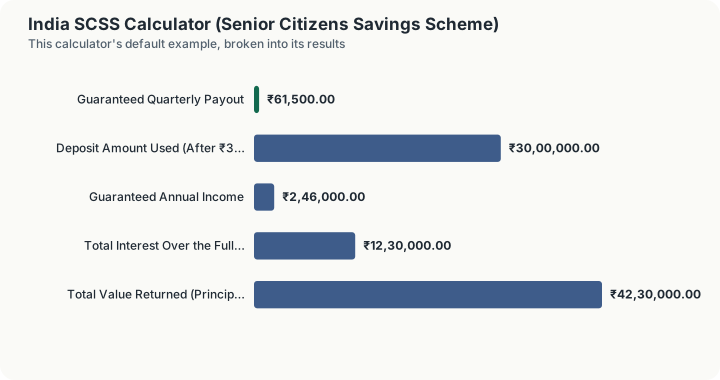
Quick Answer: Depositing the maximum ₹30,00,000 into a Senior Citizens Savings Scheme (SCSS) account at the current 8.2% p.a. rate pays a guaranteed ₹61,500 every quarter (₹2,46,000/year) for the standard 5-year tenure, totaling ₹12,30,000 in interest over the full term -- paid out each quarter, not compounded.
Overview
This calculator is built specifically for India's Senior Citizens Savings Scheme (SCSS), a government-backed fixed-income scheme for retirees, and every figure is shown in Indian Rupees (₹). It is not a generic annuity or CD calculator for another country. SCSS is one of two small savings schemes (alongside Sukanya Samriddhi Yojana) currently offering the highest notified rate among government savings instruments -- 8.2% per annum for the current quarter -- but with a critical mechanical difference from PPF or SSY: SCSS interest is not compounded. It is paid out to you every quarter, on the first working day of April, July, October, and January, as a stream of income rather than reinvested growth.
The scheme is designed for retirees: eligibility generally opens at age 60, though individuals aged 55-60 who have retired under superannuation, Voluntary Retirement Scheme (VRS), or Special VRS can open an account (subject to conditions and timing rules), and retired defense personnel can open one as early as age 50. The maximum investment per individual is ₹30,00,000 (raised from ₹15,00,000 in the 2023 Union Budget, effective April 2023) -- meaning a retired couple, each opening their own account, can jointly deposit up to ₹60,00,000 across two accounts.
How This Is Calculated
Because SCSS interest is not compounded, the math is simpler than PPF, SSY, or EPF, but the "not compounded" part is exactly what most calculators get wrong by defaulting to compound-interest logic.
Quarterly Payout = Principal × Annual Rate ÷ 4
That fixed quarterly amount is paid out to you every quarter for the full tenure -- 5 years (20 quarters) by default, or 8 years (32 quarters) if you elect the one permitted 3-year extension after the initial 5-year term matures. Your principal is returned in full at the end of the tenure (or upon premature closure, subject to conditions); it is the quarterly interest, not the principal, that changes hands each quarter. This calculator sums the quarterly payouts across the chosen tenure to show your total guaranteed interest income, separate from the principal itself.
Worked Example
A newly retired depositor puts the full ₹30,00,000 statutory maximum into SCSS at the current 8.2% p.a. rate. SCSS pays interest out rather than rolling it up, so the useful sequence here is not compounding but the cash actually arriving each quarter.
Step 1 -- The deposit after the statutory cap. ₹30,00,000 requested against the ₹30,00,000 ceiling, so the deposit used is ₹30,00,000
Step 2 -- Annual interest at the notified rate. ₹30,00,000 × 8.2% = ₹2,46,000
Step 3 -- The quarterly payout. ₹2,46,000 / 4 = ₹61,500
Step 4 -- Quarter 1. Cash received: ₹61,500 Balance still on deposit: ₹30,00,000
Step 5 -- Quarter 2. Cash received: ₹61,500 Cumulative interest received: ₹61,500 + ₹61,500 = ₹1,23,000
This is where SCSS differs from every compounding scheme on this site: quarter 2 pays exactly what quarter 1 paid. Nothing accelerates, because the interest leaves the account instead of joining the principal.
Step 6 -- One full year, four quarters. 4 × ₹61,500 = ₹2,46,000 a year
Step 7 -- The standard 5-year tenure. 5 years × 4 = 20 quarters 20 × ₹61,500 = ₹12,30,000 of total interest
Step 8 -- Total value returned over the 5 years. ₹30,00,000 principal + ₹12,30,000 interest = ₹42,30,000
Step 9 -- Electing the one permitted 3-year extension. 8 years × 4 = 32 quarters 32 × ₹61,500 = ₹19,68,000 of total interest, for a total returned value of ₹49,68,000
The extension is worth ₹7,38,000 of additional income on the same principal, but only if the rate holds: an extended account is re-set to the SCSS rate prevailing when the extension is taken, which this calculator holds constant.
Step 10 -- The same account at a third of the size. ₹10,00,000 × 8.2% / 4 = ₹20,500 a quarter 20 × ₹20,500 = ₹4,10,000 of interest over 5 years, and ₹14,10,000 returned in total
Because nothing compounds, SCSS scales exactly linearly with the deposit: the ₹10,00,000 account returns precisely one third of the ₹30,00,000 account at every point in the schedule. That property makes it easy to size a deposit against a target quarterly income, which is the reason most people come to this scheme in the first place.
What This Does Not Account For
- Premature closure penalties. SCSS permits closing the account before maturity subject to specific penalty deductions from the principal (typically a percentage reduction depending on how early the closure happens); this calculator only models the full-tenure scenario.
- Rate resets at extension. If you extend for the additional 3 years, the rate applicable during the extension is generally the rate in force at the time of extension, not necessarily the original rate you locked in -- this calculator assumes the same rate continues, which may not hold.
- TDS on interest. Interest from SCSS is fully taxable as "Income from Other Sources," and TDS applies under Section 194A once your interest income crosses the applicable threshold (reported as ₹1,00,000/year for senior citizens as of a 2025 Budget change, though this specific figure was not independently confirmed against a primary CBDT circular in this calculator's research pass -- verify with your bank or a tax advisor before relying on it).
- Reinvestment of the quarterly payout. This calculator treats the quarterly payout as income received, not reinvested; if you choose to reinvest each payout elsewhere, your effective overall return would differ from the figures shown here.
- Joint accounts and multiple accounts. A couple can each hold their own ₹30,00,000 SCSS account, effectively doubling household capacity; this calculator models a single account only.
Common Pitfalls
- Assuming SCSS compounds like a fixed deposit. The single biggest SCSS math error: modeling it as compound interest reinvested each quarter, when the scheme actually pays out interest each quarter as cash, with no automatic reinvestment.
- Depositing beyond the ₹30,00,000 cap. Amounts above the cap are not accepted into an SCSS account; any excess deposited must be refunded, without interest, by the depositing bank or post office.
- Forgetting the extension resets the applicable rate. Assuming your original locked-in rate continues automatically into the 3-year extension can lead to a rude surprise if rates have moved.
- Overlooking the TDS impact on cash flow planning. For retirees depending on the quarterly payout as income, an unexpected TDS deduction (if interest crosses the applicable annual threshold) can reduce the actual amount received relative to the gross calculated payout.
- Missing the age-55 window for VRS/superannuation retirees. The 55-60 age eligibility for retirees under superannuation or VRS comes with specific conditions and a limited window (commonly within one month of receiving retirement benefits) to open the account -- missing that window can mean waiting until age 60.
Frequently Asked Questions
How much quarterly income can I get from SCSS?
Is SCSS interest compounded?
Can I extend my SCSS account after 5 years?
Is SCSS interest taxable?
What is the maximum I can invest in SCSS?
Sources
- Income Tax Department, Government of India, the official authority for the national tax authority this calculator relates to. incometax.gov.in/iec/foportal
Also consulted: National Savings Institute, nsiindia.gov.in, SCSS scheme page -- interest rate (not compounded, paid quarterly), investment cap, tenure, extension rule, eligibility, tax treatment; Dept. of Economic Affairs, Ministry of Finance, Office Memorandum F.No.1/4/2019-NS (dated 2026-06-30) -- Q2 FY 2026-27 (1 July - 30 September 2026) small savings interest rate notification, confirming 8.2% unchanged; Union Budget 2023 (effective 2023-04-01) -- SCSS investment limit raised from ₹15,00,000 to ₹30,00,000; Income Tax Act, 1961, Section 194A (TDS on interest) and Section 80C (investment deduction).